On the sensations of tone as a physiological basis for the theory of music / by Hermann L.F. Helmholtz ; translated, thoroughly revised and corrected, rendered conformable to the 4th (and last) German edition of 1877, with numerous additional notes and a new additional appendix bringing down information to 1885, and especially adapted to the use of musical students, by Alexander J. Ellis.
- Hermann von Helmholtz
- Date:
- 1895
Licence: Public Domain Mark
Credit: On the sensations of tone as a physiological basis for the theory of music / by Hermann L.F. Helmholtz ; translated, thoroughly revised and corrected, rendered conformable to the 4th (and last) German edition of 1877, with numerous additional notes and a new additional appendix bringing down information to 1885, and especially adapted to the use of musical students, by Alexander J. Ellis. Source: Wellcome Collection.
37/604 (page 13)
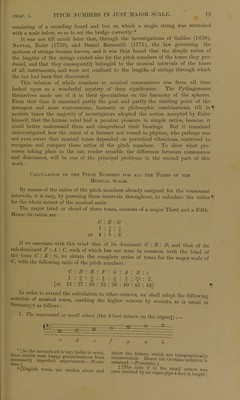
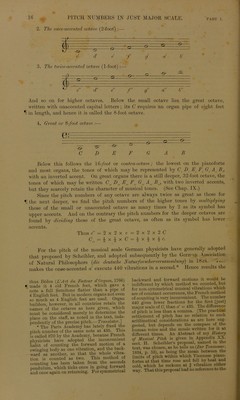
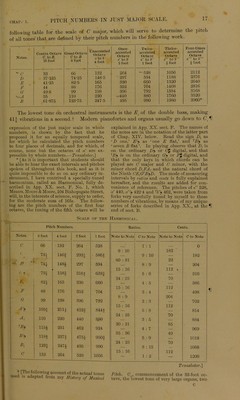
![introduced, connected with a toothed wheel which works in the screw t, and advances one tooth for each revolution of the disc s s. By the handle li this counter may be moved slightly to one side, so that the wheelwork and screw may be connected or disconnected at pleasure. If they are connected at the beginning of one second, and disconnected at the beginning of another, the hand of the connter shows how many revolutions of the disc have beeil made in the corre- sponding number of seconds.* Dove f introduced into this siren several rows of holes through which the wind might be directed, or from which it might be cut off, at pleasure. A polyphonic siren of this description with other peculiar arrangements will be figured and described in Chapter VIII., fig. 56. It is clear that when the pierced disc of one of these sirens is made to revolve with a uniform velocity, and the air escapes through the holes in puffs, the mofcion of the air thus produced must be periodic in the sense already explained. The H holes stand at equal intervals of space, and hence on rotation follow each other at equal intervals of time. Through every hole there is poured, as it were, a drop of air into the external atmospheric ocean, exciting waves in it, which succeed each other at uniform intervals of time, just as was the case when regularly fall in g drops impinged upon a surface of water (p. 10a). Within each separate period, each individual puff will have considerable variations of form in sirens of different construction, depending on the different diameters of the holes, their distance from each other, and the shape of the extremity of the pipe which conveys the air; but in every case, as long as the velocity of rotation and the position of the pipe remain unaltered, a regularly periodic motion of the air must result, and consequently the Sensation of a musical tone must be excited in the ear, and this is actually the case. It results immediately from experiments with the siren that two series of the same number of holes revolving with the same velocity, give musical tones of the H same pitch, quite independently of the size and form of the holes, or of the pipe. We even obtain a musical tone of the same pitch if we allow a metal poinr to strike in the holes as they revolve instead of blowiug. Hence it follows firstly that the pitch of a tone depends only on the number of puffs or Swings, and not on theii foi m, foice, oi method of production. Further it is very easily seen with this Instrument that on increasing the velocity of rotation and consequently the number of pufts produced in a second, the pitch becomes sharper or higher. The same result ensues if, maintaining a uniform velocity of rotation, we first blow into a series with a smaller and then into a series with a greater number of holes. The latter gives the sharper or higher pitch. With the same Instrument we also very easily find the remarkable relation which the pitch numbers of two musical tones must possess in order to form a consonant interval. Take a series of 8 and another of 16 holes in a disc, and blow into both sets while the disc is kept at uniform velocity of rotation Two 11 tones will be heard which stand to one another in the exact relation of an Octave. Increase the velocity of rotation; both tones will become sharper, but both will continue at the new pitch to form the interval of an Octave.+ Hence we conclude that a musical tone which is an Octave higher than another, makes exactlv twice as many vibrations in a given time as the latter. * See Appendix I. + [Pronounce Döli-veh, in two syllables.— Translator.'] 1 [When two notes have different pitch numbers, there is said to be an interval between them. This gives rise to a Sensa- tion, very differently appreciated by different mdividuals, but in all cases the interval is nrntsured by the ratio of the pitch numbers, and, ior sorae purposes, more conveniently by other numbers called Cents, derived from these ratlos, as explained in App. XX. sect. C. The names of all the intervals usually distiuguished are also given in App. XX. sect. D„ with tho corresponding ratlos and Cents. These names were m the first place derived from the ordinal number of the note in the scales, or succes- sions of continually sharper notes. The Octave is the eighth note in the major scale. An octave is a set of notes lying within an Octave. Ob- serve that in this translation all names of in- tervals commence with a Capital letter, to prevent ambiguity, as almost all such words are also usod in other senses.—Translator.]](https://iiif.wellcomecollection.org/image/b28141532_0037.jp2/full/800%2C/0/default.jpg)