On the sensations of tone as a physiological basis for the theory of music / by Hermann L.F. Helmholtz ; translated, thoroughly revised and corrected, rendered conformable to the 4th (and last) German edition of 1877, with numerous additional notes and a new additional appendix bringing down information to 1885, and especially adapted to the use of musical students, by Alexander J. Ellis.
- Hermann von Helmholtz
- Date:
- 1895
Licence: Public Domain Mark
Credit: On the sensations of tone as a physiological basis for the theory of music / by Hermann L.F. Helmholtz ; translated, thoroughly revised and corrected, rendered conformable to the 4th (and last) German edition of 1877, with numerous additional notes and a new additional appendix bringing down information to 1885, and especially adapted to the use of musical students, by Alexander J. Ellis. Source: Wellcome Collection.
38/604 (page 14)
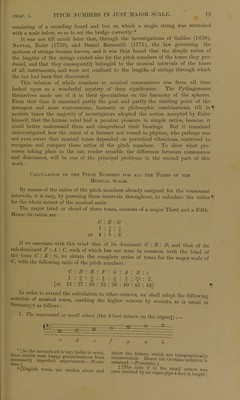
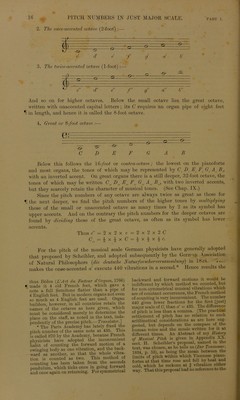
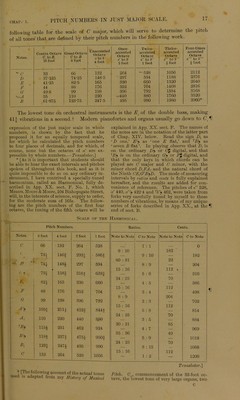
![The disc shown in fig-. 1, p. 1 lr, has two circles of 8 and 12 hole» respectively. Each, blown suocessively, gives two tones which form with each otlier a perfect Fifth, independently of the velocity of rotation of the disc. Hence, two'Musical tones stand in the relation of a so-called Fifth ivhen the higher tone makes th/ree vibrations in the same time as the lower makes two. If we obtain a musical tone by blowing into a circle of 8 holes, we require a circle of 16 boles for its Octave, and 12 for its Fifth. Hence the ratio of the pitch numbers of the Fifth and the Octave is 12 : 16 or 3 : 4. But the interval between the Fifth and the Octave is the Fourtli, so that we see that ruhen two musical tones form a Fourth, the higher malces four vibrations while the lower makes three. The polyphonic siren of Dove has nsually four circles of 8, 10, 12 and 16 holes respectively. The series of 16 holes gives the Octave of the series of 8 holes, and 51 the Fourth of the series of 12 holes. The series of 12 holes gives the Fifth of the series of 8 holes, aud the minor Third of the series of 10 holes. While the series of 10 holes gives the major Third of the series of 8 holes. The four series con- sequently give the constitueut musical tones of a major chord. By these and similar experiments we find the following relations of the pitch numbers:— 1 : 2 Octave 2 : 3 Fifth 3 : 4 Fourth 4 : 5 major Third 5 : 6 minor Third When the fundamental tone of a given interval is taken an Octave higher, the interval is said to be inverted. Thus a Fourth is an inverted Fifth, a minoi Sixth an inverted major Third, and a major Sixth an inverted minor Third. The corre- sponding ratios of the pitch numbers are consequently obtained by doubling the smaller number in the original interval. From 2 : 3 the Fifth, we thus have 3 ,, 4:5 the major Third ... 5 ,, 5:6 the minor Third, 6 : 10 = 3 4 the Fourth 8 the minor Sixth 5 the major Sixth. These are all the consonant intervals which lie within the compass of an Octave. With the exception of the minor Sixth, which is really the most imperfect of the above consonances, the ratios of their vibrational numbers are all expressed by means of the whole numbers, 1, 2, 3, 4, 5, 6. . Comparatively simple and easy experiments with the siren, therefore, corrobo- rate that remarkable law mentioned in the Introduction (p. Id), accordmg to which the pitch numbers of consonant musical tones bear to each otlier ratios expressi c 51 by small whole numbers. In the course of our Investigation we shall employ the same instrument to verify more completely the strictness and exactness of this l£l Long before anything was known of pitch numbers, or the means of counting them, Pythagoras had diseovcred that if a string be divided into two parte by a bridge. in such a way as to give two consonant musical tones whc11 lengths of these parts must be in the ratio of these whole numbers. 1 the budge is so placed that § of the string lie to the right, and ■] on the left, so that the two lengths are in the ratio of 2 : 1, they produce the interval of an Octave, the grea ei length giving the deeper tone. Placing the bridge so that * of the string lie on the right and f on the left, the ratio of the two lengths is 3 : 2, and the interval IS aThese' measurements had been cxecuted with great precision by the Greek musicians, and had given rise to a System of tones, contnved with considerable art! For these measurements they used a peculiar instrument, t ic monoc on ,](https://iiif.wellcomecollection.org/image/b28141532_0038.jp2/full/800%2C/0/default.jpg)