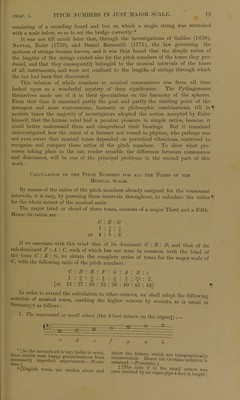
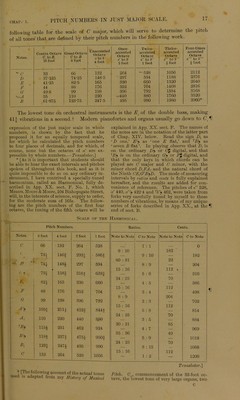
On the sensations of tone as a physiological basis for the theory of music / by Hermann L.F. Helmholtz ; translated, thoroughly revised and corrected, rendered conformable to the 4th (and last) German edition of 1877, with numerous additional notes and a new additional appendix bringing down information to 1885, and especially adapted to the use of musical students, by Alexander J. Ellis.
- Hermann von Helmholtz
- Date:
- 1895
Licence: Public Domain Mark
Credit: On the sensations of tone as a physiological basis for the theory of music / by Hermann L.F. Helmholtz ; translated, thoroughly revised and corrected, rendered conformable to the 4th (and last) German edition of 1877, with numerous additional notes and a new additional appendix bringing down information to 1885, and especially adapted to the use of musical students, by Alexander J. Ellis. Source: Wellcome Collection.
40/604 (page 16)
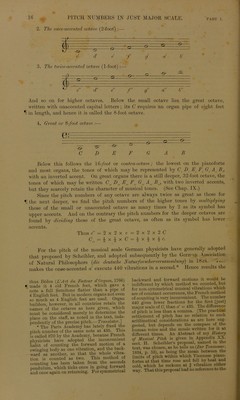
![PAKT I. 2. The once-accented octave (2-foot):— 3. The twice-accented octave (1-foot) :— And so on for higher octaves. Below the small octave lies the great octave, written with unaccented Capital letters ; its C requires an organ pipe of eight feet H in length, and hence it is called the 8-foot octave. 4. Great or 8-foot octave :— Et C D E F G AB Below this follows the 16-foot or contra-octave; the lowest on the pianoforte and most organs, the tones of which may be represented by C, If FI G, A/ Bt, with an inverted accent. On great organs there is a still deeper, 32-foot octave, the tones of which may be written C„ Du Eu Fu Gu Au Bu, with two inverted accents, but tliey scarcely retain the character of musical tones. (See Cliap. IX.) Since the pitch numbers of any octave are always twice as great as those for 1i the next deeper, we find the pitch numbers of the higher tones by multiplying those of the small or unaccented octave as rnany times by 2 as its symbol bas upper accents. And on the contrary the pitch numbers for the deeper octaves are found by dividing those of the great octave, as often as its symbol has lowei accents. Thus c = 2 x 2 x c = 2 x 2 x 2 C C„ = i x ^ x C = |x^x|c. For the pitch of the musical scale German physicists have generally adopted that proposed by Scheibler, and adopted subsequently by the German Association of Natural Philosophers (die deutsche Naturforscherversammlung) in 183*. h..., makes the onoe-accented a execute 440 vibrations in a second* Hence results the thus BMos (L'Art du Fadcur d'Orgucs, 1766) made it 4 old French feet, which gave a uote a full Semitono flatter than a pipe of 4 English feet. But in modern organs not even so much as 4 English feet are used. Organ builders, however, in all countries retain the names of the octaves as liere given, which must be considered merely to dctermine the place on the staff, as noted in the text, inde- pendently of the precise pitch.—Translator.] * The Paris Academy has lately fixed the pitch number of the same note at 435. This is called 870 by the Academy, because French physicists have adopted the inconvenient habit of counting the forward motion of a swinging body as ono Vibration, and the back- ward as another, so that the whole Vibra- tion is counted as two. This method of counting has been taken from the seconds pendulum, which ticks once in going forward and once again on returning. For symmetrical backward and forward motions it would be indifferent by which method we counted, but for non-symmetrical musical vibrations which are of constant occurrence, the French method of counting is very inconvenient. The number 440 gives fewer fractions for the first [just] major scale of C, than a’ = 135. The diffcrence of pitch is less than a conuna. [The practical settlement of pitch has no relation to such aritbmetical considerations as are here sug- gested, but depends on the compass of the human voice and the music written for it at different times. An Abstract of my Historp of Musical Pitch is given in Appendix XX. sect. IT. Scheibler’s proposal, named in the text, was chosen, as he teils us (Der Tonmesser, 1834, p. 53), as being the mean betwecn the limits of pitch within which Viennese piauo- fortes at that time rose and feil by heat and cold, which he reckons at | Vibration cither way. That this proposal had no referencc to the](https://iiif.wellcomecollection.org/image/b28141532_0040.jp2/full/800%2C/0/default.jpg)