On the sensations of tone as a physiological basis for the theory of music / by Hermann L.F. Helmholtz ; translated, thoroughly revised and corrected, rendered conformable to the 4th (and last) German edition of 1877, with numerous additional notes and a new additional appendix bringing down information to 1885, and especially adapted to the use of musical students, by Alexander J. Ellis.
- Hermann von Helmholtz
- Date:
- 1895
Licence: Public Domain Mark
Credit: On the sensations of tone as a physiological basis for the theory of music / by Hermann L.F. Helmholtz ; translated, thoroughly revised and corrected, rendered conformable to the 4th (and last) German edition of 1877, with numerous additional notes and a new additional appendix bringing down information to 1885, and especially adapted to the use of musical students, by Alexander J. Ellis. Source: Wellcome Collection.
46/604 (page 22)
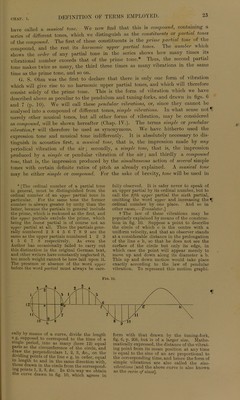
![COMPOUND AND PARTIAL TONES. PART I. string, \ve meet with a stränge and unexpected phenomenon, long known indeed to individual musicians and physicists, but commonly regarded as a mere curiosity, lts gencrality and its great significance for all matters relating to musical tones not having been recognised. Ihc ear when its attention has beeil properly directed to the effect of the vibrations which strike it, does not hcar merely that one musical tone wliose pituh is determined by the period of the vibrations in the manner already explained, but in addition to this it becomes aware of a whole series of higher musical tones, which we will call the Harmonie vpper partial tones, and sometimes simply the upper partials of the whole musical tone or note, in contra- distinction to the fundamental or prime partial tone or simply the prime, as it may be callcd, which is the lowest and generally the loudest of all the partial tones and by the pitcli of which we judge of the pitch of the whole compound musical tone itself. The series of these upper partial tones is precisely the same for all com- U pound musical tones which correspond to a uniformly periodical motion of the air. It is as follows :— The first upper partial tone [or second partial tone] is the upper Octave of the prime tone, and makes double the number of vibrations in the same time. If we call the prime C, this upper Octave will be c. The second upper partial tone [or third partial tone] is the Fifth of this Octave, or g, ruaking tliree times as many vibrations in the same time as the prime. The third upper partial tone [or fourth partial tone] is the second higher Octave or c, ruaking four times as many vibrations as the prime in the same time. The fourth upper partial tone [or fifth partial tone | is the major Third of this second higher Octave, or e, with five times as many vibrations as the prime in the same time. The fifth upper partial tone [or sixth partial tone] is the Fifth of the second higher Octave, or g, making six times as many vibrations as the prime in the 51 same time. And thus they go on, becoming continually fainter, to tones making 7, 8, 9, &c., times as many vibrations in the same time, as the prime tone. Or in musical notation C c g c e g ~'Vft c d e uf Ordinal number of i 2 3 4 5 6 7 8 9 10 11 Pitch number 66 132 198 264 330 396 462 528 594 660 726 g lJa ‘0 ft o c . 12 13 14 15 16 792 858 924 990 1054* where the figures [in the first line] beneath show how many times the corresponding pitch number is greater than that of the prime tone [and, taking the lowest note to have 66 vibrations, those in the second line give the pitch numbers of all the 51 other notes]. The whole Sensation excited in the ear by a periodic Vibration of the air we * [This diagram has been slightly altered to introduce all the first 16 harmonic partials of C 66 (which, excepting 11 and 13, are given on the Hatmonical as harmonic notes), and to show the notation, symbolising, both in letters and on the staff, the 7th, llth, and 13th harmonic partials, which are not used in general music. It is easy to show on the Harmonical that its lowest note, C of this series, contains all theso partials, after the theory of tho beats of a disturbed unison has been explained in Chap. VIII. Keep down the note G, and touch in succession the notes c, g, c', c', cf, &c., but in touching the latter press the finger-key such a little way down that tho tone of tho note is only just audible. This slightly flattens each note, and slow beats can be produced in every case (except, of course, 11 and 13, which are not on the instrument) up to 16. It should also be ob- served that the pitch of the beat is very nearly that of the upper (not the lower) note in each case. The whole of these 16 harmonics of C66 (except the llth and ISth) can be played at once on the Harmonical by means of the harmonical bar, first without and then with the 7th and 14th. The whole series will be found to sound like a single fine note, and the 7th and llth to materinlly increase its rich- ness. Tho relations of the partials in this case may be studied from the tables in the footnotes to Chap. X.—Translator.]](https://iiif.wellcomecollection.org/image/b28141532_0046.jp2/full/800%2C/0/default.jpg)