On the sensations of tone as a physiological basis for the theory of music / by Hermann L.F. Helmholtz ; translated, thoroughly revised and corrected, rendered conformable to the 4th (and last) German edition of 1877, with numerous additional notes and a new additional appendix bringing down information to 1885, and especially adapted to the use of musical students, by Alexander J. Ellis.
- Hermann von Helmholtz
- Date:
- 1895
Licence: Public Domain Mark
Credit: On the sensations of tone as a physiological basis for the theory of music / by Hermann L.F. Helmholtz ; translated, thoroughly revised and corrected, rendered conformable to the 4th (and last) German edition of 1877, with numerous additional notes and a new additional appendix bringing down information to 1885, and especially adapted to the use of musical students, by Alexander J. Ellis. Source: Wellcome Collection.
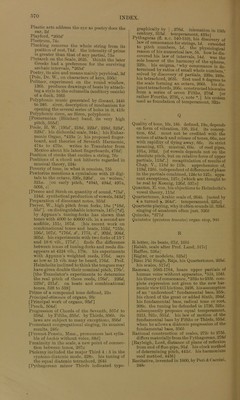
590/604 (page 566)
![INDEX. Justly mtoned Harmoniums,with twomanuals arrauged by the Author, 316c to 319c. instru- lnents necessary for teacliing singing, 327«. instruments, plan for them, with a single manual, 421« to 4226 K Keppler could not free liimself from musical __ iniagination, 229c? Kettledrums, their secondary tones not inves- tigated, 736 Key of polyphonic composition different for different voices, 245d. [acoustical effects of change of key, 551c?.] Keynote, sec Tonic Keys, have they special characters ? 310c. [their presumed characters, 550c] [Khorassan, Tambour of, its scale, after Prof. Land, 5176] Kiesewetter, R. G., 236c?, *2816, c, 282c?' Kirchengesang, or congregational singing, Kircher, Athanasius, finds both macrocosm and microcosm musical, 229c [Kirkman’s harpsichord, 1773, its striking- place, 77c?J Kirnberger tun es Bach’s major Thirds sharp, 321c [Kirsten, 5096] Kissar, five-string lyre of North Africa, penta- tonic according to Yilloteau, 257c [Klang, 24c] Koenig, R. [when tuning-forks have no partials, 55c?', 106r?'. on vowel resonance, *109c', *109c?', 122c?'. on influence of dif- ference of phase on quality of tone, 126c?.] with short sounding-rods has shewn that tones with 4000 to 40000 vibrations in a second can be heard, 151c, 152c?, 159c?, c?\ 167c?. recent work on combinational tones and beats, 152c?. experiments on forks with sliding weights, his results, 1596, [159c?], 176c. makes resonators, 372d. his manometric flames, 374«, 6. [his clock method of deter- mining pitch, 442c. his tuning-fork tonome- ters, price of various kinds, 446«, 6, 494c?'. on beats and combinational tones, 527 to 538] Kosegarten, J. G. L., 282c?' [Krebs, 510«] [Kummer, 5096] [Kiitzing, C., 1884, gives £ length as suitable striking-place, but had met with f, *77c'] L [Land, Prof. J. P. N., Gamme Arabe, *280c', *281c. hisaccount of the Arabic scales, 284 note. Al Farabi’s Greek Scales, 515c. Arabic and Persian,515c?. Ditto Medieval and Ancient Lute, 5166. Tambours of Khorassan and Bagdad, 5176, c, 523c'] Larynx, aetion of, 98« Later Greek Scales, 270«, 6, c Leading note, conception of, 2856, between Seventh and Octave, not between Third and Fourth, 286«, but between Second and Third in the minor mode, 2866. not marked, but sung, even in Protestant churches, to 16th and 17th centuries, 287c?. found in Cantus firmus, 287r. not sung by Esthonians cven when played by the organ, 288«. exists only in two tonal modcs, Greek Lydian and Hypolydian, 288«. causes alteration of Greek Phrygian mode to the ascending minor scale, and Greek Eolic to instrumental minor scale, -886. its general introduction leads to development of feeling for the tonic, 2886 c eöect of excessively sharpening, 315« ’ ' Leaps, when they aro not advisable, 3556 [Lehnert, 509c] [Leibner, 508c] Loibnitz, 1646-1716, percipirt and appcrcipirt .L,7rtJ!\etlCa y and analytically perceived, [Lemmens, preferred false intervals as a child F^tis’s story, 280c?'] [Lemoine, 5086] [Lewis, 506c, 507«] Lichaon of Samos, 266c Light and Sound, analogies of their compass, 186. [light extends over an Octave and ä Fourth, 18c', c?'] [Linear temperaments, 433a] Lips, as membranous reeds, 97c [Lissajous, 496c?', and Ferrand, 508c] [Liston, Rev. Henry, his organ, 4736] Liturgy, Roman, its singing, 239« Locrian (Hypodoric) Scale, 267d Low tones, sec Deep tones [Lupot (France, 1750-1820), resonance of his violins, 87c] [Lushington, V., and daughter, assist in Und- ing resonance of violins, 87c?] [Lute stop of harpsichord in 18th Century, 77c?] Luther, his feelings on music, 246c Lydian Scale, Glarean’s, 245c? Lydian Scales, Greek, 267c M [Macfarren, Sir G., sees right (just intonation) through wrong (tempered intonation), 346c?'. writes siglit test for Tonic Sol-fa Festival, 427c'. on character of keys, 550c, Standard pitch, 555c] Mach and J. Hervert’s experiment witli gas flames before the end of open hue-pipes, 936, *93c?' [Macleod, Prof. H., andLieut. Clark, their opti- cal method of finding pitch, *4426, 494c?'] Madrigals, 244c? [Mahillon, V., on Boehm’s flutes, *103d', 500d, 504c?] Major chords used as a close to minor modes, 296c?, 297« Major or Ionic mode, its harmony well de- veloped in 16th Century, 246c?. gives full ex- pression to tonality, 293c. its harmonic superiority, together with the minor mode, 298c. considered, 302 Major Scale, ascending, 2746 Major Seventh, 337«. its chord in the direct System, 349c Major Sixth, a medial consonance, 194c Major Tenth botter than major Third, 1956 Major Tetrads, their most perfect positions, 223c Major Third a medial consonance, 194c. not easily distinguished by differential tones, 200c, [<?']. just, with the ratio 4 : 5 included by Didymus and Ptolenneus in the syntono- diatonic mode, but not recognised as a con- sonance, 228c. that it was not considered a consonance was due to the tonal Systems used, 228c?. not clearly defined and doubtful in pure melody, 255c?. [itidicated by + after 276c?.] just, 3346 Major Thirteenth worsc than major Sixth, 196« Major triads, their combiuational tones gene-](https://iiif.wellcomecollection.org/image/b28141532_0590.jp2/full/800%2C/0/default.jpg)