On the sensations of tone as a physiological basis for the theory of music / by Hermann L.F. Helmholtz ; translated, thoroughly revised and corrected, rendered conformable to the 4th (and last) German edition of 1877, with numerous additional notes and a new additional appendix bringing down information to 1885, and especially adapted to the use of musical students, by Alexander J. Ellis.
- Hermann von Helmholtz
- Date:
- 1895
Licence: Public Domain Mark
Credit: On the sensations of tone as a physiological basis for the theory of music / by Hermann L.F. Helmholtz ; translated, thoroughly revised and corrected, rendered conformable to the 4th (and last) German edition of 1877, with numerous additional notes and a new additional appendix bringing down information to 1885, and especially adapted to the use of musical students, by Alexander J. Ellis. Source: Wellcome Collection.
591/604 (page 567)
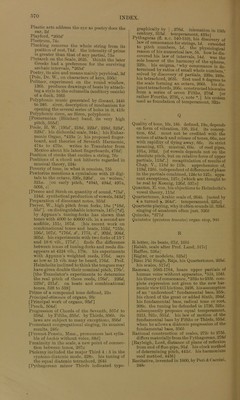
![rally suitable to the chord, 2156. their most perfect positions, 219r. their less perfect positions, 220« MaUlus, sec Ear .... Marloye makes pipe with additional piece a half lengtk of wave, for experiment on plane of reflexion, 91<Z [explanations, 91«/'. 504«7, 508«, 510c] Marpurg quotes Kirnberger on equal tempera- meut, 321«, [494«/', 5106] [Mason and Hemlin, 511«] Matheson, his Oriticct Mustert, 1752, *321«. says Silbermann’s uneqnal temperament is best for organs, 323«, [509«/] [Maxwell, Clarke, fundamental colours, 64«/] Mayer, Prof. A., observations on the duration of sound and numbers of audible beats, 417« and note. [his electrographic method cf de- termining pitch, 4426. his lecture-room ana- lysis of a reed-tone, 549c. his harmonic curves, 5506] [Mazingue, 5086] [Mazzini (Brescia, 1560-1640), resonance of his violins, 87«] [Meantone Temperament, 433«Z. its history, 546c. used in 1880, in Spain, in Greene’s organs, &c., 549«'] Mcätus auditörius, 130« Mechanical problem of transference of the vibrations of air to labyrinth of ear, 134cZ [Mediant Duodene, 462«] [Meeson, his elliptical tension bars, 552d] Melodie relationship, original development of the feeling for, 3686 Melodies in modern music supposed to arise from hamionies, 2536 Melody is not resolved harmony, 289«. in simple tones, how appreciated, 2896 to 2906. expresses motion appreciable by immediate perception, 252«. goes far beyond an imita- tion of nature, 371«. does not arise from distinctive cries, 3716 Membranes, circular, their sympathetic re- sonance, 40« to 41c Membranes, stretched, their inharmonic proper tones, 736 Membranous tongues, how to make, 97a. [reeds, 5546] [Mental efiects of each degree of the scale, 279<Z note] ]\Iental tune = Gemüthsslimmung, 250«7 Mercadier, sce Cornu, *325«/ Mercator’s cycle of 53, 328«, [436c] [Merkel, 106«’. on whispering, *108«Z'. his comparison of all opinions on vowel reso- nance with comparative table, *109«, d, 110«/] [Mersenne, 494«/, 508«, 6, d. spinet, 509«. on equal temperament, 548c] Mese, middle string, answered to tonic, 242« Meshäqah, *264«', 265«/. his modern Arabic scale of 24 Quartertones, 2646, 285«/', 5256, d Metal reeds, 986 Metallic quality of tone, 716 [Meyerbeer, 499c] Middle-tone, see Mese [Millimetres, their relation to inclies, 42d] Minor chord, its treatment by older Com- posers, avoided at close, 217c«. its use at the close marks the period of modern music, 365«. its root or fundamental bass ambiguous, 291«. how avoided, 295«. on the second, a real modulation into the subdominant, 299« Minor-Major Mode, Hauptmann’s name, and its chain of chords, 3056 Minor mode arises from fusion of Doric, Eolic, and Phrygian in Monteverde’s time, 248«/. does not give full expression to tonality, 2946. formerly closed with major chords, 296«/, 297«. the harmonic superiority of this and the major mode, 298c Minor scale, ascending and descending forms, 2746, c. instrumental form, 2886. the eSect on its chords of using the major Seventh, 299« Minor Seventh of scale always replaceable by major Seventh, 2996, c. the effect of this on the chords of minor scale, 299«. acuter or wider, 336c, «7. chord of the, in the direct System, 349c Minor Sixth an imperfect consonance, 194«7. [its partials compared with those of subminor Seventh, 1956] [Minor Submediant Duodene, 4626] Minor System inferior to major in harmonious- ness, 3016, «. this nowise depreciates its value, 302«. its eapabilities in consequence, 302« Minor Tenth, much worse than minor Third, 196« Minor Tetrads, their best positions, 2246 Minor Third, an imperfect consonance, 194«Z. [indicated by - from 276«/.] Pythagorean, 3346. just, 3346 Minor Thirteenth, much worse than minor Sixth, 196« Minor triad, false, 340«. [examples analysed, 340c/.] not so harmonious as major triads, 214c. their combinational tones do not be- long to the harmony, 216«. effect of such tones, 216c. their most perfect and less perfect positions, 2216, c Mixolyclian scale, Greek, 267«/. Glarean’s, 245«/. considered as mode of the Fourth, 302«7 Mode of Fourth ascending form ,275«. of minor Seventh descending form, 275«, ascending form, 2756. of minor Sixth descending form, 2756. its chain of chords, 305c, «7. its relation to the major scale, 3066. traces of its use by Haudel, 307«, 6. by Bach, 307c. by Mozart, 308«, 6. by Beethoven, 3086 [Modelet = rägini, 525c'] [Modern Greek scales, 556«/'] Modes, ecclesiastical, their System differed greatly from modern keys, 247(7. Professor Helmholtz’s names for, compared with an- cient Greek and ecclesiastical, 269«. an- cient Greek, tabulated with the same initial or tonic, 269«. the five with variable Seconds or Sevenths, in the new notation, 277«'. sce Tonal Modes Mvdi'ühts of cochlea, 1376 Modulation in the modern sense, unknown to polyphonic music, 246«. rules for, 328«. [into the Dominant Duodene, 461 «7. into the sub- dominant, mediant, minor submediant, rela- tive and correlative Duodenes, 462] Mongolian pentatonic scales, 257c Monochord, 14«7. [liable to error, 15«], 746. used to train singers, 326«. [experiments with, by Messrs. Hipkins and Hartan, with Translator, 442«] [Monneron, 497c] Monteverde, Claudio, a.d. 1565-1649, invents solo songs with airs, 248«. first composer who used chords of the dominant Seventh without preparation, 248«Z, 296« [Montal, 4986] [Moore & Moore, London, makers of Harmo- nical, 176] Moore, H. Keatley, 307«/, 311 «7. [says Handel took a chorus from Carissimi, 307«'. explains](https://iiif.wellcomecollection.org/image/b28141532_0591.jp2/full/800%2C/0/default.jpg)