On the sensations of tone as a physiological basis for the theory of music / by Hermann L.F. Helmholtz ; translated, thoroughly revised and corrected, rendered conformable to the 4th (and last) German edition of 1877, with numerous additional notes and a new additional appendix bringing down information to 1885, and especially adapted to the use of musical students, by Alexander J. Ellis.
- Hermann von Helmholtz
- Date:
- 1895
Licence: Public Domain Mark
Credit: On the sensations of tone as a physiological basis for the theory of music / by Hermann L.F. Helmholtz ; translated, thoroughly revised and corrected, rendered conformable to the 4th (and last) German edition of 1877, with numerous additional notes and a new additional appendix bringing down information to 1885, and especially adapted to the use of musical students, by Alexander J. Ellis. Source: Wellcome Collection.
593/604 (page 569)
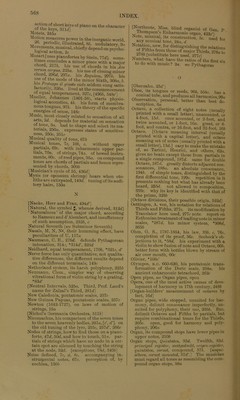
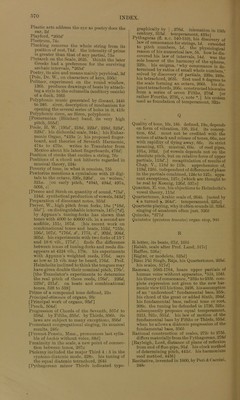
![Organum of Hucbald, 244« Oscillation, length of, 85. period of, 8b Ossicles, see Auditory Ofcoliths, ear stones, see Auditory [Ouseley, Sir F. A. Gore, 503«] Outwards striking reeds, 97c Oval window of labyrintk, 130«, 1365 [Overtones, used by Prof. Tyndall for upper partial tones, an error of translation, here avoided ; the term should never be used for partials in general, 25(2'] [Overtooth, 25^'] P [Pacific, South, Balafong, 518c, 5225] Palestrina, a.d. 1524-1594, under Pius IV., pupil of Goudimel, 2475. carries out sim- plification of church music, 247«. his use of chords, especially in the opening of his Slabat mater, 2255, 247c, 2485, 296«, c, [351<2'] [Paris, Aime and Nanine, pupils of Galin, 425c'. Aime’s kridge tones, 4265] Partial tones in general, and upper partial tones in particular, how distinguished, 22«. in musical notes, 22c. [partialtöne = par- tial tones, 24c'.] partials, contraction for partial tones, 24c'. no illusion of the ear any more than prismatic colours are of the eye, 48c. those unevenly numbered are easier to observe, 49c. methods for observ- ing by ear, 50c. on piano, 50c. on strings generally, 50c to 51«. modes of observing on human voice, 515. [high upper, their exist- ence proved by beats with forks by Trans- lator, 56(2'.] partials fuse into a compound tone, shewn by experiments, Ohm’s with a violin, Prof. Helmholtz’s with bottles, 605, c. [Translator’s with tuning-forks and resonant jars, 61(2.] upper, their influence on quality of tone, 62«. inharmonic upper, 705. favoured on a piano whose period is nearly twice the duration of stroke, 76«. of a string-tone disappear which have a node at point excited, 76c, 77«. [not always when struck by a pianoforte hammer, 76(2, 78c, 5465.] shewn by flames seen in a revolving mirror, Koenig’s manometric flames, 374«, 5. [of a pianoforte string struck at one- eighth its length, 545c.] upper, of human voice, difficult to recognise but keard by Rameau and Seiler, 1045. upper, perceived synthetically, even when not analytically, 655. by properly directed attention they may be observed analytically, 65c. at any rate they effect an alteration of quality of tone, 65c Passing notes, 353« [Patna, Balafong from, 518«, 521(2'] [Pauer, Ernst, on presumed character of keys, 550(2', 551«] Paul, O., considers that Hucbald invented the principle of imitation, *244« [Pedals = footkeys, 50(2'] [Pellisov, see Schafhäutl, 103(2] [Pelog scales, 518(2, 526«] Pendular or simple vibrations, 23«. their law and form, 23c' Pendulum, its periodic motion, 19c. how set swinging by the hand, by periodicallymoving the point of Suspension, 875. to shew Vibration of membrane due to that of air in bottlo, 42« Pentatonic scales in China, Mongolia, Java, Sumatra, Hudson’s Bay, New Guinea, New Caledonia, and among Fullah negroes, 257c. five varieties, 259«, 5, c. [259(2. numerous other, 5185. independent of lieptatonic scales, 525(2. do not arise from inability to appreciate Semitones, 5265] [Peppercorn, 496(2, 497«, 549«] Perception, synthetical and aualytical, 62d Peri, Giacomo, in 1600 invents recitative, 2455, 248c Periodic motions of pendulum, 19c. of water- wheel hammer, 19c. of ball struck up when falling, 19(2 Periods of musical composition, three, 236(2 Persian, see Arabic Persian music later develops 12 Semitones, 285«. Kiesewetter’s kypotkesis, 285« [(2] [Phonograph, Edison’s, used to analyse vowel sounds, by Messrs. Jenkin & Ewing, 539«] Phase, difference of, 345. its effects on forms of vibrational curves, 119(2. on quality of tone, 120c. in compounded simple tones does not affect quality of tone, 124c to 127c. as seen in the Vibration microscope, 126(2,127«. [its influence on quality of tone according to Koenig, 537«] Philolaus, 257d Phrynis, victor at Panathenaic competitions, adds a ninth string to his ly re, 269c Pkrygian scale, 267c. Greek = mode of the minor Seventh, 303c. Glarean’s, 245(2, 305c Pianoforte, echoes vowels, 61c [129(2]. strings, where struck, 775 [77c]. takes the first place among Instruments with struck strings, 208(2. the quality of its chords arising from the quality of its tones, 209«, c, d. bears disso- nances well, 2095. its strings, mathematieal investigation of their vibrational forms, 380«. [its string struck at one-eighth its length, has the 8th harmonic and partial, 545c.] sec also Hammer [Pichler, tuner at Berlin opera, 509(2] Pipes, their theory, 388-397. theory of blow- ing them, mathematically treated, 390 to 3965. conical, calculated series of their tones, 393c. [with remarks note * aud 394(2 note *.] see also Organ pipes Pitch, 10c. number defined, 11« [11(2]. de- pends only on the number of vibrations in a second, 13c. numbers of just musical scale, how calculated, 155, c. Scheibler’s, 16c. Prench, 16d. numbers of the just musical scale, tabulated to «'440, 17«. of a compound tone, is the pitch of its prime, 24«. its definite appreciation begins at 40 vib. 177«. alters by definite intervals and why, 2505, 2525, d. of tonic undetermined, depending on compass of voice or instrument, 310«. [numbers, how to determine, App. XX. sect. B, see contents, 4415. musical, de- fined, 4945. its history, 495 to 513, sect. H. see contents, 493(2. Church, lowest, 495«. low, 4955. medium, 499«. high, 503«. kighest, 503(2. extreme, 524. ckamber low, 495c. kighest, 504«. mean of Europe for two centuries, 495d, 497(2. compromise, 497(2. modern orchestral, 499«. when it began to rise, 512c] [Pitman, Organist at Covent Garden Theatre, 500(2] [Pitt-Rivers, Gen., his balafong, 5185, 522«] Pius IV., Pope, a.d. 1559-1565, Orders simpli- fication of church. music, 217« Pizzicato of violin inore piercing than piano tones, 67«, 745 Plagal scales, Glarean’s six, 245c. the fourth, 267«, 271(2](https://iiif.wellcomecollection.org/image/b28141532_0593.jp2/full/800%2C/0/default.jpg)