On the sensations of tone as a physiological basis for the theory of music / by Hermann L.F. Helmholtz ; translated, thoroughly revised and corrected, rendered conformable to the 4th (and last) German edition of 1877, with numerous additional notes and a new additional appendix bringing down information to 1885, and especially adapted to the use of musical students, by Alexander J. Ellis.
- Hermann von Helmholtz
- Date:
- 1895
Licence: Public Domain Mark
Credit: On the sensations of tone as a physiological basis for the theory of music / by Hermann L.F. Helmholtz ; translated, thoroughly revised and corrected, rendered conformable to the 4th (and last) German edition of 1877, with numerous additional notes and a new additional appendix bringing down information to 1885, and especially adapted to the use of musical students, by Alexander J. Ellis. Source: Wellcome Collection.
594/604 (page 570)
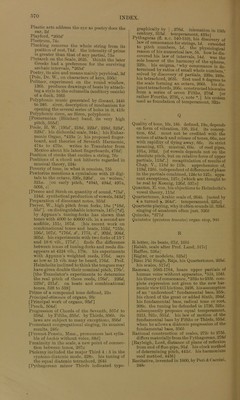
![Plastic arts address the eye as poetrv does the ear, 2d Playford, *260d' Plectrum, 74c Plucking removes the whole string from its Position of rest, 74d. the intensity of prime is greater than that of any partial, 75« Plntarch on the Scale, 2625.“ thinks the later Greeks had a preference for the surviving archaic intervals, *265d' Poetry, its aim and meansmainly psychical, 2d [Pole, Dr. W., on characters of keys, 550c] Politzer, experiment on the round window, 136b. produces drawings of beats by attach- ing a style to tbe columella (auditory ossicle) of a duck, 1665 Polyphonic music generated by discant, 2445 to 246. siren, description of mecbanism for opening tbe several series of boles in it, 413c Polyphonic siren, sec Siren, polyphonic [Pomeranian (Blücher) band, its very high pitch, 555(7] Poole, H. W. [195(7', 218(7, 222(7', 228(7, 323d', 329(7'. bis dichordal scale, 344c.] his Euhar- monic Organ, *423« [c. his proposed finger- board, and theories of Seventh Harmonie, 474« to 479«. writes to Translator from Mexico about his latest fingerboards, 478(7] Position of stroke that excites a string, 76c Positions of a chord not hitherto regarded in musical theory, 224c Poverty of tone, in what it consists, 755 Prsetorius mentions a cymbalum with 19 digi- tals to the octave, -320c, 320(7'. on ‘ wolves,’ 321«. [on early pitch, *4945, 494(7, 497«, 5095, c] [Preece and Stroh on quantity of sound, *75(7', 124(7. synthetical production of vowels, 542(7] Preparation of dissonant notes, 353(7 Preyer, W., high pitch from forks, 18« [*18(7, 55(7']. on distinguishahle intervals, 147c [*(7]. by Appunn’s tuning-forks has shewn that tones with 4000 to 40000 vib. in a second are audihle, 151c, 167(7. [his recent work on combinational tones and beats, 152(7, *153c, 156(7, 167(7, *176(7, d', 1775, (7', 202(7, 204(7, 205(7. his experiments with two forks of 13-7 and 186 vib., 177(7'.] finds t*he difference between tones of tuning-forks and reeds dis- appears at 4224 vib., 179c. his experiments with Appunn’s weighted reeds, 176(7. says as low as 15 vib. may be heard, 176(7. Prof. Helmholtz inclined to think the tongues may have given double their nominal pitch, 176c'. [the Translator’s experiments to determine the real pitch of these reeds, 176(7'. 226(7, 229(7', 231(7'. on beats and combinational tones, 528 to 538] Prime of a compound tone defined, 22« Principal-stimmen of organs, 93c [Principal work of organs, 93(7'] |Proch, 504(7] Progression of Chords of the Seventh, 357(7 to 358(7. by Fifths, 355(7. by Thirds, 3565. its laws are subject to many exceptions, 356(7 Protestant congregational singing, its musical results, 246c [Provost-Ponsin, Mme., pronounces last sylla- ble of hach ix without voice, 68(7] Proximity in the scale, a new point of connec- tion between tones, 287« Ptolemy included the major Third 4 : 5 in the syntono-diatonic mode, 228c. bis tuning of the equal diatonic tetracliord, 2645 [Pytliagorean minor Thirds indicated typo- graphically by | , 276(7. intonation in 15th Century, 313(7, temperament, 433«I Pythagoras (fl. b.c. 540-510), his discovery of law of consonance for strings, 1(7. extended to pitch numbers, 1(7. the physiological reason of his numerical law, 55. how he dis- covered his law of intervals, 14(7. was the sole hearer of the harmony of the spheres, 229c. his enigma, ‘ why consonance is de- termined by ratios of small whole numbers ’ solved by discovery of partials, 229«, 249« his tetrachord, 2635. first used 8 degrees to the scale forming an octave, 2665. his dis- j unct tetrachords, 266c. constructed his seales from a series of seven Fifths, 278(7. [or rather Fourths, 2795, c, note *.] his System used as foundation of temperament, 322« Q Quality of tone, 10c, 185. defined, 19«, depends on form of Vibration, 195, 21(7. its concep- tion, 65(7. must not be credited with the noises of attack and release of tones, 66«, nor with rapidity of dying away, 66c. its strict meaning, 675. musical, 69«. of reed pipes, 101«, 102(7. [of vowels depends not on the absolute pitch, but on relative force of upper partials, 113(7'.] recapitulation of results of Chap. V., 118(7 to 119c. apprehension of, 119(7,1285. independent of difference of phase in the partials combined, 124c to 127c. appa- rent exceptions, 127c, [which are thought to be real by Koenig, 126(7, 537«] Quanten, E. von, his objections to Helmholtz’s vowel theory, 115(7 Quartertones, Arabic scale of, 2645. [noted by 7j a turned (?, 264(7'. temperament, 525«] Quartette playing, why it often sounds ill, 324(7. singing of amateurs often just, 3265 Quincke, *377(7 Quintetten (quintam tenentes) organ stop, 945 R R letter, its beats, 67(7, 1685 [Rabab, scale after Prof. Land, 517c] [Raffles, 526«] [Rägini, or modelets, 525(7] [Ram Pal Singh, Raja, his Quartertones, 265(7. his seales, 517(7] Rameau, 1685-1764, hears upper partials of human voice without apparatus, *515, 1047». his theory of consonance, *232« to2335. com- plete expression not given to the new har- monic view tiil his time, 2495. liisassumption of an ‘ understood ’ fundamental bass, 253c. his chord of the great or added Sixth, 294(7. his fundamental bass, radical tone or root, 309c. the tuning he defended in 1726, 321«. subsequently proposes equal temperament, 3215, 321c, 351(7. his law of motion of the fundamental bass by Fifths or Thirds, 355(7. when he allows a diatonic progression of the fundamental bass, 3565 Rational construction of seales, 272c to 2755. differs materially from the Fythagorean, 278(7 [Rayleigh, Lord, distancc of plane of refiexion from end of flue-pipe, 91(7. his clock method of detennining pitch, 442/7. his harmonium reed method, 4435] Recitative, invented in 1600, by Peri & Cacciui, 248c](https://iiif.wellcomecollection.org/image/b28141532_0594.jp2/full/800%2C/0/default.jpg)