On the sensations of tone as a physiological basis for the theory of music / by Hermann L.F. Helmholtz ; translated, thoroughly revised and corrected, rendered conformable to the 4th (and last) German edition of 1877, with numerous additional notes and a new additional appendix bringing down information to 1885, and especially adapted to the use of musical students, by Alexander J. Ellis.
- Hermann von Helmholtz
- Date:
- 1895
Licence: Public Domain Mark
Credit: On the sensations of tone as a physiological basis for the theory of music / by Hermann L.F. Helmholtz ; translated, thoroughly revised and corrected, rendered conformable to the 4th (and last) German edition of 1877, with numerous additional notes and a new additional appendix bringing down information to 1885, and especially adapted to the use of musical students, by Alexander J. Ellis. Source: Wellcome Collection.
595/604 page 571
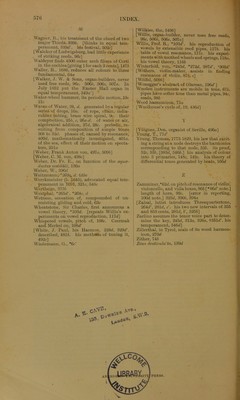
![Recitation, musical, 239a Reeds or vibrators of harmoniums, how they act, 95a, 6. how their quality of tone is modiüed, 95c. on Organs and harmoniums for one note each, 98a. on wooden wind in- struments one reed serves for several notes, 986. of clarinets, 96b, oboes and bassoons, 97a. striking inwards and outwards, 97b, c. notes proper to them not used at all on wooden wind instruments, 98c. pipes, their musical tones, 95a. of Organs, 96a. pipes, their quality of tone, 101a, 102d. experiments to shew that they are modified by resonance chambers, 1026. with cylindrical pipes, 3916. striking inwards and outwards, 391c?. metal, 392a. with conical pipes, 392c?. pipes, theory of blowing them, mathematically treated, 390d, 394a. [action of, by Hermann Smith, 5536 to 555c'. their kinds, 653c. for clarinets, 553c. for Hichi-riki, 553c'. for bassoons and oboes, 554a. membranous, 5546. stream, 544c. free reed, Chinese, 554c?. harmonium, 554a'. American organ, 5546'. voicing of, 554dl. suction chambers, 5556. drilled, 555a'] [Register, used by T. Young for quality of tone, why not so used here, 246'] [Registers of the voice in singing, from Lennox Browne and Emil Behnke, described, 100c?' to 101c, d, e', (?'] Reissner’s membrane, 137c? Relationship of tones in first and second de- gree, 2566. differs with the quality of the tone, 256c. due in melody to memory, in harmony to immediate Sensation, 368d. be- tween tones more than two Fifths apart iin- perceptible, 2796. of chords, its degrees, 2966 [Relative Duodene, 4626] Resemblance, unconscious sense of, 369c Resonance of boxes of violin, Violoncello, and viöla, 866 [86c?', S76 to c?']. of cavities of mouth, how to find, 104c? to 105a. depends on vowel uttered independent of age and sex, 1056. [difficulties of dctermining it, 105c.] of cavity of mouth, how it affects vowels, 110c. its influence in reed pipes, mathe- matically treated, 388 to 390cc Res'onätors for separating the musical tones in noise, 7c?. spherical and cylindrical, 436, c. Bosanquet’s, 43(?'. advantages of a tuned series of, 446. use in finding partials, 51c. affect the prime tone of the voice as well as partials, their effect on reed pipes, 1126. spherical, their advantages, 372(/. formula for their pitch, 373a. of glass, their dimen- sions, 373c. tin or pasteboard in double cones, 373-/. conical, 373c? [Resultant tones, Prof. Tyndall’s name for comhinational tones, 153c] Results of the whole investigation, 362a to 3666 Rotrospect of results in Parts I. & II., 226 to 233 Reverted System, its chords, 342c. serve to mark the key, 3446 [Reyher, S., on vowel resonance, *108c?, 109c] Richness of tone, in what it consists, 756 Riemann, Hugo, *365c?, *411r [Ritchie, E. S., 511a] Robson, Messrs., built Gen. Perronet Thomp- son’s Enharmonic Organ, 423a [Rockstro, W. S., doubts whether the authentic scalos are rightly attributed to Ambrose, 242c?. on Ecclesiastical scales, 266c?. on the Hexachord, *351c?'J Rockstro, R. S., intonation of bis * mode! ’ flute 555c? to 556a Rods, effect of their material on the quality of tone, 71a Rohrflöte, organ stop, 946, [94c?'] Roman Catholic Church alters its music, 247a Root or fundamental bass, 294c [Rossetti, Prof., 494c?] Roughness of intervals, referred to the same bass note calculated and constructed, 192c, discussed, 193 Round window of labyrinth, 130a, 1366 [Rudall, 103c?] Riidinger on the semicircular canals, 136c? Rudolph II. of Prague, his eymbalum of 19 tones to the Octave, 320c [Ruggieri (Cremona, 1668-1720), resonance of his violins, 87c] [Rule for tuning in just intonation, 493c] [Russia, pitch, 510c?] [Rust, how it affects forks, 555c] [R, uvular, where localised, 67c?] S Saacülits, see Ear St. Paul’s, London, tones of its former bell, 72c? [Salendro Scales, 518c, 526a] Salidonnl, organ stop, 94a, [94c?] [Salinas, F., 1513-1590, 351c?'. his tempera- ments, 5476. completes meantone tempera- ment, 518] Salisbury, Prof., at Yale, his MS., 281c [Samvadi, or 1 minister ’ note, 526c;] Sand, see. Auditory Sand figures on membranes, 41c? [Sarti, 510-?] Sauerwald, 161c?' [Sauveur’s cycle of 43, 436c?', 494c?', 5096] Savart on pitch of resonance of violin and Violoncello boxes, 866, 175c? Scälct, vestibuli et tympani, or gallery of the Vestibüle and drum of the ear, 1376 Scales, musical, their construction, 5c. major, division into two tetrachords, 2556. foundecl on relationship of tones, 2566. later Greek, withconjunctanddisjuncttetrachord,270a,6. [in the complete notation with intervals in cents, 274c to c?'. harmonic and non-har- monic, 5146. Greek, most ancient form, 5156. later, 515c. Al Farabi’s, 515c. early, their possible origin, 522c?] Schafhäutl, or Pellisov, *72c?'. [his theory of stopped and conical pipes, 103c/] Scheibler, J. H. (1777-1837), his pitch, 16c. [why selected by him, 16c?', 87c, 153c, 200c?, c?'. his tonometer, does not shew that com- binational tones of higher Orders existed, *199c?.] rule for tuning the Fifth by the Octave, 202c?. [not found by Translator, 202c?'. his method of finding the major Third on forks, 203c?.] worked out combina- tional tones for two simple tones only, 227a. [on the beautv of just intonation, 423c?. his tuning-fork tonometer, 443c. his theoreti- cally perfect method of tuning pianos and organs, and its inconveniences, 4886. 494c?', 504c, 508c, 509a, 6] Schicdmaycr, J. and P., made Prof. Helm- holtz’s Just Harmonium, 316c?' [Schlick, 494c?, 509c, 5116. his temperament, *546c?, 5496] [Sclnnahl, 494c?', 548c?] [Schmidt, Benihardt, called Father Smith, organ-builder, 505c] Schneebeli, on the blade of air in flue-pipes. *395c?. [his theory, 3966]](https://iiif.wellcomecollection.org/image/b28141532_0595.jp2/full/800%2C/0/default.jpg)

 No text description is available for this image
 No text description is available for this image
 No text description is available for this image