On the sensations of tone as a physiological basis for the theory of music / by Hermann L.F. Helmholtz ; translated, thoroughly revised and corrected, rendered conformable to the 4th (and last) German edition of 1877, with numerous additional notes and a new additional appendix bringing down information to 1885, and especially adapted to the use of musical students, by Alexander J. Ellis.
- Hermann von Helmholtz
- Date:
- 1895
Licence: Public Domain Mark
Credit: On the sensations of tone as a physiological basis for the theory of music / by Hermann L.F. Helmholtz ; translated, thoroughly revised and corrected, rendered conformable to the 4th (and last) German edition of 1877, with numerous additional notes and a new additional appendix bringing down information to 1885, and especially adapted to the use of musical students, by Alexander J. Ellis. Source: Wellcome Collection.
599/604 (page 575)
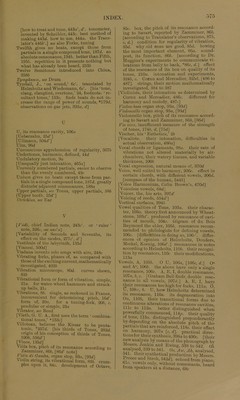
![Ö75 [how to treat and tune, 443a', d'. tonometer, invented by Sckeibler, 443c. best mctkod of making 443(6. how to use, 444a. tke Trans- lators 4466'.] see also Forks, tuning Twelfth gives no beats, except those from partials in a single compound tone, 187d. an absolute oonsonance, 1946. better than Fiftk, 1956. repetition in it presents nothing but what kas already been keard, 2536 Twelve Semitones introduced into China, 2586 Tympänum, see Drum Tyndall, J., ‘ on sound,’ 6c'. translated by Helmholtz and Wiedemann, 6c'. [bis ‘tone, clang, clangtint, overtone,’ 24, footnote. ‘re- sultant tones,’ 153c. finds beats do not in- crease the ränge of power of sounds, *179(6. observations on gas jets, 395a, <6] U U, its resonance cavity, 106a [Ueberzahn, 25(6'] [Ullmann, 504(6'] Ulm, 96d Unconscious apprekension of regulärity, 3676 Undertones, karmonic, defined, 44c6 Undulatory motion, 9a [Unequally just intonation, 465a] Unevenly numbered partials, easier to observe tkan tke evenly numbered, 49c Unison gives no beats except tkose from par- tials in a single compound tone, 187(6. greatly disturbs adjacent consonanees, 188a Upper partials, see Tones, upper partials, 586 [Upper tooth, 25(6'] Utricülus, see Ear V [ V<idi, chief Indian note, 243c'. or 1 ruler ’ note, 526c, see ans'a\ [Variability of Seconds and Seventks, its effect on tke modes, 277c', (6'] Vestibüle of the labyrinth, 135(6 [Vianesi, 500(6] Viadana invents solo songs with airs, 248c Vibrating forks, phases of, as compared witk those of tke exciting current, mathematically -investigated, 4026 Vibration microscope, 80(6. curves shewn, 826 Vibrational form or form of Vibration, simple, 21a. for water-wkeel hammers and struck- up balls, 21c Vibrations, 86. single, as reckoned in France, inconvenient for determining pitck, 16(6'. form of, 20a. for a tuning-fork, 206, c. pendnlar or simple, 23a Vibrator, see Reed [\ ietk, G. U. A., first uses tke term 1 combina- tional tones,’ *153c] Villoteau, believes the Kissar to be penta- tonic, *257(6. [kis tkirds of Tones, 282d. origin of kis conception of thirds of Tones 5206, 556(6'] [Vince, 135(6] \ iola box, pitck of its resonance accordina to Zamminer, 866, [86(6' note] Vjöla di Gainba, organ stop, 93a, [93(6] Viohn string, its vibrational form, 836. crum- ples upon it, 84c. development of Octave, 85c. box, the pitch of its resonance accord- ing to Savart, reported by Zamminer, 866. [according to Translator’s observations, 876, c, (6.] condition for regularity of Vibration, 85d. wky old ones are good, 85d. bowing tke most important element, 86a. sound- post, its function, 866. [according to Dr. Huggins’s experiments to communicate vi- brations from belly to back, *86c, (6.] effect of tke resonance of its box on quality of its tones, 210a. intonation and experiments, 3246, c. Cornu and Mercadier, 325(6, [486 to 487]. strings, tkeir motion mathematically investigated, 384 to 387 [Violinists, tkeir intonation as determined by Cornu and Mercadier, 486c. different for harmony and melody, 487c] Violon-bass organ stop, 93a, [93(6] Violoncello organ stop, 93a, [93(6] Violoncello box, pitck of its resonance accord- ing to Savart and Zamminer, 866, [86(6] Vis v'mi, insufficient measure of tke strength of tones, 1746, (6, [75(6] Vischer, kis ‘ Esthetics,’ 26 [Vocalists. tkeir intonation, difkculties in actual observation, 486a] Vocal ckords or ligaments, 98a. tkeir rate of vibrations not altered materially by air- ckambers, tkeir watery tissues, and variable tkickness, 1006 Vocal expression, natural means of, 370d Voice, well suited to harmony, 206c. efiect in certain ckords, witk different vowels, 206(6. [compass of tke human, 5446] [Voice Harmonium, Colin Brown’s, 470(6] [Voiceless vowels, 68(6] [Voicer, tke, his arts, 397d' [Voicing of reeds, 554(6'] Vortical surfaces, 3946 Vowel qualities of Tone, 103a. their ckarac- ter, 103a. theory first announced by Wkeat- stone, 103(6'. produced by resonance of cavi- ties of mouth, 104c. trigram of du Bois Reymond the elder, 1056. resonance recom- mended to philologists for defining vowels, 106c. [difficulties in doing so, 106c'. differ- ences of opinion of Helmholtz, Donders, Merkel, Koenig, 106(6'.] resonances in notes according to Helmholtz, 1106. tkeir recogni- tion by resonators, 110c tkeir modifications, 113a Vowels, A, 1056. O U, 106a, [106c, (6.] O“ and A°, 1066. the above kave only a single resonance, 106c. A, E, I, double resonance, 107a, 6, c. [Graham Bell finds double reso- uance in all vowels, 107(6.] Ä, E, I, kave tkeir resonances too kigk for forks, lila. Ö, Ü, 108((, 6. U, kow Helmholtz determined its resonance, 110a. its degeneration into Ou, 1106, tkeir transitional forms due to continuous alterations of resonance cavities, 111c to 112a. better distinguished when powerfully commenced, 114p. tkeir quality of tone, 115a. distinguished preponderantly by depending on the absolute pitck of tke partials tkat are reinforced, 118c. tkeir effect on harmony, 207a [c, (6]. practical direc- tions for their synthesis, 398a to 400c. [tkeir new analysis by means of tke phonograph by Messrs. Jenkin and Ewing, 538 to 542 ü), analysed, 539 to 541. üo, A w, Ah, anaiysed, 541. their syntketical production by Messrs. Preece and Stroh, 542d]. eclioed from piano, 61c. vowels only, witkout consonants, keard from Speakers at a distance, 68c](https://iiif.wellcomecollection.org/image/b28141532_0599.jp2/full/800%2C/0/default.jpg)