On the sensations of tone as a physiological basis for the theory of music / by Hermann L.F. Helmholtz ; translated, thoroughly revised and corrected, rendered conformable to the 4th (and last) German edition of 1877, with numerous additional notes and a new additional appendix bringing down information to 1885, and especially adapted to the use of musical students, by Alexander J. Ellis.
- Hermann von Helmholtz
- Date:
- 1895
Licence: Public Domain Mark
Credit: On the sensations of tone as a physiological basis for the theory of music / by Hermann L.F. Helmholtz ; translated, thoroughly revised and corrected, rendered conformable to the 4th (and last) German edition of 1877, with numerous additional notes and a new additional appendix bringing down information to 1885, and especially adapted to the use of musical students, by Alexander J. Ellis. Source: Wellcome Collection.
69/604 (page 45)
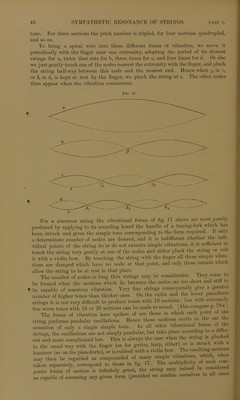
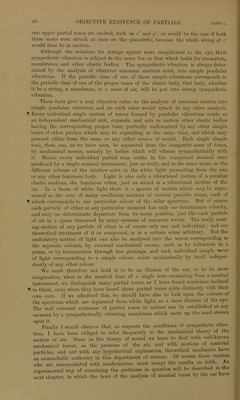
![the resonator is c, it will be hoard when a musical instrument sounds c,f, c, A'ry, F, D, C, and so on.* In this case the resonator is made to sound in sympathy with one of the harmonic upper partial tones of the compound musical tone which is vibrating in the external air. It must, however, be noted that by no means all the harmonic upper partial tones occur in the compound tones of every instrument, and that they have very different degrees of intensity in different instruments. In the musical tones of violins, pianofortes, and harmouiums, the first five or six are geuerally very distinctly present. A more detailed account of the upper partial tones of strings will be given in the next chapter. On the harmonium the un- evenly numbered partial tones (1, 3, 5, &c.) are generally stronger than the evenly numbered ones (2, 4, 6, &c.). In the same way, the upper partial tones are clearly heard by means of the resonators in the singing tones of the human voice, but differ in strength for the different vowels, as will be shown hereafter. H Among the bodies capable of strong sympathetic Vibration must be reckoned stretched strings which are connected with a sounding board, as on the pianoforte. The principal mark of distinction between strings and the other bodies which vibrate sympathetically, is that different vibrating forms of strings give simple tones correspondiug to the harmonic upper partial tones of the prime tone, whereas the secondary simple tones of membranes, bells, rods, &c., are mharmonic with the prime tone, and the masses of air in resonators have generally only very high upper partial tones, also chiefly mharmonic with the prime tone, and not capable of beiug much reinforced by the resonator. The vibrations of strings may be studied eitlier on elastic chords loosely stretched, and not sonorous, but swinging so slowly that their motion may be followed with the liand and eye, or eise on sonorous strings, as those of the piano- forte, guitar, monochord, or violin. Strings of the first kind are best made of thin U spirals of brass wire, six to ten feet in length. They should be gently stretched, and both ends should be fastened. A string of this construction is capable of rnaking very large excursions with great regularity, which are easily seen by a large audience. The Swings are excited by moving the string regularly backwards and fonvards by the finger near to one of its extremities. A string may be first made to vibrate as in fig. 17, a (p. 466), so that its appear- ance when displaced from its position of rest is always that of a simple half wave. 1 he string m this case gives a single simple tone, the deepest it can produce, and no other harmonic secondary tones are audible. But the string may also during its motion assume the forms fig. 17, b c d. In this case the form of the string is that of two, three, or four half waves of a simple wave-curve. In the vibrational form b the string produces only the upper Octavc of its prime tone, in the form c the Twelfth, and in the form d the second ° aV’G' 1 he dotted Imes show the position of the string at the end of half its 11 periodic tune, ln b the point ß remains at rest, in c two points y, and y, remain at rest, in d three points 8„ 8* 8, These points are called nodes. In a swinghm spiral wire the nodes are readily seen, and for a rcsonant string they are shown by 1 tle paper ridcrs which are jerked off from the vibrating parts and remain sitting ^i c nodes. When, then, the string is divided by a node into two swinging cotions, it produces a simple tone having a pitch number double that of the prime 5ti,* cTv® nl occ!irs as thö 2ud- 3rd, 4tli tn, Gth, 7th, 8th partials of these notef tho 7th being ratlier flat, in fact:— c' c f f c C c' /' c A\> a\) cjj a'|> c p f c' f «' c r> d a d’ /'# «. c ' c J c e f b’b c.— 'Translator.] The partials are](https://iiif.wellcomecollection.org/image/b28141532_0069.jp2/full/800%2C/0/default.jpg)