On the sensations of tone as a physiological basis for the theory of music / by Hermann L.F. Helmholtz ; translated, thoroughly revised and corrected, rendered conformable to the 4th (and last) German edition of 1877, with numerous additional notes and a new additional appendix bringing down information to 1885, and especially adapted to the use of musical students, by Alexander J. Ellis.
- Hermann von Helmholtz
- Date:
- 1895
Licence: Public Domain Mark
Credit: On the sensations of tone as a physiological basis for the theory of music / by Hermann L.F. Helmholtz ; translated, thoroughly revised and corrected, rendered conformable to the 4th (and last) German edition of 1877, with numerous additional notes and a new additional appendix bringing down information to 1885, and especially adapted to the use of musical students, by Alexander J. Ellis. Source: Wellcome Collection.
95/604 (page 71)
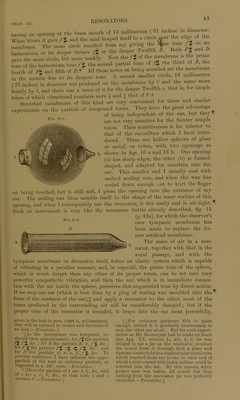
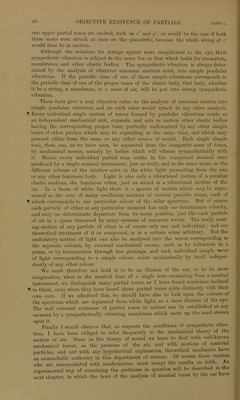
![CIIAP. v. 2. TONES W1TH 1NHARM0N1C UPPER PARTIALS. althouo-h they have lately been introduced for military and dance music on account of their penetrating qualities of tone. Glass rods or plates, and wooden rods, were formerly nsed in this way for the glass harmonicon and the straiv-fiddle or wood harmonicon. The rods were inserted between two pairs of intertwisted strings, which grasped them at their two nodal iines. The wooden rods in the German straw-fiddle were simply laid on straw cylinders. They were Struck with hämmere of wood or eork. The only effect of the material of the rods on the quality of tone m these cases, consists in the greater or less length of time that it allows the piopei tones at different pitches to continue. These secondary tones, including the higher ones, usually continue to sound longest in elastic metal of fine uniform consistency, because its greater mass gives it a greater tendency to continue in any state of motion which it has once assumed, and among metals the most peifect elasticity is found in steel, and the better alloys of copper and zinc, or copper and tin. ln H slightly alloyed precious metals, their greater specific gravity lengthens the dura- tion of the tone, notwithstanding their inferior elasticity. Superior elasticity appears to favour the continuance of the higher proper tones, because imperfect elasticity and friction generally seems to damp rapid more quickly than slow vibra- tions. Hence I think that I may describe the general characteristic of what is usually called a metallic quality of tone, as the comparatively continuous and uniform maintenance of higher upper partial tones. The quality of tone for glass is similar; but as it breaks when violently agitated, the tone is always weak and Fig. 21. soft, and it is also comparatively high, and dies rapidly away, on account of the smaller mass of the vibrating body. In wood the mass is small, the internal structure comparatively rough, being full of countless intcrstices, and the elasticity also comparatively imperfect, so that the proper tones, especially the higher ones, rapidly die away. And for this reason the straiv-fiddle or wood harmonicon is per- liaps more satisfactory to a musical ear, than harmonicons formed of steel or glass rods or plates, with their piercing inharmonic upper partial tones,— at least so far as simple tones are suitable for music at all, of which I shall have to speak later on.* For all of these instruments which have to be struck, the hämmere are made of wood or cork, and covered with leather. This renders the highest upper partials much weaker than if only hard metal liammers were employed. Greater H hardness of the striking mass produces greater discontinuities in the original motion of the plate. The influenee exerted by the manner of striking will be considered more in detail, in reference to strings, where it is also of much impor- tance. According to Chladni’s discoveries, elastic plates, cut in circular, oval, square, oblong, triangulär, or hexagonal forms, will sound in a great number of different virrational forms, usually producing simple tones which are mutually inharmonic. hig. 21 gives the more simple vibrational forms of a circular plate. Much more complicated forms occur when several circles or additional diameters appear as nodal lines, or where both circles and diameters occur. Supposing the vibrational form A to give the tone c, the others give the following proper tones :— * Un Java the principal music is producod by harmonicons of metal or wooden rods and kettle-shaped gongs. The wooden harmonicons are frequent also in Asia and Africa. In Java the rods are laid on the edges of boat-shaped yessels, like old fashion cheese-trays, and kept in position by nails passing loosely through holes. See App. XX. sect. K..— Translator;]](https://iiif.wellcomecollection.org/image/b28141532_0095.jp2/full/800%2C/0/default.jpg)