A dictionary of chemistry, on the basis of Mr. Nicholson's: in which the principles of the science are investigated anew, and its applications to the phenomena of nature, medicine, mineralogy, agriculture, and manufactures, detailed (Volume 1).
- Andrew Ure
- Date:
- 1821
Licence: Public Domain Mark
Credit: A dictionary of chemistry, on the basis of Mr. Nicholson's: in which the principles of the science are investigated anew, and its applications to the phenomena of nature, medicine, mineralogy, agriculture, and manufactures, detailed (Volume 1). Source: Wellcome Collection.
Provider: This material has been provided by the National Library of Medicine (U.S.), through the Medical Heritage Library. The original may be consulted at the National Library of Medicine (U.S.)
97/432
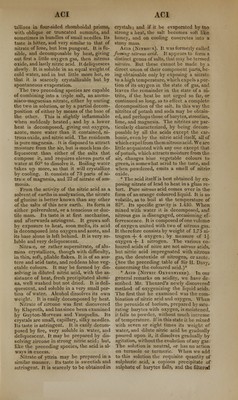
![and nitrogen, in the proportion above stated. It retains its oxygen with little force, so that it is decomposed by all combustible bodies. Wrought into contact with hydrogen gas at a high temperature, a violent detonation ensues, so that this must not be done without great caution. It inflames essential oils, as those of tur- pentine and cloves, when suddenly poured on them ; but, to perform this experiment with safety, the acid must be poured out of a bottle tied to the end of a long stick, otherwise the operator's face and eyes will be greatly endangered. If it be poured on perfectly dry charcoal powder, it excites combustion, with the emission of copious fumes. By boiling it with sulphur it is decomposed, and its oxygen, uniting with the sulphur, forms sulphuric acid. Chemists in general agree, that it acts very powerfully on almost all the metals; but Baume has asserted, that it will not dissolve tin, and Dr. Woodhouse of Pennsylvania affirms, that in a highly concentrated and pure state it acts not at all on silver, copper, or tin though, with the addition of a little water, its action on them is very powerful. * Proust has ascertained, that acidhaving the specific gravity 1.48, has no more ac- tion on tin than on sand, while acid some- what stronger or weaker acts furiously on the metal. Now, acid of 1.485, by Dr. Ure's table, consists of one prime of real acid united with two of water, constituting, it would thus appear, a peculiarly power* ful combination^ Acid which takes up TVo8o ths of its weight of marble, freezes, according to Mr. Cavendish, at—2°. When it can dis- solve toVo» it requires to be cooled to— 41°.6 before congelation; and when so much diluted as to take up only toVo' i* congeals at—40°.3. The first has a specific gravity of 1.330 nearly, and con- sists of 1 prime of dry acid + 7 of water; the second has a specific gravity of 1.420, and contains exactly one prime of dry acid -f- four of water; while the third has a specific gravity of 1.215, consisting of one prime of acid -f- 14 of water. We perceive, that the liquid acid of 1.420, composed of 4 primes of water -f- one of dry acid, possesses the greatest power of resisting the influence of temperature to change its state. It requires the maximum heat to boil it, when it distils unchanged; and the maximum cold to effect its con- gelation.* It has already been observed, that the nitric acid, when first distilled over, holds in solution a portion of nitric oxide, which is greater in proportion as the heat has been urged toward the end, and much increased by even a small portion of in- flammable matter, should any have been present. The colour of the acid, too, is affected by the quantity of nitric oxide it holds, and Sir H. Davy has given us the following table of proportions answering to its different hues. Colour. Real Aci Pale yellow 90.5 Bright yellow 88.94 Dark orange 8C.84 Light olive 86.0 Dark olive 85.4 Bright green 84.8 Blue green 84.6 But these colours are not exact indica- tions of the state of the acid, for an addition of water will change the colour into one lower in the scale, so that a considerable portion of water will change the dark orange to a blue green. The nitric acid is of considerable use in the arts. It is employed for etching on copper; as a solvent of tin to form with that metal a mordant for some of the finest dyes; in metallurgy and assaying; in va- , rious chemical processes, on account of the facility with which it parts with oxy- x gen and dissolves metals; in medicine as a tonic, and as a substitute for mercurial preparations in syphilis and affections of the liver; as als» in form of vapour to de- stroy contagion. For the purposes of the arts it is commnnly used in a diluted state, and contaminated with the sulphuric and muriatic acids, by the name of aquafortis. This is generally prepared by mixing Vol. i. [ 10 ] Nithic Oxide. Wateh. 1.2 8.3 2.96 8.10 5.56 7.6 6.45 7.55 7.1 7.5 7.76 7.44 8. 7.4 common nitre with an equal weight of sulphate of iron, and half its weight of the same sulphate calcined, and distilling the- mixture ; or by mixing nitre with twice its weight of dry powdered clay, and dis- tilling in a reverberatory furnace. Two kinds are found in the shops, one called double aquafortis, which is about half the strength of nitric acid ; the other simply aquafortis, which is half the strength of the double. A compound made by mixing two parts of the nitric acid with one of muriatic, known formerly by the name of aqua regia, and now by that of nilvo-muriatic acid, has the property of dissolving gold and platina. On mixing the two acids, heat is given out, an effervescence takes place, and the mixture acquires an orange colour. This is likewise made by adding gradually to an ounce of powdered muriate of ammonia, four ounces of double aqua.](https://iiif.wellcomecollection.org/image/b21160909_0097.jp2/full/800%2C/0/default.jpg)