An encyclopaedia of domestic economy comprising such subjects as are most immediately connected with housekeeping : as, the construction of domestic edifices ... duties of servants, the general account of the animal and vegetable substances used as food ... making bread ... preservation of health ; domestic medicine &c. &c. / by Thomas webster ; assisted by the late Mrs. Parkes.
- Thomas Webster
- Date:
- 1844
Licence: Public Domain Mark
Credit: An encyclopaedia of domestic economy comprising such subjects as are most immediately connected with housekeeping : as, the construction of domestic edifices ... duties of servants, the general account of the animal and vegetable substances used as food ... making bread ... preservation of health ; domestic medicine &c. &c. / by Thomas webster ; assisted by the late Mrs. Parkes. Source: Wellcome Collection.
Provider: This material has been provided by The University of Glasgow Library. The original may be consulted at The University of Glasgow Library.
23/1294
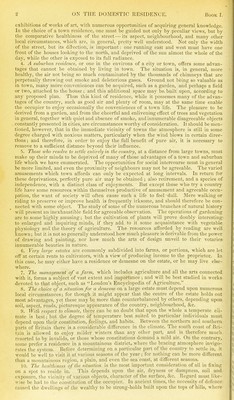
![El^CYCLOP J]DIA OF DOMESTIC ECONOMY BOOK I. ON THE DOMESTIC RESIDENCE. CHAPTER I. CHOICE OF A SITUATION. TOne of the first objects ■which usually engage the attention of those who are just setting ^50Ut in life, and on the eve of forming a domestic establishment, is the acquisition of a ddwelling. In England it is generally the desire of every one whose finances can afi'ord iiit, to have a house of his own. In other countries, even wealthy families are often con- ''tented to occupy a part of a large mansion ; but this practice is inconsistent with those views 'Of domestic comfort which an Englishman looks forward to at his own fireside, where he nmay plan his arrangements of a permanent nature without molestation. This feeling is ppeculiarly characteristic of England; and the anticipation of these domestic pleasures is iiperhaps one of the strongest inducements to those exertions of industiy which are not -surpassed in any other part of the world. The great improvements which have been nmade of late in the interior of our houses are in a great measure the result of this national :rtaste. 1. The primary consideration in the choice of a residence is generally the situation; and I the next is the suitableness of the building to the wants of the family that is to inhabit it. lit is not always the good fortune of those who are desirous of possessing a house of their lown to meet with one that will suit them in every respect, and more particularly when 'they have limited themselves to a particular locality. A house already built may stand in need of some repair — perhaps to be juodemised, or to have additions made to it; and ■where considerable alterations are required, it may be a question, which is too seldom asked, whether it would not be better to build a new one : for it happens not unfrequently 'that from one alteration giving rise to another, the expense of these at last exceeds the cost of a new house. To make a judicious choice of a residence, it is therefore necessary that the intended occupier should not only well consider his principal wants, but under- stand all the essential points to be attetided to in supplying them. An improper choice •is often very difficulfto remedy, and may destroy nuich of the comfort that was antici- rpatcd. To supply the requisite information on tliis subject will therefore be our first endeavour. 2. The situation of a domestic residence may be conveniently reduced to three classes — that of a town, suburban, and a country house; each of which has its peculiar advantages. •3. A residence in town is superior to any other for social intercourse and varied enjoyment by means of public and private parties, theatres, concerts, balls, public libraries, museums, B](https://iiif.wellcomecollection.org/image/b21471708_0023.jp2/full/800%2C/0/default.jpg)


 No text description is available for this image
 No text description is available for this image
 No text description is available for this image