Licence: In copyright
Credit: Australian insects / by Walter W. Froggatt. Source: Wellcome Collection.
124/626
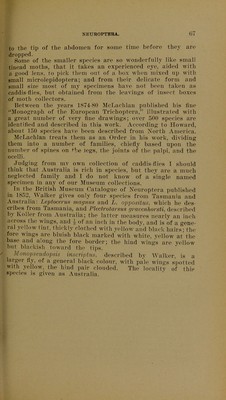
![green fading into yellow after death; the large golden eyes are so bright that they can be seen through the cocoon some time before it emerges. .The Brown Lace Wing, Micromus australis, is common among dead bushes, and also in summer in orange orchards; it is much smaller than the last, only slightly over 14 °f au in°h across the expanded wings; is of a general light brown colour mottled all over the wings with darker tints. The broad head is furnished with large bronzy eyes, and slender hairy antennae composed of 44 very short annular joints. Both the slender, brown, ferret-like larvae and the perfect insects are very active little creatures, always on the move. This species was described by me in the Agricultural Gazette N.S. Wales, 1904. Family 7. Caddis Flies. TRICHOPTERA. The larval forms of these interesting little creatures are common in our creeks and waterholes, encased in their cocoons or sacks formed of silken strands covered with bits of sticks, leaves, sand or small stones; they may be often noticed floating on the surface or crawling about under the water among the weeds and mud. These are protective coverings, for though the head and front of the thorax, that are projected in front when the larva is moving along, are hard and leathery, the abdominal segments are covered with a thin integument, and would soon fall a prey to the many car- nivorous water insects in the ponds if it were not for their case-bearing habits. These cases, unlike those of the terres- trial case moths, are open at both ends, so that the water can How right through when the creature is crawling about. They are known in England as “water moths,” or “caddis- flies,” and are much sought for by anglers as bait for fly fishing. The perfect insects have two pairs of membranous] wings with fewer cross veins than other members of the Neuroptera; the hind pair are broadest and folded when at rest; most of them are clothed with fine hairs instead of scales. The head is small, with very long, slender, thread- like antennae composed of many short indistinct joints, and the biting mouth is rudimentary; the prothorax is short, with an elongate body rounded at the extremity; and the legs are well developed, and more or less provided with spines. The female deposits her eggs, enveloped in a gelatinous mass, in the water, often carrying them about with her attached](https://iiif.wellcomecollection.org/image/b28104535_0126.jp2/full/800%2C/0/default.jpg)
 No text description is available for this image
 No text description is available for this image
 No text description is available for this image