Text-book of the embryology of man and mammals / by Oscar Hertwig ; translated from the third German edition by Edward L. Mark.
- Oscar Hertwig
- Date:
- 1892
Licence: Public Domain Mark
Credit: Text-book of the embryology of man and mammals / by Oscar Hertwig ; translated from the third German edition by Edward L. Mark. Source: Wellcome Collection.
Provider: This material has been provided by The University of Leeds Library. The original may be consulted at The University of Leeds Library.
51/700 page 31
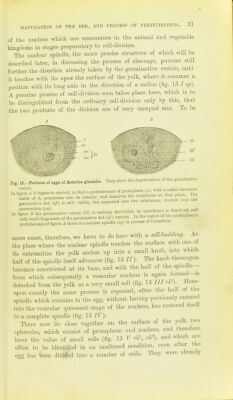
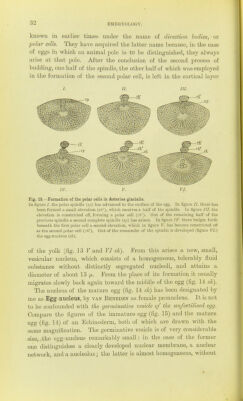
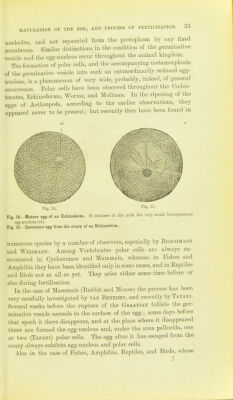
![of the nucleus which one encounters in the animal and vegetable kingdoms in stages preparatory to cell-division. The nuclear spindle, the more precise structure of which will be described later, in discussing the process of cleavage, pvu-sues stUl further.the cUrection ah-eady taken by the germinative vesicle, unti it touches with its apex the surface of the yolk, where it assumes a position with its long axis in the dii-ection of a radius (fig. 13 / s])). A genuine process of cell-division soon takes place here, which is to be^'cUstinguished from the ordinary cell-division only by this, that the two products of the division are of very unequal size. To be X .- kb rig. 12.-Portions of eggs of Asterias glaciaUs. They show the degeneration of the gei-nnnative In ^ it begins to shrivel, in that a protuberance of protoplasm (x), with -adial st™^^^^^ Lde of it, penetrates into its interior, and dissolves the membrane at that po> t The ^ninative dot (i/) is stUl visible, but separated into two substances, nuclem and In fi^rr'tte Sanative vesicle m is entirely shrivelled, its membr,u.e l^^;^;;-^ only sm.dl fragments of the germinative dot (kf) remain. In the i-egion o the piotopLvsmic protuberance of figure A there is a nuclear spindle {sp) in process of formation. more exact, therefore, we have to do here with a cell-budding. At the place where the nuclear spindle touches the sui-face with one of its extremities the yolk arches up into a small knob, into which half of the spindle itself advances (fig. 13 //). The knob thereupon becomes constricted at its base, and with the half of the spmcUe- from which subsequently a vesicular nucleus is again formed—is detached from the yolk as a very small cell (fig. 13 /// rk^)- Here- xvpon exactly the same process is repeated, after the half of the spindle which remains in the egg, without having previously entered into the vesicular quiescent stage of the nucleus, has restored itself to a complete spindle (fig.. 13 IV). There now lie close together on the surface of the yolk two spherules, which consist of protoplasm and nucleus, and therefore have the value of small cells (fig. 13 V rk\ rP), and which are often to be identified in an unaltered condition, even after the egg has been divided into a number of cells. They were already](https://iiif.wellcomecollection.org/image/b21505731_0053.jp2/full/800%2C/0/default.jpg)
 No text description is available for this image
 No text description is available for this image
 No text description is available for this image