Text-book of the embryology of man and mammals / by Oscar Hertwig ; translated from the third German edition by Edward L. Mark.
- Oscar Hertwig
- Date:
- 1892
Licence: Public Domain Mark
Credit: Text-book of the embryology of man and mammals / by Oscar Hertwig ; translated from the third German edition by Edward L. Mark. Source: Wellcome Collection.
Provider: This material has been provided by The University of Leeds Library. The original may be consulted at The University of Leeds Library.
75/700 page 55
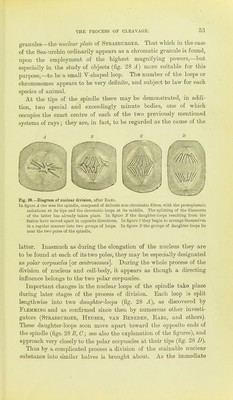
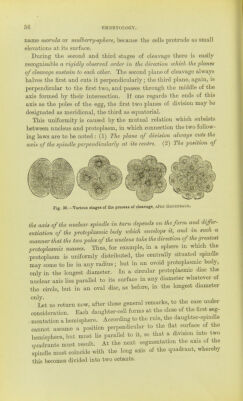
![spermatic nucleus remain for a time separate, even after they have approached each other. After a brief period of rest both of them begin to exhibit simultaneously the changes which precede the for- mation of the nuclear spindle. In each the chromatic substance is metamorphosed into a fine thread, which is arranged within the nuclear membrane in numerous windings. Each filament is there- upon divided into two equally large coUed loops, the chromosomes (fig. 25 ch). Now the two vesicular nuclei lose their delimitation from the surrounding yolk, in which there arise at a little distance from each other two polar corpuscles [centrosomes], surrounded by a system of rays, which is at first faint, but subsequently becomes more distinct. Between the two centrosomes, the method of whose development no one has as yet succeeded in observing, there are formed spindle-fibres, and the four loops (chromosomes), set free by the dissolution of the two nuclear membranes, so arrange themselves that they lie upon the outside of the spindle at its equator. In the case of the egg of the Maw-worm, therefore, the union of the two sexual nuclei, which terminates the act of fertilisation, takes place only at the time of the metamorphosis to form the cleavage- spindle, in which metamorphosis they take an equal share. In conse- quence of this remarkable deviation from the ordinary course of the process of fertilisation, van Beneden has been able to establish the interesting and important fact that half of the chromosomes of the first cleavage-spindle are derived from the egg-nucleus, and half from the spermatic nucleus, and that consequently they may be distin- guished as female and male chromosomes. Since in this instance, just as in nuclear division ordinarily, the four loops are split lengthwise and then move apart toward the two polar corpuscles (centrosomes), there are formed two groups of four daughter-loops each, of which two are of male origin and two of female. Each group is then meta- morphosed into the qioiescent nucleus of the daughter-cell. This furnishes incontestable proof, that to each daughter-nucleus in each half of the egg, which arises as the result of the first cleavage, there is transmitted exactly the same amount of chromatic substance from the egg-nucleus as from the spermatic nucleus. The first division is followed after a brief period of rest by the*- second, this by the third, the fourth, etc., during wlaich are repeated the same series of changes in nucleus and protoplasm that have just been described. Thus in quick succession the 2 first daughter-cells are divided into 4, these into 8, 16, 32, 64, etc. (fig. 30), until there has resulted a large spheroidal mass, which has received the](https://iiif.wellcomecollection.org/image/b21505731_0077.jp2/full/800%2C/0/default.jpg)


 No text description is available for this image
 No text description is available for this image
 No text description is available for this image