Twelve lectures on comparative embryology : delivered before the Lowell Institute, in Boston, December and January, 1848-9 / by Louis Agassiz ... Phonographic report, by James W. Stone ... Originally reported and published in the Boston Daily Evening Traveller.
- Louis Agassiz
- Date:
- 1849
Licence: Public Domain Mark
Credit: Twelve lectures on comparative embryology : delivered before the Lowell Institute, in Boston, December and January, 1848-9 / by Louis Agassiz ... Phonographic report, by James W. Stone ... Originally reported and published in the Boston Daily Evening Traveller. Source: Wellcome Collection.
100/116 (page 94)
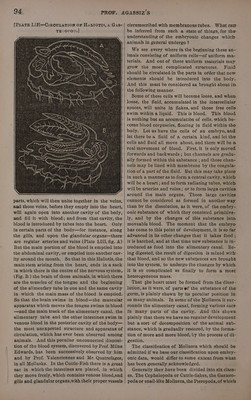
![g4 [PLATE LIFI—CirovuLtaTion OF HabtorTts, A GAse TEROPOD.] blood is introdueed by tubes into the heart. Only in certain parts of the body—for instance, along the gills, and upon the glandular organs—there are regular arteries and veins (Plate LIIE, fig. A) But the main portion of the blood is emptied into the abdominal cavity, or emptied into another cav- ity aroundthe mouth. So that in this Haliotis, the mainstem arising from the heart, ends in a sack in which there is the centre of the nervous system, (Fig. B.) the brain of these animals, in which there are the muscles of the tongue and the beginning of the alimenfary tube in one and the same cavity in which the main mass of the blood is emptied. So that the brainswims in blood—the museular apparatus which moves the tongue swims in blood —and the main track of the alimentary canal, the alimentary tube and the other intestines swim in venous blood in the posterior cavity of the body— the most unexpected structure and apparatus of circulation, which has ever been observed among animals. And this peculiar unconnected disposi- tion of the blood system, discovered by Prof. Milne Edwards, has been successively observed by him and by Prof. Valenciennes and Mr. Quatrefages, in all Mollusks. In the Cuttle-Fish there is a great sac in which the intestines are placed, in which they move freely, which contains venous blood,and gills and glandular organs,with their proper vessels / circumscribed with membranous tudes. What car be inferred from such a state of things, for the understanding of the embryonic changes which animals in general undergo ? We see every where in the beginning these an- imals consisting of uniform cells—of uniform ma- terials. And outof these uniform materials may grow the most complicated structures. Fluidé should be circulated in the parts in order that new elements should be introduced into the body. And this must be considered as brought about im the following manner. Some of these cells will become loose, and whem loose, the fluid, accumulated in the intereellular spaces, will unite in flakes, and those free cells swim within a liquid. This is blood. This blood is nothing bet an accumulation of cells, which be- come blood corpuscles, floating in fluid within the body. Let us have the cells of an embryo, and let there be a fluid of a certain kind, and let the cells and fluid all move about, and there will be a real movement of blood. First, it is only moved forwards and backwards ; but channels are gradu- ally formed within the substance ; and those chan- nels may be lined with membrane by the coagula- tion of a part of the fluid. But this may take place in such a manner as to form a central cavity, which will be a heart ; and to form radiating tubes, which will be arteries and veins; or to form large cavities around the main organs. Those large cavities cannot be considered as formed in another way than by the dissolution, as it were, of the embry- onic substance of which they consisted .primitive- ly. and by the changes of this substance into moveable blood. The moment that the embryo has come to this point of development, it is so far advanced in its other changes that it takes food ; it is hatched, and at that time new substance is in- troduced as food into the alimentary canal. Be- ing digested, the result of digestion is mixed with - that blood, and so the new sabstances are brought into the system, to undergo the changes by which it is so complicated as finally to form a most heterogeneous mass. That the heart must be formed from the disso- lution, as it were, of parts @f the substance of the germ, is plainly shown by its peculiar position in so many animals. In some of the Mollusca it sur- rounds the alimentary canal, forming various sacs in many parts of the cavity. And this sbows plainly that there we have no regular development but asort of decomposition of the animal sab- stance, which is gradually restored, by the forma- tion of more and more blood, by the process of di- gestion. The classification of Mollusca which should be admitted if we base our classification upon embry- onic data, would differ to some extent from what has been generally acknowledged. Generally they baye been divided into six class- es. The Cephalopoda or Cuttle-fishes, the Gastero- poda or snail-like Mollusca, the Pteropoda, of which](https://iiif.wellcomecollection.org/image/b33278982_0100.jp2/full/800%2C/0/default.jpg)