Twelve lectures on comparative embryology : delivered before the Lowell Institute, in Boston, December and January, 1848-9 / by Louis Agassiz ... Phonographic report, by James W. Stone ... Originally reported and published in the Boston Daily Evening Traveller.
- Louis Agassiz
- Date:
- 1849
Licence: Public Domain Mark
Credit: Twelve lectures on comparative embryology : delivered before the Lowell Institute, in Boston, December and January, 1848-9 / by Louis Agassiz ... Phonographic report, by James W. Stone ... Originally reported and published in the Boston Daily Evening Traveller. Source: Wellcome Collection.
103/116 page 97
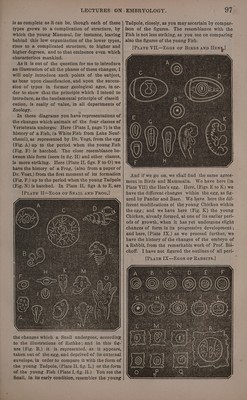
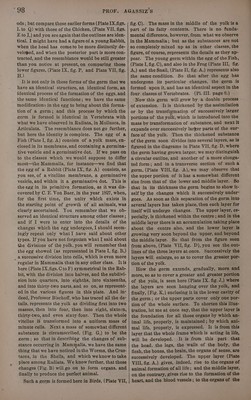
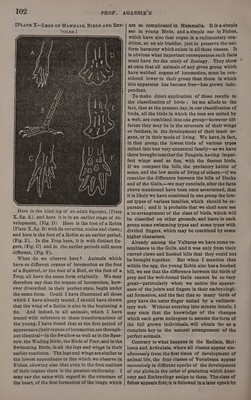
![is as complete as it can be, though each of these types grows to a complication of structure, by which the young Mammal, for instance, leaving behind this low organization of the lower types, rises to a complicated structure, to higher and higher degrees, and to that eminence even which characterizes mankind. an illustration of all the phases of these changes, I will only introduce such points of the subject, as bear upon classification, and upon the succes- sion of types in former geological ages, in or- der to show that the principle which I intend to introduce, as the fundamental principle of classifi cation, is really of value, in all departments of Zoology. ‘ In these diagrams you have representations of the changes which animals of the four classes of Vertebrata undergo/ Here (Plate I, page 7) is the history of a Fish, (a White Fish from Lake Neuf- chatel), as represented by Dr. Vogt, from the egg (Fig. A) up to the period when the young Fish (Fig. F) is hatched. The close resemblance be- tween this form (seen in fig. H) and other classes, is more striking. Here (Plate II, figs. F to 0) we have the history of a Frog, (also from a paper of Dr. Vogt,) from the first moment of its formation (Fig. F,) up to the period when the young Tadpole (Fig. N) is hatched. In Plate II, figs A to KE, are the changes which a Snail undergoes, according to the illustrations of Rathke; and in this fig- ure (Fig. B,) it is represented, as it appears, taken out of the egg, and deprived of its external envelope, in order to compare it with the form of the young Tadpole, (Plate II, fig. L,) or the form of the young Fish (Plate I, fig. H.) You see the Snail, in its early condition, resembles the young 97 Tadpole, closely, as you may ascertain by compar- ison of the figures. The resemblance with the And if we go on, we shall find the same agree- ment in Birds and Mammalia. We have here (in Plate VII) the Hen’s egg. Here, (Figs. E to K) we ured by Pander and Baer. We have here the dif- ferent modifications of the young Chicken within theegg; and we have here (Fig. K) the young Chicken, already formed, at one of its earlier peri- ods of growth, when it has yet undergone slight changes of form inits progressive development ; and here, (Plate IX,) as we proceed further, we have the history of the changes of the embryo of a Rabbit, from the remarkable work of Prof. Bis- choff. I have not figured the outlines of all peri- [PLatE IX—Eces or RaBBiTs.]](https://iiif.wellcomecollection.org/image/b33278982_0103.jp2/full/800%2C/0/default.jpg)