Twelve lectures on comparative embryology : delivered before the Lowell Institute, in Boston, December and January, 1848-9 / by Louis Agassiz ... Phonographic report, by James W. Stone ... Originally reported and published in the Boston Daily Evening Traveller.
- Louis Agassiz
- Date:
- 1849
Licence: Public Domain Mark
Credit: Twelve lectures on comparative embryology : delivered before the Lowell Institute, in Boston, December and January, 1848-9 / by Louis Agassiz ... Phonographic report, by James W. Stone ... Originally reported and published in the Boston Daily Evening Traveller. Source: Wellcome Collection.
106/116 page 100
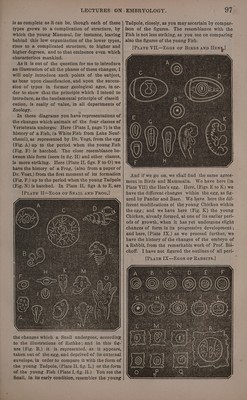
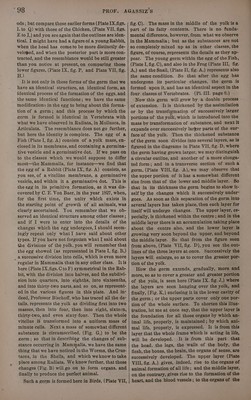
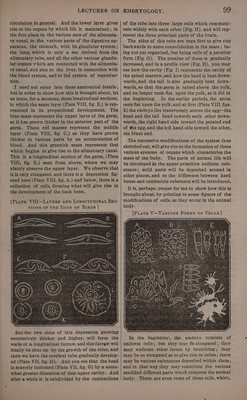
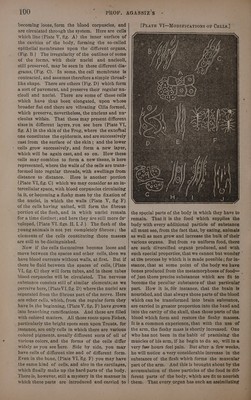
![becoming loose, form the blood corpuscles, and are circulated through the system. Here are cells which line (Plate V, fig. A) the inner surface of the cavities of the body, forming the so-called epithelial membranes upon the different organs, (Fig. B.) The irregularity of the outlines of some of the forms, with their nuclei and nucleoli, still preserved, may be seen in these different dia- grams, (Fig. C}). In some, the cell membrane is contracted, and assumes therefore asimple thread- like shape. There are others (Fig. D) which form a sort of pavement, and preserve their regular nu- cleoli and nuclei. There are some of these cells which have thus been elongated, upon whose broader flat end there are vibrating Cilia formed, which preserve, nevertheless, the nucleus and nu- cleolus within. That these may present different sizesin different layers, you see here (Plate VI, fig. A) in the skin of the Frog, where the external one constitutes the epidermis, and are successively cast from the surface of the skin; and the lower cells grow successively, and form a new layer, which will be again cast,and so on. How these cells may combine to form a new tissue, is here represented, where the walls of the cells are trans- formed inte regular threads, with swellings from distance to distance. Here is another portion (Plate VI, fig. C} which we may consider as an in- tercellular space, with blood corpuscles circulating in it, or becoming a fleshy mass by the fixation of the nuclei, in which the walls (Plate V, fig. F) of the cells having united, will form the fibrous portion of the flesh, and in which nuclei remain for a time distinct; and here they are still more de* veloped, {Plate VI, figs. H, I, J.) The flesh of the young animals is not yet completely fibrous; the elements of the cells constituting those masses are still to be distinguished. Now if the cells themselves become loose and move between the spaces and other cells, then we have blood currents without walls, at first. But if there be fluid between the spaces of cells, (Plate VI, fig. C) they will form tubes, and in these tubes dlood corpuscles will be circulated. The nervous substance consists still of similar elements,\as we perceive here, (Plate Vi, fig. D) where the nuclei are separated from the fibrous part of the nerve. Here are Other cells, which, from the regular form they have in the beginning, (Plate V, fig. F) have grown into branching ramifications. And these are filled with colored matters. All those spots upon Fishes, particularly the bright spots seen upon Trouts, for instance, are only cells in which there are various colored pigments, usually different sorts of oil of various colors,and the forms of the cells differ widely as you see here. Side by side, you may have cells of different size and of different form. Even in the bone, (Plate VI, fig. F) you may have the same kind of cells, and also in the cartilages, which finally make up the hard parts of the body, There is, however, still a mystery in the manner in which these parts are introduced and carried to [PLrate VI—Mopi#ications of Cretts.] various organs. But from so uniform food, there are such diversified organs produced, and with such special properties, that we cannot but wonder — at the process by which it is made possible; for in« stance, that at some point of the body we have bones produced from the metamorphoses of food= _ of just those precise substances which are fit to — become the peculiar substance of that particular part. How it is,for instance, that the brain is nourished, and that always those parts of the blood which can be transformed into brain substance, are carried in greater proportion into the head and into the cavity of the skull, than those parts of the blood which form and restore the fleshy masses. It is a common experience, that with the use of the arm, the fleshy mass is shortly increased. One who has not been in the habit of practising the muscles of his arm, if he begin to do so, willina very few hours feel pain. But after a few weeks, he will notice a very considerable increase in the substance of the flesh which forms the muscular part of the arm. And this is brought about by the accumulation of those particles of the food in dif ferent parts of the body, which are fit to nourish them. That every organ has such an assimilating](https://iiif.wellcomecollection.org/image/b33278982_0106.jp2/full/800%2C/0/default.jpg)