Twelve lectures on comparative embryology : delivered before the Lowell Institute, in Boston, December and January, 1848-9 / by Louis Agassiz ... Phonographic report, by James W. Stone ... Originally reported and published in the Boston Daily Evening Traveller.
- Louis Agassiz
- Date:
- 1849
Licence: Public Domain Mark
Credit: Twelve lectures on comparative embryology : delivered before the Lowell Institute, in Boston, December and January, 1848-9 / by Louis Agassiz ... Phonographic report, by James W. Stone ... Originally reported and published in the Boston Daily Evening Traveller. Source: Wellcome Collection.
109/116 page 103
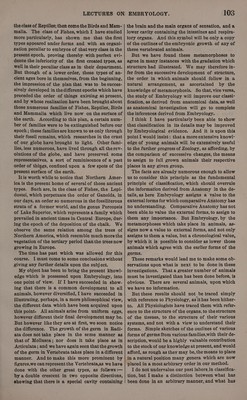
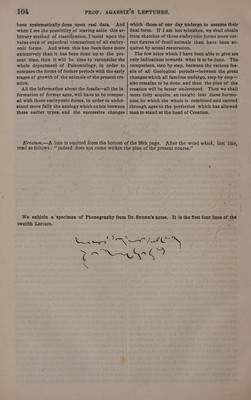
![the class of Reptiles; then come the Birds and Mam- malia. The class of Fishes, which I have studied more particularly, has shown me that the first types appeared under forms and with an organi- zation peculiar to embryos of that very class in the present epoch, proving thereby with perfect evi- dence the inferiority of the first created types, as well in their peculiar class as in their department. But though of a Jower order, these types of an- cient ages bore in themselves, from the beginning, the impression of the plan that was to be succes- sively developed in the different epochs which have preceded the order of things existing at present, and by whose realization have been brought about those numerous families of Fishes, Reptiles, Birds and Mammalia which live now on the surface of the earth. According to this plan, a certain num- ber of families were to be extinguished before our epoch ; these families are known to us only through their fossil remains, which researches in the crust of our globe have brought to light. Other fami- lies, less numerous, have lived through all the rev- Olutions of the globe, and have preserved some representatives, a sort of reminiscence of a past order of things, confined upon a few spots of the present surface of the earth. Itis worth while to notice that Northern Amer- ica is the present home of several of those ancient types. Such are, in the class of Fishes, the Lepi- dostei, which perpetuate the order of Ganoids, in our days, an order so numerous in the fossiliferous strata of a former world, andthe genus Percopsis of Lake Superior, which represents a family which prevailed in ancient times in Central Europe, dur- ing the epoch of the deposition of the chalk. We observe the same relation among the trees of Northern America, which resemble much more the vegetation of the tertiary period than the trees now growing in Europe. The time has past which was allowed for this course. I must come to some conclusions without giving any further details upon the subject. My object has been to bring the present know]l- edge which is possessed upon Embryology, into one point of view. If I have succeeded in show- ing that there is a common development to all animals, however diversified, I have succeeded in illustrating, perhaps, in a more philosophical view, the different data which have been acquired upon this point. Allanimals arise from uniform eggs, however different their final development may be. But however like they are at first, we soon notice the difference. The growth of the germ in Radi- ata does not take place in the same manner as that of Mollusca; nor does it take place as in Articulata; and we have again seen that the growth of the germ in Vertebrata takes place in a different manner. Andtomake this more prominent by figures,we can represent the Vertebrata,as we have done with the other great types, as follews :— by a double crescent in two opposite directions, showing that there is a special cavity containing the brain and the main organs of sensation, and a lower cavity containing the intestines and respira- tory organs. And this symbol will be only a copy of the outlines of the embryonic growth of any of these vertebrated animals. But we have found these metamorphoses to agree in many instances with the gradation which structure had illustrated. We may therefore in- fer from the successive development of structure, the order in which animals should follow in a natural arrangement, as ascertained by the knowledge of metamorphosis. So that, vice versa, the study of Embryology will improve our classi- fication, as derived from anatomical data, as well as anatomical investigation will go to complete the inferences derived from Embryology. I think I have particularly been able to show that classification in its details may be improved by Embryological evidence. And it is upon this point I would insist: that a more extensive knowl- edge of young animals will be extensively useful ° to the further progress of Zoology, as affording, by the comparison of successive changes, the means to assign to full grown animals their respective places in any given group. The facts are already numerous enough to allow us to consider this principle as the fundamental principle of classification, which should overrule the information derived from Anatomy in the de- tails, as here Embryology assigns a value to the external forms for which comparative Anatomy has no understanding. Comparative Anatomy has not been able.to value the external forms, to assign to them any importance. But Embryology, by the metamorphoses which take place in animals, as- signs now a value to external forms, and not only assigns to them a value, but a chronological value, by which it is possible to consider as lower those animals which agree with the earlier forms of the germs. These remarks would lead me to make some ob- servations upon whatis next to be done in these investigations. That a greater number of animals must be investigated than has been done before, is obvious. There are several animals, upon which we have no information. But these results should not be traced simply with reference to Physiology, as it has been hither- to. All Physiologists have traced them with refer- ence to the structure of the organs, to the structure of the tissues, to the structure of their various systems, and not with a view to understand their forms. Simple sketches of the outlines of various forms of germs from various families,with their de< scription, would be a highly valuable contribution to the stock of our knowledge at present, and would afford, as rough as they may be, the means to place in a natural position many genera which are now placed in a most arbitrary order in our method. I do not undervalue our past labors in classifica- tion, but I make a distinction between what has been done in an arbitrary manner, and what has](https://iiif.wellcomecollection.org/image/b33278982_0109.jp2/full/800%2C/0/default.jpg)