Twelve lectures on comparative embryology : delivered before the Lowell Institute, in Boston, December and January, 1848-9 / by Louis Agassiz ... Phonographic report, by James W. Stone ... Originally reported and published in the Boston Daily Evening Traveller.
- Louis Agassiz
- Date:
- 1849
Licence: Public Domain Mark
Credit: Twelve lectures on comparative embryology : delivered before the Lowell Institute, in Boston, December and January, 1848-9 / by Louis Agassiz ... Phonographic report, by James W. Stone ... Originally reported and published in the Boston Daily Evening Traveller. Source: Wellcome Collection.
13/116 (page 7)
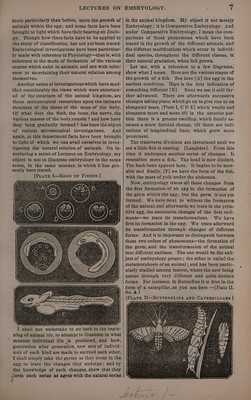
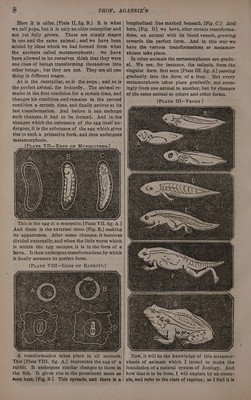
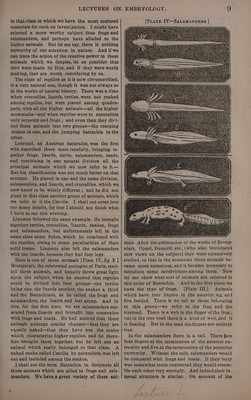
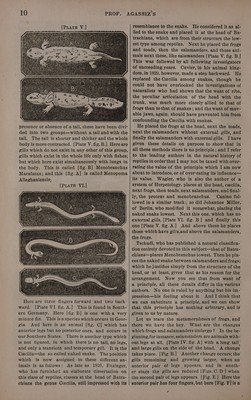
![more particularly than before, upon the growth of animals within the egg; and some facts have been brought to light which have their bearing on Zoolo- gy. Though how these facts have to be applied to the study of classification, has not yet been traced. Embryological investigations have been particular- ly made with reference to Physiology—that is, with reference to the mode of formation of the various organs which exist in animals, and not with refer- ence to ascertaining their natural relation among themselves. ‘ Another series of investigations which have mod- ified considerably the views which were entertain- ed of the structure of the animal kingdom, are those microscopical researches upon the intimate structure of the tissue of the mass of the body. Of what does the flesh, the bone, the nerve, the various masses of the body,consist ¢ and how have they been gradually formed ? has been the object of various microscopical investigations. And again, in this department facts have been brought to light of which we can avail ourselves in inves- tigating the natural relation of animals. On in- troducing a series of Lectnres on Embryology, my ebject is not to illustrate embryologv in the same sense, in the same manner, in which it has gen- erally been traced. {Pirate I—EcGeés or FisneEs.] I shall not undertake to go back to the begin- ning of animal life, to attempt to illustrate in what manner individual life js produced, and how, generation after generation, new sets of individ- uals of each kind are made to succeed each other. I shall simply take the germs as they occur in the egg,to trace the changes they undergo; and by the knowledge of such changes, show that they i such series as agree with the natural series in the animal kingdom. My object is not merely Embryology; it is Comparative Embryology. And under Comparative Embryology, i mean the com- parisons of those phenomena which have been traced in the growth of the different animals, and the different modifications which occur in individ- dual species, throughout the different classes, in their natural gradation, when full grown. Let me, with a reference to a few diagrams, show whatI mean. Hereare the various stages of the growth of a fish. See here [A] the egg in the earliest condition. Here is the first indication of something different [Bj]. Next we see it still fur- ther advanced. There are afterwards successive changes taking place, which go on to give rise to an elongated mass, | Plate 1, C D E} which “swells and elongates more and more till in the anterior por- tion there is a greater swelling, which finally as- sumes a more decided change, till there are indi- cations of longitudinal lines, which grow more prominent. The transverse divisions are introduced until we see alittle fish is coming. [Laughter]. From this time it undergoes another series of changes. It resembles more a fish. The head is now distinct. The back bone appears here. It begins to be mov- able and finally, [F] we have the form of the fish, with the mass of yolk under the abdomen. Now, embryology traces all these changes from the first formation of an egg to the formation of the germ within the egg; but the germ is not yet formed. We have next to witness the formation of the animal; and afterwards we trace in the prim- itive egg, the successive changes of the first rudi- ments—we trace its transformations. We have first its formation in the ege. We trace afterward its transformation through changes of different forms. And it is important to distinguish between these two orders of phenomena—the formation of the germ, and the transformation of the animal into different outlines. The one would be the sub- ject of embryology proper; the other is called the EMBRYOLOGY. ularly studied among insects, where the new being passes through very different and quite distinct forms. For instance, in Butterflies it is first in the form of a caterpillar, as you see here :—[Plate II. fig. Aj [PLATE II—BUTTERFLIFS AND CATERPILLARS J](https://iiif.wellcomecollection.org/image/b33278982_0013.jp2/full/800%2C/0/default.jpg)