Twelve lectures on comparative embryology : delivered before the Lowell Institute, in Boston, December and January, 1848-9 / by Louis Agassiz ... Phonographic report, by James W. Stone ... Originally reported and published in the Boston Daily Evening Traveller.
- Louis Agassiz
- Date:
- 1849
Licence: Public Domain Mark
Credit: Twelve lectures on comparative embryology : delivered before the Lowell Institute, in Boston, December and January, 1848-9 / by Louis Agassiz ... Phonographic report, by James W. Stone ... Originally reported and published in the Boston Daily Evening Traveller. Source: Wellcome Collection.
16/116 (page 10)
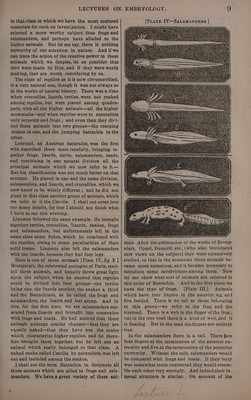
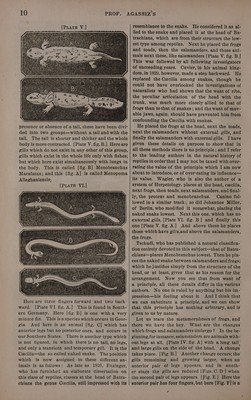
![Fst presence or absence of a tail, these have been divi- ded into two groups—without a tail and with the tail. The tail is shorter and thicker and the whole body is more contracted. [Plate V. fig. B.] Here are gills which do not exist in any other of this group, gills which exist in the whole life only with fishes; but which here exist simultaneously with lungs in the body. This is called [fig. B] Menobranchus Maculatus; and this [fig. A] is called Menopoma Alleghaniensis; Here are three fingers forward and two back- ward. [Plate VI. fig. A.] This is found in South- ern Germany. Here [fig. B] is one witha very minate fin. This isa species which occurs in Geor- gia. And here is an animal [fig. C] which has anterior legs but no posterior ones, and occurs in our Southern States. There is another type which is not tigured, in which there is no tail, no legs, and only a transient and temporary gill. It ig the Cexcilia—the so called naked snake. The position which is now assigned to these different an- imals is as follows: As late as 1826, Fitzinger, who has furnished an elaborate dissertation on this class of reptiles, classes at the head of Batra- chians the genus Coecilia, still impressed with its resemblance to the snake. He considered it as al- lied to the snake and placed it at the head of Ba- trachians, which are from their structure the low- est type among reptiles. Next he placed the frogs and toads, then the salamanders, and those ani- mals next these, like salamanders [Plate V. fig. B.] This was followed by all following investigators of succeeding years. Cuvier, in his animal king- dom, in 1829, however, made a step backward. He replaced the Cecilia among snakes, though he could not have overlooked the investigations of naturalists who had shown that the want of ribs, the peculiar articulation of the head with the trunk, was much more closely allied to that of frogs than to that of snakes ; and the want of mov- able jaws, again, should have prevented him from confounding the Cecilia with snakes. He placed the frogs at the head, next the toads, next the salamanders without external gills, and finally the salamanders with external gills. I have given these details on purpose to show that in all these methods there is no principle ; and I refer to the leading authors in the natural history of reptiles in order that I may not be taxed with over- rating the value of the principle which I am now about to introduce, or of over-rating its influence— its value. Wagler, who is also the author of a system of Herpetology, places at the head, cecilia, next frogs, then toads, next salamanders, and final- ly, the proteus and menobranchus. Canino fol- lowed in a similar track; so did Johannes Miller, of Berlin, who modified it somewhat, placing the naked snake lowest. Next this one, which has no external gills, [Plate VI. fig. B] and finally this those which have gilis,and above the salamanders, the frogs. Tschudi, who has published a natural classifica- tion entirely devoted to this subject—that of Batra- chians—places Menobranchus lowest. Then he pla- ces the naked snake between salamanders and frogs; which he justifies simply from the structure of the head, or at least, gives that as his reason for the arrangement. Now you see that from want of a principle, all these details differ in the various authors. No one is ruled by anything but his im- pression—his feeling about it. And I think that we can substitute a principle, and we can show that this principle has nothing arbitrary, and is given to us by nature. Let us trace the metamorphoses of frogs, and there we have the key. What are the changes which frogs and salamanders undergo? In the be- ginning,for instance, salamanders are animals with- out legs at all, [Plate IV. fig. A] with a long tail, and large gills on the side of the head. A change takes place. [Fig.B.] Another change occurs; the gills remaining and growing larger, when an auterior pair of legs appears, and in anoth- er stage the gills are reduced |Figs.C. D } when the second pair of legs appears. [Fig. E.] Here the anterior pair has four fingers, but here [Fig. F]is a ¢](https://iiif.wellcomecollection.org/image/b33278982_0016.jp2/full/800%2C/0/default.jpg)