Twelve lectures on comparative embryology : delivered before the Lowell Institute, in Boston, December and January, 1848-9 / by Louis Agassiz ... Phonographic report, by James W. Stone ... Originally reported and published in the Boston Daily Evening Traveller.
- Louis Agassiz
- Date:
- 1849
Licence: Public Domain Mark
Credit: Twelve lectures on comparative embryology : delivered before the Lowell Institute, in Boston, December and January, 1848-9 / by Louis Agassiz ... Phonographic report, by James W. Stone ... Originally reported and published in the Boston Daily Evening Traveller. Source: Wellcome Collection.
20/116 (page 14)
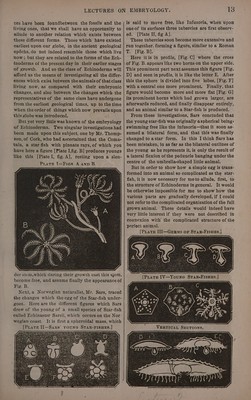
![These figures [Plates III and EV] represent the changes which I have observed in a species of Star-fish from Boston harbor, from its first forma- tion in the egg up to its perfect condition ; though I have not been able to trace it to the full size to which it grows on these shores. Sars has not been able to ascertain the internal structure of the Star-fish, because the species which he observed was too opaque, and did not allow an investigation of the internal parts. The species which I have compared admitted of such an examination, havy- ing more transparent parts, and by a peculiar pro- cess of investigation it has been possible to ob- serve the whole internal structure, the specimens being pressed between two glass plates, when placed under the microseope. Before I allude to all the details represented in plate I[I & IV, let me show from these figures how I conceive that the diagrams of Sars [Plate II] though drawn from nature, give an erroneous im- pression of the animal. It is simply that the pe- duncle hanging from the centre of the discoid or spherical body being laid flat upon a glass plate, and perhaps pressed it on the glass, for the mi- croscope is bent sideways, and thus it is seen as in these figures. But when seen floating, it will be noticed that this peduncle hangs downward, [Plate III, fig, A, B, C, D]. As aclass of animals the Echinoderms agree most remarkably in their structure, though differing most widely in their external forms. We havein the first place elongated forms, somewhat like worms, with a star-shaped extremity, called Ho- lothuriz. [PLraTtE V—HotorTuurti | Here are spherical or spheroidal forms of these animals called Echini or Sea-Urchins, [Plate VI} and finally star-shaped ones, called star-fishes, and among which there are free ones, those which rest on a stem, like lilies, [Plate VII, fig. A. D.] Prats VI{—Sran-Fisnes—Crinorps | ~ These various animals are so widely different that if seems scarcely possible to finda fundamental plan of structure and a uniform arrangement of parts in allofthem. Yet it is so. Conceive for a mo- ment that the fundamental form is a spherical one.. If the sphere is extensively elongated, we have the forma of the Holothuriz, Plate V.; the spheroid form itself may be more or less ovate [Plate- VI.| or angular; or if the corners of these be drawn out, we have a real star-fish. In the cen- tre of some of the circular ones there are plates or prominent knobs on the summit, [Plate LI. fig.. B.] which may form a kind of peduncle above.— Now it is easy to conceive that these growing’ longer will appear in the shape of a longer or shorter stem upon which the animal will move, [Plate VI. fig. A D] balancing itself. So that from these polypi-like forms up to the worm. like forms we have gradual transitions. As the highest among the radiata the echino- derms are more complicated in their structure.— Their external coverings are already more distinct than in any other. In the polypi the skin is close- ly attached to the fleshy mass of the hody. Here](https://iiif.wellcomecollection.org/image/b33278982_0020.jp2/full/800%2C/0/default.jpg)