Twelve lectures on comparative embryology : delivered before the Lowell Institute, in Boston, December and January, 1848-9 / by Louis Agassiz ... Phonographic report, by James W. Stone ... Originally reported and published in the Boston Daily Evening Traveller.
- Louis Agassiz
- Date:
- 1849
Licence: Public Domain Mark
Credit: Twelve lectures on comparative embryology : delivered before the Lowell Institute, in Boston, December and January, 1848-9 / by Louis Agassiz ... Phonographic report, by James W. Stone ... Originally reported and published in the Boston Daily Evening Traveller. Source: Wellcome Collection.
24/116 (page 18)
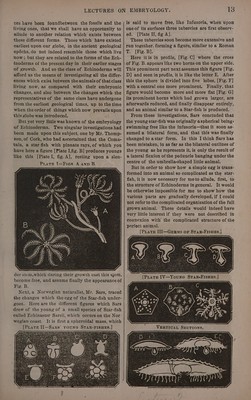
![er types produce their young during winter. But on considering what may be the cause of their eggs being deposited at this season,we can suppose it is owing to the fact, that during this epoch the water is less changeable in its temperature and will admitof a more uniform growth of animal life than during the spring and summer. All animals of low temperature or whose temperature is deep- ly influenced by the surrounding medium, in op- position to the higher organized ones, seem in- deed to develope more naturally during the cold period of the winter, when the possible changes are only slight, undulating about the freezing point, from about the temperature of the greatest density of water te that of the freezing point it- self, that is between 32° and 38°. The limits of va- riation of the temperature of water being so very slight under such circumstances, we can conceive that these low animals are more likely to devel- ope regularly than under the changing influences of spring andsummer; when along the shores the influences are extremely variable and might kill so delicate animals which have no means to main- tain a temperature of their own. In my next lecture, I shall compare these em- bryonic changes with the perfect state of the vari- ous Echinoderms of the present creation, and with the perfect state of the numerous fossils of this class which have been discovered by geologists in the successive deposits of former ages. f have shown, in one instance, the development of the star-fishes, as obseryed on these shores during winter. It was mentioned, that from a spherical form there was gradually a flattened disk, a hanging peduncle, developed, out of which after- wards arose a pentagonal form, which was finally changed into a regular star-fish, with the structure of the full grown animals of that class. These changes have been traced from the beginning of the formation of the germ in the egg, when they are protected by the mother who takes care of them, carrying them about. At no period of this development were the young star-fishes observed Swimming free. There can, however, scarcely be any doubt that the young observed on the Norwe- gian shore were free. The observations of Sars can the less be doubted in that point, as similar moving animals, which were afterwards ascertain- ed to have been the star-fish and other Echino- derms, have been discovered by the investigations of Professor Johannes Muller, of Berlin. This minute and learned investigator described, several years ago, a small animal as a new type in the ani- mal kingdom, which he could not refer to any class, nor to any family. It was a paradoxicon by its form and its peculiarities, and he called it Plu- teus Paradoxus. It is a transparent mass, support- ed by several diverging stitks, surrounding an internal cavity (Pl. XII, A) and moving free upon the surface of the water. I have not dared to have them shaded in my diagrams, in order to increase the distinctness of the forms; and only give these slight outlines as they are figured by Muller. In this condition, that animal is bi-lateral as seen from above. Atthe two extremeties of the longitudi- nal axis, are two appendages; these appendages are the stems which project laterally in Figs. A and B, pl. XII., they being the anterior and poste- rior ends of the longitudinal axis. Between these, you see one shorter pair on one side, and on the other side another pair, which hang lower down, [Pl. XIL., figs. A. B.] These two pairs of appene dages are indeed not equal inlength. One pair on one of the sides hangs lower down than the other pair. Between those six supports, united by a gel- atinous solid mass, there is an inner cavity, as seen in the figures quoted. The side of the longer ends has lateral projections,so that, in fact, there are eight prominent sticks diverging from the sum« mit of this curious being. No further structure was observed in the first year by Mr: Muller. He only ascertained they moved free in all directions, sometimes rising forwards and sometimes revoly- ing in different directions. These movements were performed by vibratory cilia, which are minute fringes extending all around the edges of the frame, and which are also grouped on the summit of the animal: These fringes are microscopic. They form a swollen edge round the whole of these dentations, extend- ing all round the edge of thesestems. (Plate XII, fig. B.) What this being was, could not be ascer- tained. It had been observed in the Northern Sea, in thousands and thousands, and could not be referred to its proper class. Whether it was to be considered a medusa or a polyp, or whether it was the germ of some other animal, could not be ascertained.](https://iiif.wellcomecollection.org/image/b33278982_0024.jp2/full/800%2C/0/default.jpg)