Twelve lectures on comparative embryology : delivered before the Lowell Institute, in Boston, December and January, 1848-9 / by Louis Agassiz ... Phonographic report, by James W. Stone ... Originally reported and published in the Boston Daily Evening Traveller.
- Louis Agassiz
- Date:
- 1849
Licence: Public Domain Mark
Credit: Twelve lectures on comparative embryology : delivered before the Lowell Institute, in Boston, December and January, 1848-9 / by Louis Agassiz ... Phonographic report, by James W. Stone ... Originally reported and published in the Boston Daily Evening Traveller. Source: Wellcome Collection.
31/116 (page 25)
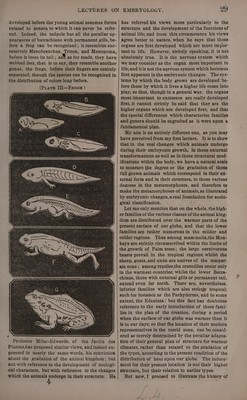
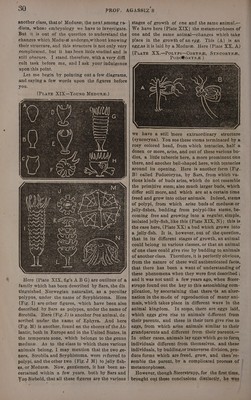
![troducing a natural classification among these an- imals? is a further question which lays in my plan; as these embryonic investigations were trac- ed from the beginning with reference to the classi- fication of the animal kingdom in relation to the order of all types, when compared with the chang- es which embryos undergo. Among Echinoderms the investigation of struc- ture has already settled the classification to this extent,that they have been divided into three fam- ilies, Holothurians,the tubular ones, Plates XIV & V, & V; Echini,the spherical ones, Plate XII; and the Asterians, (Plate VIII,\ the star-shaped ones: but from this general arrangement there is still a con- siderable distance to the perfect fixation of the or- der of succession of genera in all their details. The various arrangements which have been proposed have been influenced by the various states of our knowledge. The improvements in the classifica- tion of Echinoderms have been greatly advanced by the knowledge of the Crinoids, which are universally placed in the lowest rank among those animals, from their Se hiaiee to Polyps. When their structure was ascertained,the knowledge thus acquired, did not modify the position which was assigned to them when not yet sufficiently known. The knowledge of the change in the growth of one Crinoid, the Comatula, has indeed influenced more the classification than the knowledge of their struc- ture. The free star-fishes are placed next to the Echini and above all the Holothuriz. Among Ech- ini we have some in which the mouth is central and the alimentary canal ends onthe margin; and there are others in which the alimentary canal ends on the two extremities of the body, as seen here, (Plate VI fig. B.) thus forming a transition to the worm-like form, they indeed begin to be re- lated to the Holothuriz (Plate XIV) and will rank higher. Structure and embryonic growth have satisfied u8 thus far. But why should we not venture to go fur- ° BD 24008 SOA oh Wat -@ & 1.6 > de .— aie . + ee . —s. | - ™ * ther,and make use of the order of succession of these types, in order to ascertain all their relations ? The Crinoids whieh have been described as fossils, are exceedingly numerous. Here are figured several forms, to which I have not yet alluded. Plate XVII, fig. C, is a genus called Caryoirinus. Here is another, which occurs also in old strata, (Fig. B) called Pentremites; and here (Fig. D) one which oe- curs in deposites of the coal period, called Echino- crinus. In Plate XVII, fig. C, we have a spherical body, like an Echinus,with a stem as in Crinoids, but the plates are not yet ranged in regular rows (Fig. C), but alternate irregularly ; there are not yet rows for the pores distinctly circumscribed, but only at irregular intervals, and few of them. This form, as also the Sphoronites are the most primitive Cri- noids, and they correspond somewhat in structure to the earliest condition which we observe in Echi- ni, and which we observe also inthe youngest stage of the star fish. Here is one (Plate XVII, fig B) in which we have & mere star-fish-like form; the sphere is in its full condition of development ; and here we have one which would seem to be a common sea-urchin, (Fig. D.) But on comparing both (Plate XIII, fig. C) they are found widely different. In Echinus (Plate XIII, fig. C) there are two rows of perfora- ted and two of imperforated plates, while in Echi- nocrinus (Plate XVII, fig. D) there are four rows of imperforated plates, and the animal is really a crinoid, and not a sea-urchin. This (Fig. D) has a stem: that (Plate XIII, fig.C) has not. The Cri- noids are found in ancient geological strata—in the middle geological ages are those of (Plate VII). Free Star-fishes- begin later in the geological for- mations. The Comatulaor free Crinoids are again later (Plate I, fig A). The Echini appear ‘long af- ter the families of Crinoids and free: star-fishes have been introduced upon our globe. We have not yet oneof the spherical Echinoderms before the deposition of the red stone or the Marchalkalk of Germany. And those spherical] Echini or Cida-~ ris are the earliest ones, (Plate VI, figs. D and E.) Next we have such as have a central mouth, and in which the alimentary canal ends laterally. And at a later epoch those which have an elong- ated body (Plate VI. fig. Bs) The first epoch in which elongated Echini appear is in the chalk de- posit. When there was not yet one free starfish, there were only Crinoids on earth. And what sort of Crinoids had we? Not such as already resembled common starfishes (Plate VII.), but which resem- bled the lowest stage of growth of these animals, when they are still without arms (Plate XI. fig. E.) with irregular arrangement of their plates (Plate XVII. fig.C.) Next we have such which assume are stilll Crinoids resting on stems with few irregu- lar plates, but in which holes are arranged in a re- gular star above. And next we have Echinocrinus,](https://iiif.wellcomecollection.org/image/b33278982_0031.jp2/full/800%2C/0/default.jpg)