Twelve lectures on comparative embryology : delivered before the Lowell Institute, in Boston, December and January, 1848-9 / by Louis Agassiz ... Phonographic report, by James W. Stone ... Originally reported and published in the Boston Daily Evening Traveller.
- Louis Agassiz
- Date:
- 1849
Licence: Public Domain Mark
Credit: Twelve lectures on comparative embryology : delivered before the Lowell Institute, in Boston, December and January, 1848-9 / by Louis Agassiz ... Phonographic report, by James W. Stone ... Originally reported and published in the Boston Daily Evening Traveller. Source: Wellcome Collection.
37/116 (page 31)
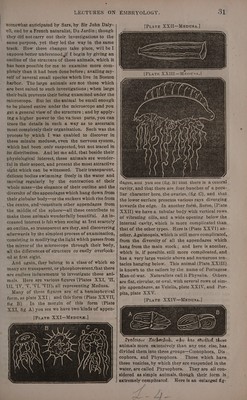
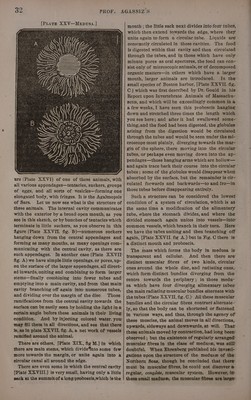
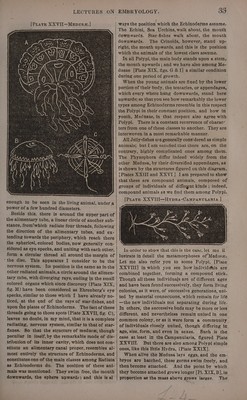
![s somewhat anticipated by Sars, by Sir John Daly- eli, and by a French naturalist, Da Jardin; though they did notcarry out their investigations to the same purpose, yet they led the wayin the same track. How these changes take place, will be I suppose better understood if I begin by giving an outline ef the structure of these animals, which it has been possible for me to examine more com- pletely than it had been done before; availing my- self of several small species which live in Boston ‘harbor. The large animals are not those which are best suited to such investigations ; when large their bulk prevents their being examined under the microscope. But let the animal be small enough to be placed entire under the microscope and you get a general view of the structure ; and by apply- ing ahigher power to the vacious parts, you can trace the details in such a way as to ascertain most completely their organization. Such was the process by which I was enabled to discover in these minute meduse, even the nervous system, which had been .only suspected, but not traced in its distribution. And let me add, that beside their physiological interest, these animals are wonder- ful in their aspect, and present the most attractive sight which can be witnessed. Their transparent, ‘delicate bodies swimming freely in the water and moving regularly by the contractien of their whole mass—the elegance of their outline and the diversity of the appeudages which hang down from their globular body—or the suckers which rise from _ the centre, and*censtitute other appendages from the middle of the sphere—all these centribute to make these animals wenderfally beautiful. An in- creased interest is felt when seeing at Grst scarcely an outline, so transparent are they, and discovering afterwards by the simplest precess ef examination, the mirror of the microscope through their bedy, all the differences of structure ‘0 easily overlook- ed at first sight. And again, they belong toa class‘of which so many are transparent, or phosphorescent,that there are endless inducements to investigate these ani- mals. Here are various figures (Plates XXI, Ii, WIL, LV,’V, VI, VIL}; all representing Medusa. Many of these figures are of a hemispherical form, as plate XXI; and this form (Plate XXVII, fig B) In the margin of this form (Plate XXI, tig. A) you see we have two kinds of appen- [Prats XXI—MeEpvus~z.] [Prare XXII[—Mroosa.| dages, and you see (fig. KB) that there is a central cavity, and that there are four bunches of a pecu- liar character here, the ovaries, (fig. C)}, and that the lower surface presents various rays diverging towards the edge. In another form, Beroe, (Plate XXIT) we havea tubular body with vertical rows of vibrating cilia, and a wide opening below the internal cavity, which is more complicated than that of the other types. Hereis (Plate X XVI) an- other, Agalmopsis, which is still more complicated, from the diversity of all the appendages which hang from the main stock; and here is another, which is, if possible. still more complicated, and has a very large vesicle above and numerous ten- tacles hanging below. This animal (Plate XXIII} is known to the sailers by the name of Portugese Man-of-war. Naturalists callit Physalia. Others are flat, circular, or oval, with several rows of sim- ple appendages, as Velella, plate XXIV, and Por- pita, plate XXV. [Purate XX{V—MeEpwsa.] cophora, and Physophora. Those which have these vesicles, by which they are suspended in the water, are called Physophora. They are all con- sidered as simple animals, though their form is extremely complicated. Here is an évlarged fig-](https://iiif.wellcomecollection.org/image/b33278982_0037.jp2/full/800%2C/0/default.jpg)