Twelve lectures on comparative embryology : delivered before the Lowell Institute, in Boston, December and January, 1848-9 / by Louis Agassiz ... Phonographic report, by James W. Stone ... Originally reported and published in the Boston Daily Evening Traveller.
- Louis Agassiz
- Date:
- 1849
Licence: Public Domain Mark
Credit: Twelve lectures on comparative embryology : delivered before the Lowell Institute, in Boston, December and January, 1848-9 / by Louis Agassiz ... Phonographic report, by James W. Stone ... Originally reported and published in the Boston Daily Evening Traveller. Source: Wellcome Collection.
39/116 (page 33)
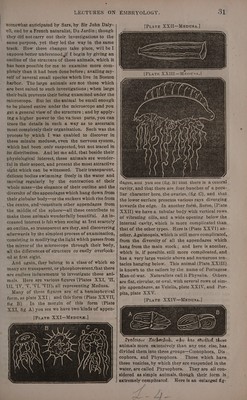
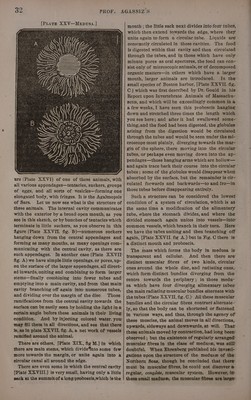
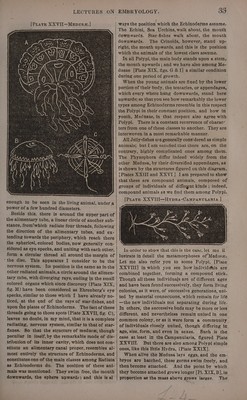
![\ — LECTURES ON {Prats XXVII—MeEpvs2.] enough to be seen in the living animal, under a power of a few hundred diameters. Beside this. there is around the upper part of the alimentary tube, a linear circle of another sub- stance, from‘which radiate four threads, following the direction of the alimentary tubes, and ex- tending towards the periphery, which reach there the spherical, colored bodies, now generally con- sidered as eye specks, and uniting with each other, form a circular thread all around the margin of ‘the disc. This apparatus I consider to be the nervous system. Its position is the same as in the other radiated animals, a circle around the alimen- tary tube, with diverging rays, ending in the small colored organs which since discovery (Plate XIX, fig. M) have been considered as Ehrenberg’s eye specks, similar to those which I have already no- ticed, at the end of the rays of star-fishes, and upon the plates of Echinoderms. The fact of these threads going to those spots (Plate XXVIL, fig. C), leaves no doubt; in my mind, that it is a complete radiating, nervous system, similar to that of star- fisnes. So that the structure of meduss, though peculiar in itself, by the remarkable mode of dis- tribution of its inner cavity, which does not con- stitute an alimentary canal proper, resembles al-< most entirely the structure of Echinoderms, and eonstitutes ons of the main classes among Radiata as Echinoderms do. The position of these ani- mals was mentioned: They swim free, the mouth downwards, the sphere upwards; and this is al EMBRYOLOGY. 33 ways the position which the Echinoderms assume. The Echini, Sea Urchins, walk about, the mouth downwards. Star-fishes walk about, the mouth downwards. The Crinoids, however, stand upe- right, the mouth upwards, and this is the position which the animals of the lowest class assume. In all Polypi, the main body stands upon a stem, the mouth upwards ; and we have also among Me- dusae [Plate XIX, figs. G & I} a similar condition during one period of growth. ; When the young animals are fixed by the lower portion of their body, the tentacles, or appendages, which every where hang downwards, stand here upwards} so that you see how remarkably the lower types among Echinoderms resemble in this respect the Polypi in their constant position, and how in youth, Medutsae,in that respect also agree with Polypi. There is a constant recurrence of charac? ters from one of these classes to another. They are interwoven in a most remarkable manner: All Jelly-fishes are generally considered as simple animals; but [am satistied that there are,on thé contrary, highly complicated ones among them. The Physophora differ indeed widely from the other Medusa, by their diversified appendages, as is shown by the structures figured on this diagram. {Plates XXIII and XXVI] I am prepared to show that these are compound animals, composed of groups of individuals of differygnt kinds ; indeed, compound animals as we find them among Polypi. [Prats XXVIII—Hypra-CAMPANULARIA. | lu order to show that this is the case, let me il lustrate in detail the metamorphoses of Meduse: Let me also refer you to some Polypi, [Plate XXVIII} in which you see how individt&ls are combined together, forming a compound sticks Though all these individuals are of different agés and have been found successively, they form living colonies, as it were, of successive generations, uni- ted by material connections, which remain for lifé —the new individuals not separating during life. In others; the successive buds may be more or less different, and nevertheless remain united in one ~ common colony, or as it were form a community of individuals closely united, though differing in age, size, form, and even in sexes. Such is the case at least in the Campanularia, figured Plate XXVIII. But there are also among Polypi simple ones, like this little Hydra, | Plate X XIX]. When alive the Medusa lays eggs, and the em: bryos are hatched, these germs swim freely, and then become attached. And the point by which they become attached grows longer [Pl. XIX, B],in proportion as the mass above grows larger. The](https://iiif.wellcomecollection.org/image/b33278982_0039.jp2/full/800%2C/0/default.jpg)