Twelve lectures on comparative embryology : delivered before the Lowell Institute, in Boston, December and January, 1848-9 / by Louis Agassiz ... Phonographic report, by James W. Stone ... Originally reported and published in the Boston Daily Evening Traveller.
- Louis Agassiz
- Date:
- 1849
Licence: Public Domain Mark
Credit: Twelve lectures on comparative embryology : delivered before the Lowell Institute, in Boston, December and January, 1848-9 / by Louis Agassiz ... Phonographic report, by James W. Stone ... Originally reported and published in the Boston Daily Evening Traveller. Source: Wellcome Collection.
40/116 (page 34)
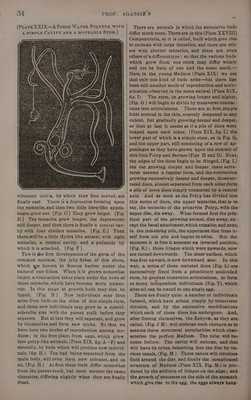
![[Prats XXTX—A Fresuy WaTER POLYPUS, WITH A SIMPLE CAVITY AND A MOVEABLE STEM.] finally cast. Tnere is a depression forming upon the summits, and then two little horn‘like appen- dages grow out. (Fig. C.] They grow larger. [Fig. D.] The tentacles grow longer, the depressions still deeper, and then there is finally a central cav= ity with four distinct tentacles. [Fig. E.] . Then there will be a little Hydra like animal, with eight tentacles, a central cavity, and a peduncle by which it is attached. [Fig. F ] This is the first developmentof the germ of the common meduss, the jelly-fishes of this shore, which are known in Boston harbor under the nameof sun-fishes. Whenitis grown somewhat larger, a contraction takes place under the rows of those tentacles, which have become more numer- ous. In this stage of growth buds may also be found. (Fig. H) New individuals may thus arise from buds on the sides of this simple stem, and these new individuals may grow to a consid- siderable size with the parent stalk before they separate. But at last they will separate, and grow by themselves and form new sticks. So that we have here two modes of reproduction among me:+ duse; in the first place, from eggs, which grow into polyp-like animals, (Plate XIX, fig’ A—F) and secondly, by buds which will produce new individ: nals, (fig. H.) The bud being-separated from the main body, willeven form new colonies, and so on, (Fig. H.) At first these buds differ somewhat from the parent stock, but soon assume the same character, differing slightly when they are finally freed. There are animals in which the successive buds differ much more. There are in this (Plate XX VIII) Campanularia, as it is called, bud’ which give rise to animals with large tenta¢les, and there are othe ers with shorter tentacles, and there are even others of a differenttype; so that the various buds which grow from one stock may differ widely and yet be buds of one and the same stock.— Here, in the young Meduse (Plate X[X) we see that only one kind of buds arise—but there Has been still another mode of reproduction and multi- plication observed in the same animal (Plate X[X, fig. I). The stem, on growing longer and higher, (Fig. G.) will begin to divide by transverse contrac- tions into articulations. There are at first, simple folds noticed in the skin, scarcely deepened to any extent, but gradually growing deeper and deeper, so that at last it seems as if a pile of discs were heaped upon each other, (Plate XIX, fig.I,) the lower part of which is a simple stem, as in Fig. G, and the upper part, still consisting of a row of ap- pendages as they have grown upon the summit of this little Pulvyp and Serrate (Figs H and G). Next, the edges of the discs begin to be fringed, (Fig. I,) _ the cut growing deeper and deeper, these serra- tures assume a regular form, and the contraction growing successively deeper and deeper, those ser- rated discs, almost separated from each other,form a pile of loose discs simply connected by a central axis. And as soon as the Polyp has divided into this series of discs, the upper tentacles, that is to say, the tentacles of the primivite Polyp, with the upper disc, die away. What formed first the prin- cipal part of the growing animal, dies away, ex- cept the basal attachment,which remains; and next, in the remaining pile, the uppermost dise frees it- self from the pile and begins toswim. But the moment it is free it assumes an inverted position, (Fig. K) ; those fringes which were upwards, now are turned downwards. The inner surface, which was first upward, is now downward also. In this way, a series of these serrated discs (Fig. L) are successively freed from a primitively undivided stem, by gradual transverse articulations, to form as many independent individuals (Fig. T), which after all can be traced to one single egg, There are finally quite a number of individuals formed, which have arisen simply by transverse division, and by the successive modifications which each of these discs has undergone. And, after freeing themselves, the Ephyra, as they are called, (Fig. J M) will undergo such changes as to assume those structural peculiarities which chare acterise the perfect Medusew. The tube will bee come hollow. The cavity will enlarge, and that will have its tubes, branching into the dise by vas rious canals, (Fig. M.) Those canals will circulate fiuid around the disc, and finally the complicated . structure of Medusa (Plate XIX. Fig. M.) is pro-. duced by the addition of fringes on the edge; and the growth of processes on the side of the stomach ‘ which give rise to the egg, the eggs always hang-](https://iiif.wellcomecollection.org/image/b33278982_0040.jp2/full/800%2C/0/default.jpg)