Twelve lectures on comparative embryology : delivered before the Lowell Institute, in Boston, December and January, 1848-9 / by Louis Agassiz ... Phonographic report, by James W. Stone ... Originally reported and published in the Boston Daily Evening Traveller.
- Louis Agassiz
- Date:
- 1849
Licence: Public Domain Mark
Credit: Twelve lectures on comparative embryology : delivered before the Lowell Institute, in Boston, December and January, 1848-9 / by Louis Agassiz ... Phonographic report, by James W. Stone ... Originally reported and published in the Boston Daily Evening Traveller. Source: Wellcome Collection.
41/116 (page 35)
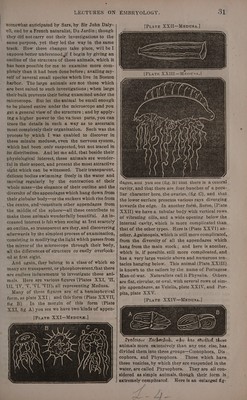
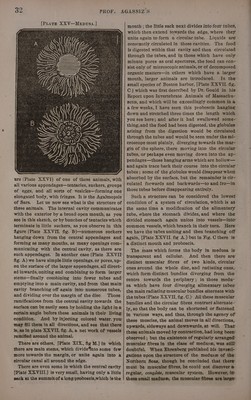
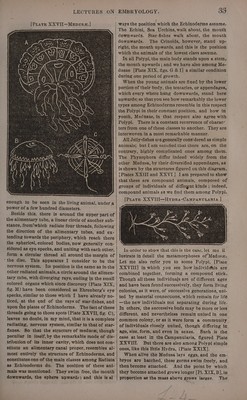
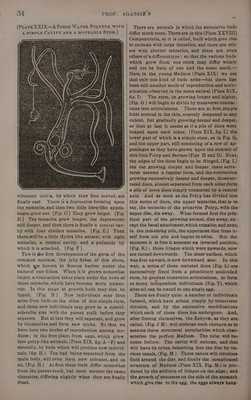
![ing from the sides of the stomach, being, indeed, simple pouches from the stomach. I ought to have mentioned before, that the eggs in Medusee are universally formed in| connection with the ali- mentary tube, and thatin some of them, as the small species of Boston harbor above described, they are simply diverticula of the digestive cavity, formed in ccecal appendages of the same, to be- come free, independent eggs afterwards. Their position varies even most remarkably along the alimentary tubes, in some, that before mentioned, being developed along the central proboscis ; in bunches along the four tubes diverging from the central cavity. Their mode of formation in such positions has nothiag more to astonish us, since we know, from the investigations of Sars, that there are Meduss, the Cythers, in which new indi viduals are developed from buds arising from tLe stomach. At acertain epoch the whole genera- tion produced, arises by transverse division of the stem derived from the eggs of the Medusz, pro- ducing a number of connected individuals, from the sides of the primitive stem (Plate XIX Fig. H); there are also often found buds growing upon the lower portion, but invariably, at some period, the perfect Mudusz will produce eggs. In some Polypi we have also eggs arising from the sides, like buds as in Hydra. [Pl. XXIX| We have here, [Plate XX] from Polyp, Syncoryna and Podocoryna buds arising which differ entirely from the main stock, but which are successively freed from it, and which give rise to animals which are metamorphosed into real Medusz. Instead of be- ing considered as Polypi, those beings should no longer be considered as perfect animals—should no longer be arranged in our systems by them- selves, any more than Ephyra, the larva of Medu- sx {Plate XIX fig. J.]; any more than Strobila [Fig. I.] or Scyphistoma [Fig. E.]. They are only to be considered as the stages of growth of Meduse ; in some of which the regular Polyp divides into many buds, forming as many Medusz [Plate XX fig. B ], or in others, of which simple Polypi give also rise by budding to regular Medusz, there being simultaneously other modifications of the process- es of budding introduced, by which the animal is finally brought to its higher metamorphosis, [Fig- A.|; the budding being [Plate XX fig. B.] the step by which the higher metamorphosis is introduced. The free individuals, which differso much from the parent stock, being finally cast off. In Medusz proper the budding does not intro- duce the higher metamorphosis; this taking place only in the individuals formed by transverse divi- sion. Now, let us for a moment compare such a being as Agalmopsis (Plate XXVI) with the dividing stock of Strobila(Plate XIX, fig.I). We see at once that their position is inverted. Here (Plate XXVI) the fringes hang downwards, but here ide XIX, fig. I) they are upright. To institute 35 a close comparison, we must therefore consider them in the same position, and the resemblance will be striking, especially towards the narrow end. But when we know that in Polypi buds of various aspects can arise from one stem, and remain con- nected with the cavity of the inain stem, asit is here shown in Campanularia (Plate XX VIII)—the connecting axis being the main body with a con- tinuous cavity which extends into the: branches —we have no reason to wonder at a similar growth in animals like Strobila (Plate XIX, figs. G and H) where there is also a similar connection between the bud and the main cavity of the body. And now in Agalmopsis (Piate XXVI) instead of considering those various appendages as organs of a simple animal, let us for a moment inquire if we could not consider them as buds of various kinds remaining around one stock, and forming a community of heterogeneous individuals, living a common life, in the same manner as in polypi, where we have observed individuals, though some- what heterogeneous, living also a common life. And if this comparison can be carried out, we have established that Agalmopsis must be consid- ered as a community of distinct individuals. Now, what are, in the first place, those largest bottle-shaped appendages? They are considered ‘as suckers. But they are suckers which pump food, which digest it in each of these bottles.— There is acavity in which the food is digested; and the result of this digestion is circulated through the main tube. It is a condition identical with the condition of the polypi, in which a new bud arisesto remain connected with the main bo- dy, to have, however, a cavity of its own in which to digest food, and then circulate it with the main mass. Here (Plate XXVI) is another kind of suckers, but performing the same function. They are similar individuals in a lower degree of growth. At first these bottle-shaped open suckers are small, simple appendages from the main tube,which grow larger and finally assume a more individualist life, so that we would have eating individuals upon a common stem, which provide the whole communi- ty with food. They are the mouths, the eating in- dividuals — other appendages which seize upon the prey and which bring it to the suckers, may be considered as compound stems. Of these apporates here is one highly magnified: you have first, the bottle-shaped apporates with their various modifi- cations. Here we have the nettling organs, which are,when highly magnified, also bottle-shaped, and from which threads hang down. They are another kind of individuals, suspended by their peduncles and from which fringes hang down—but not sim- ple individuals. They are individuals which bud in their turn, so as to form groups of individuals— groups of catching individuals. - Then there are other buds, which remain hollow cavities, and are considered as vesicles to suspend the animals. It is the swimming apparatus of the](https://iiif.wellcomecollection.org/image/b33278982_0041.jp2/full/800%2C/0/default.jpg)