Twelve lectures on comparative embryology : delivered before the Lowell Institute, in Boston, December and January, 1848-9 / by Louis Agassiz ... Phonographic report, by James W. Stone ... Originally reported and published in the Boston Daily Evening Traveller.
- Louis Agassiz
- Date:
- 1849
Licence: Public Domain Mark
Credit: Twelve lectures on comparative embryology : delivered before the Lowell Institute, in Boston, December and January, 1848-9 / by Louis Agassiz ... Phonographic report, by James W. Stone ... Originally reported and published in the Boston Daily Evening Traveller. Source: Wellcome Collection.
43/116 (page 37)
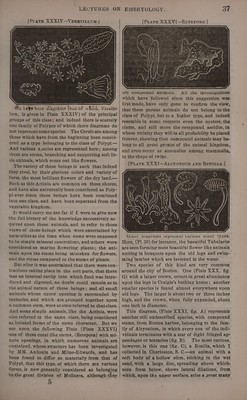
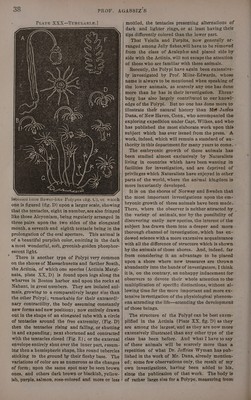
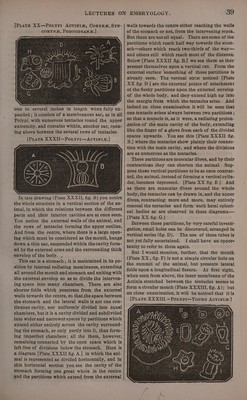
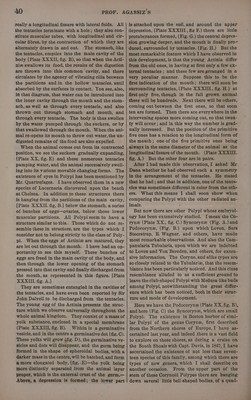
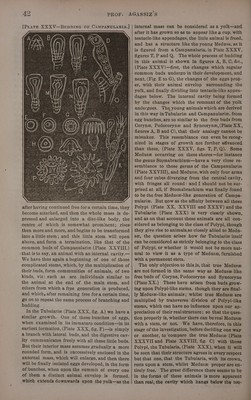
![We hage here diagrams (oue of which, Veretil- lum, is givenin Plate XXXIV) of the principal groups of this class; and indeed there is scarcely one family of Polypes of which these diagrams do not represent some species. The Corals are among those which have from the beginning been consid- ered as a type belonging to the class of Polypi.— And various species are represented here; among them are stems, branching and supporting soft lit- tle animals, which come out like flowers. ‘The variety of these beings is such that indeed they rival, by their glorious colors and variety of form, the most brilliant flowers of the dry land.— Such as this Actinia are common on these shores, and have also universally been considered as Poly- piever since tkese beings have been combined into one class, and have been separated from the vegetable kingdom. Jt would carry me tco far if { were to give now the full history of the knowledge successively ac: quired upon these animals, and to refer to those views of these beings which were entertained by naturalists at the time when some were supposed to be simple mineral concretions, and ethers were mals upon the stems being mistaken for flowers, and the stems compared to the stems of plants. But after it was ascertained that there were con- tractions taking place in the soft parts, that there was an internal cavity inte which food was intro- duced and digested, no doubt could remain as to the animal nature of these beings; and all small animals whose upper opening is surrounded by tentacles, and which are grouped together upon & common stem, were at once referred to that class. And some simple animals, like the Actinia, were also referred to the same class, being considered as isolated forms of the same character. But we see upon the following Plate {Plate XXXVI) ‘ene of these coral-like stems, (Retepora) with mi- nute openings, in which numerous animals are contained, whose structure has been investigated by MM. Andouin and Milne-Edwards, and has been found to differ so materially from that of Polypi, that this type, of which there are various forms, is now generally ‘considered as belonging te the great division of Mollusca, although they 5 3f EMBRYOLOGY. [PLATE XXXVI—ReTEPORE | are compound animals. All the investigations which have followed since this suggestion was first made, have only gone to confirm the view, that these porous animals do not belong to the class of Polypi, but toa higher type, and indeed resemble in some respects even the oysters, the clams, and still more the compound ascidia, in whose vicinity they willin all probability be placed forever, showing that compound animals may be- long to all great groups of the animal kingdom, and even occur as anomalies among mammalia, in the shape of twins. [PLATE XXXI—ALCYONIUM AND RENILLA. ] Ovuuer diagrams represent various Other Lypes. Here, (PI. 30) for instance, the beautiful Tubulariz are seen forming most beautiful fower-like animals uniting in bouquets upon the old logs and swim- ming lumber which are fastened in the water. Two species of this kind are very common around the city of Boston. One (Plate XXX, fig. G) with a larger crown, occurs in great abundance upon the legs in Craigie’s bathing house; another smaller species is found almost everywhere upon old iogs. The larger is abouttwo or three inches high, and the crown, when fully expanded, about one inch in diameter. This diagram, (Plate XX XI, fig. A) represents another still undescribed species, with compound stems, from Boston harbor, belonging to the fam- ily of Alcyonium, in which every one of the indi- viduals terminates with a star of eight fringed ap- pendages or tentacles (fig. B). The most curious, however, is this one (fig. C), a Renilla, which I collected in Charleston, S. C.—an animal with a soft body of a hollow stem, sticking in the wet sand, with a large disc, spreading above which» seen from below, shows lateral dilations, from which, upon the upper surface, arise a great many](https://iiif.wellcomecollection.org/image/b33278982_0043.jp2/full/800%2C/0/default.jpg)