Twelve lectures on comparative embryology : delivered before the Lowell Institute, in Boston, December and January, 1848-9 / by Louis Agassiz ... Phonographic report, by James W. Stone ... Originally reported and published in the Boston Daily Evening Traveller.
- Louis Agassiz
- Date:
- 1849
Licence: Public Domain Mark
Credit: Twelve lectures on comparative embryology : delivered before the Lowell Institute, in Boston, December and January, 1848-9 / by Louis Agassiz ... Phonographic report, by James W. Stone ... Originally reported and published in the Boston Daily Evening Traveller. Source: Wellcome Collection.
47/116 (page 41)
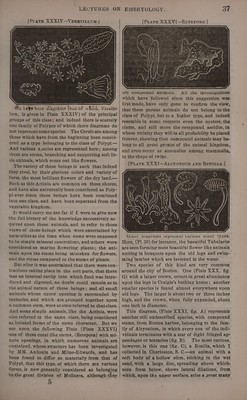
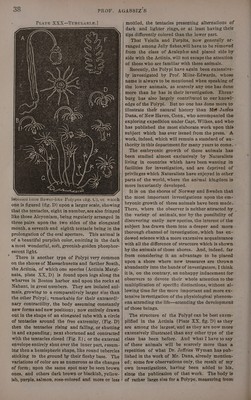
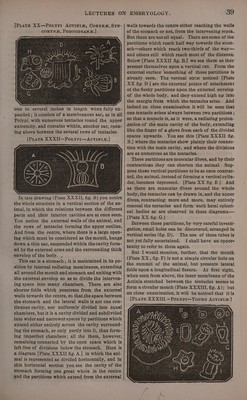
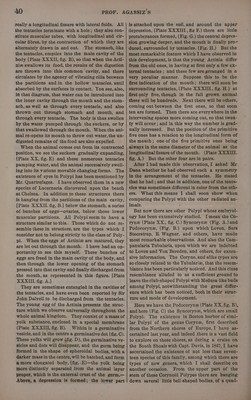
![rangular form. The outline of these bell-shaped bodies being, when seen from below, as in figures A and B.- The angles are prominent, and from them there are colored specks rising, similar to the eye specks of common Medusz. A membrane is stretched across over the central cavity, leaving, however, an opening below; and from the cor- ners are produced short tentacles, which, in the progress of time, grow longer and more moveable. In the interior there is a sucker-like projection, first with a single margin, which will be fringed afterwards. From these details it is plain that ‘these buds, when fully developed, resemble most remarkably the small Medusa, (Plate XXVIII, fig. C) to which I have before referred. Indeed, they are finally freed from the stem upon which they grow, and move as independent animals. The structure of these small animals is indeed very simple; as they have only four straight tubes branching in four directions from their summit.— The investigators of these phenomena have been unwilling to refer them to the class of Medusz, but have considered them as closely allied to Tu- bulariz, and belonging therefore to the class oJ Polypi. They have compared the Medusa-like buds of Coryne, Syncoryne and Podocoryne, (Plate XX,) to the crown of the Tubularix, (Plate XXX, fig. A.) and you see that the comparison is very close. You see thatthe hollow tube within the Medusa-like bud (Plate XX, fig. A.) will com- pare to the hollow cavity with fringes hanging be- low the tentacles of Tubularie. (Plate XXX, fig. A.). Then you see the tentacles above spreading around the bunches of eggs and arising from the upper cavity, as the main cavity of the little Me- Gusa-like buds surrounds its inner hollow tube, from which the eggs are developed in them, form- ing also special bunches, exterior to the inferior or anterior part of the alimentary canal, so that the resemblances between these bell-shaped bulbs (Plate XX, fig. F) andthe crown of Tubulariz (Plate XXX, fig. A) is as close as itcan be. The conclusion derived by Steerstrup from these facts is that the genera Syncoryne, Coryne and Podoco- ryne, (Plate XX, figs. A, B, C) should no longer be considered as genera by themselves, but only as the nurses of animals of a higher order, the little Medusa-like animal, but that they nevertheless should remain with the Polypi near the Tubula- riz. Steerstrup insists upon this point, when he says: “The more perfect forms, however, notwith- standing their resemblance to Medusa, must still occupy the systematic place of the clariform Po- lypes, or Coryne, as animals closely allied to ppbn- lari, Sertularia, &c. &e. Let us now examine the Tubulariz and also the Campanularia, as they have been carefully studied, and then we shall be prepared for an opinion upon these conclusions. We have here [Plate XXVIII] astem of the Campanulariz, which has branches of various kinds. How these branches grow must be examined more fully. EMBRYOLOGY. 4] In a growing stem—the first origin of the stem we shall examine afterwards—there is in the inte- rior a cavity, which cavity expands above and forms a kind of stomach; the moveable part of the animal forming tentacles around, and the mouth being therefore above. And from the side of such a Polype there will be, after acertain time, a bud, forming asimple sac, communicating with the main cavity, and the changes which have pro- duced the main stem will be repeated here so as to give rise to another Polype of the same structure as the terminal one, witha open communication with its main cavity ; and after by repeated budding, -numerous branches, all alike, have been found ag they are figured inthis diagram, [Plate XXVIII] Where you see seven buds all alike,ssome new buds forming in the axis between the main stem and the first buds. And these new buds differ from the former, inasmuch as the bud will not terminate with a new Polype,similar to those of the first buds, but will remain closed,and while it is still closed there may be buds arising on its side i in which eggs are developed. Loven, who described these phenomena more extensively, represents these axilary buds as giv- ing rise, by budding, to new branches, remaining longer shut in a common cavity, and indeed being branches similar to the external one; with the only differences that the terminating animais have smaller tentacles, and are of a slightly different shape; communicating with the main cavity, and giving finally rise to free moving individuals ; whilst there are below simpler sacs, of the same order, but still less developed. Plate XXXYV rep- resents the various stages of this growth. Now these sacs are something like buds; but they are, in fact, eggs, which, in the beginning, are simple buds, or diverticula from the common cavity, so that we can consider the whole as buds, which throw out new buds, from which eggs are developed, in the shape of pouches. And that these are eggs, can be proved by the characters - which distinguish eggs. (Pl. XXX’V. fig. D.) They may have a germinative vesicle, and a germinative dot; and there a new animal is formed, which will escape as soon as the upper buds, which are now full grown, have removed the closing opercu- lum; so that, by a process of budding—of bud- ding egg-like buds—there is a new generation, formed, which does not remain upon the primitive stem, but is freed; and when freed, the germs arising from the eggs are elongated, and little cylindrical animals, which swim free, appear; and](https://iiif.wellcomecollection.org/image/b33278982_0047.jp2/full/800%2C/0/default.jpg)