Twelve lectures on comparative embryology : delivered before the Lowell Institute, in Boston, December and January, 1848-9 / by Louis Agassiz ... Phonographic report, by James W. Stone ... Originally reported and published in the Boston Daily Evening Traveller.
- Louis Agassiz
- Date:
- 1849
Licence: Public Domain Mark
Credit: Twelve lectures on comparative embryology : delivered before the Lowell Institute, in Boston, December and January, 1848-9 / by Louis Agassiz ... Phonographic report, by James W. Stone ... Originally reported and published in the Boston Daily Evening Traveller. Source: Wellcome Collection.
49/116 (page 43)
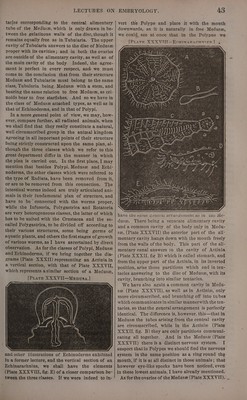
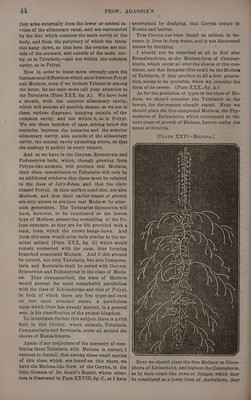
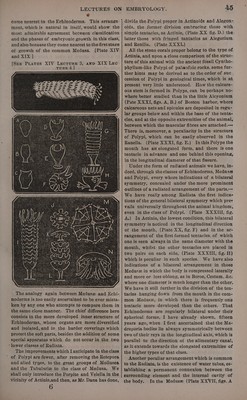
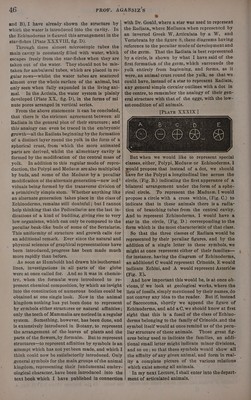
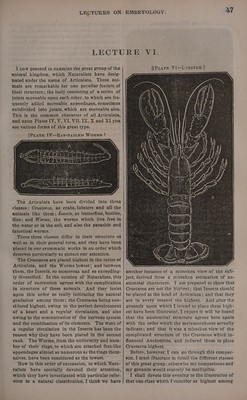
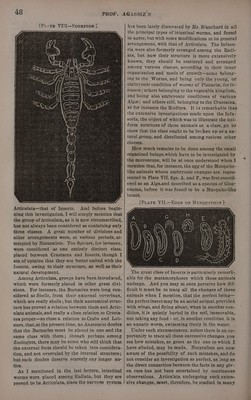
![LECTURES ON tacles corresponding to the central alimentary tube of the Medusez, which is only drawn in be- tween the gelatinous walls of the disc, though it remains equally free as in Tubularia. The upper cavity of Tubularia answers to the dise of Medusee proper with its cavities; and in both the ovaries are outside of the alimentary cavity, as well as of the main cavity of the body. Indeed, the agree- ment is perfect in every respect, and we must come to the conclusion that from their structure Medusz and Tubulariz must belong to the same class, Tubularia being, Meduse with a stem, and bearing the same relation to free Medusa, as cri- noids bear to free starfishes. -And so we have in the class of Meduse attached types, as well as in that of Echinoderms, and in that of Polypi. In a more general point of view, we may, how- ever, compare further, all radiated animals, when we shall find that they really constitute a natural, well circumscribed group in the animal kingdom agreeing in all important points of their structure being strictly constructed upon the same pian, al- though the three classes which we refer to this great department differ in the manner in which the plan is carried out. In the first place, I may mention that besides Polypi, Meduse and Echi- noderms, the other classes which were referred to the type of Radiata, have been removed from it, or are to be removed from this connection. The intestinal worms indeed are truly articulated ani- mals in their fundamental plan of structure, and have to be connected with the worms proper, while the Infusoria, Polygastrica and Rotatoria are very heterogeneous classes, the latter of which has to be united with the Crustacea and the so- called Polygastrica, to be divided off according to their various structures, some being germs of aquatic plants, and others the first stages of growth of various worms, as I have ascertained by direct observation. As for the classes of Polypi, Medusz and Echinoderms, if we bring together the dia- grams (Plate XXXII) representing an Actinia in a vertical section, with that of Plate XX XVII, which represents asimilar section of a Medusa, [PLATE XXXVII—MeEpvsa.] and other illustrations of Echinoderms exhibited in a former lecture, and the vertical section of an Echinarachnius, we shall have the elements (Plate XXX VIII, fig. E) of a closer comparison be- tween the three classes. If we were indeed to in- EMBRYOLOGY. AS vert the Polype and place it with the mouth downwards, as it is naturally in free Meduse, we could see at once that in the Polypus we [Puate XXX VIIT—Ecarnaracnyies 1. the ile- from the walls of the body. This part of the ali- mentary canal answers to the cavity of Actinia (Plate XX XII, fig B) which is called stomach, and from the upper part of the Actinia, in its inverted position, arise those partitions which end in ten- tacles answering to the disc of Medusz, with its cavity, branching into similar tentacles. We have also again acommon cavity in Medu- se (Plate XXXVII), as well asin Actiniz, only more circumscribed, and branching off into tubes which communicates in similar mannerwith the ten- tacles, so thatthe general arrangement is perfectly identical. The difference is, however, this—that in Meduse the tubes arising from the central cavity are circumscribed, while in the Actinie (Plate XXXII, fig. B) they are only partitions communi- cating all together. And in the Medusz (Plate XXXVII) there isa distinct nervous system. I suspect that in Polypes we should find the nervous system inthe same position as a ring round the mouth, if it is at all distinct in those animals; that however eye-like specks have been noticed, even in these lowest animals, I have already mentioned. As for the ovaries of the Meduse (Plate XX XVII), .](https://iiif.wellcomecollection.org/image/b33278982_0049.jp2/full/800%2C/0/default.jpg)