Twelve lectures on comparative embryology : delivered before the Lowell Institute, in Boston, December and January, 1848-9 / by Louis Agassiz ... Phonographic report, by James W. Stone ... Originally reported and published in the Boston Daily Evening Traveller.
- Louis Agassiz
- Date:
- 1849
Licence: Public Domain Mark
Credit: Twelve lectures on comparative embryology : delivered before the Lowell Institute, in Boston, December and January, 1848-9 / by Louis Agassiz ... Phonographic report, by James W. Stone ... Originally reported and published in the Boston Daily Evening Traveller. Source: Wellcome Collection.
52/116 page 46
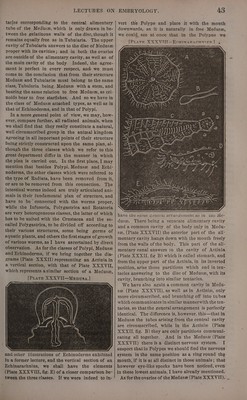
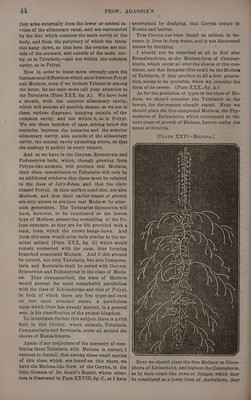
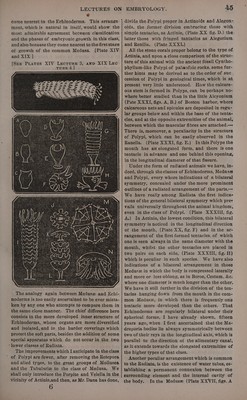
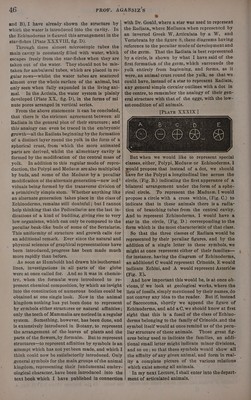
![and B),I have already shown the structure by which the water is introduced into the cavity. In the Echinoderms is figured this arrangement in the star-fishes (Plate XX XVIII, fig. D). Through these almost microscopic tubes the main cavity is constantly filled with water, which escapes freely from the star-fishes when they are taken out of the water. They should not be mis- taken for ambulzral tubes, which are placed in re- gular rows—whilst the water tubes are seattered almost over the whole surface of the animal, but only seen when fully expanded in the living ani- ‘mal. In the Actinia, the water system is plainly developed (Plate XX, fig. D), in the forms of mi nute pores arranged in vertical series. From the above statements it can be concluded, that thereis the strictest agreement between all Radiata in the general plan of their structure; and this analogy can even be traced in the embryonic growth—all the Radiata beginning by the formation of a distinct layer round the yolk in the form of a spherical crust, from which the more animated parts are derived, whilst the alimentary eavity is yolk. In addition to this regular mode of repro- duction, the Polypi and Medusz are also multiplied by buds, and some of the Medusz by a peculiar modification of the alternate generation—new ind! viduals being formed by the transverse division of a primitively simple stem. Whether anything like Echinoderms, remains still doubtful; but I cannot help thinking that the Pedicellariz are the last in- dications of a kind of budding, giving rise to very low organisms, which can only be compared to the peculiar beak-like buds of some of the Sertulariz. an additional remark. Ever since the natural and physical sciences of graphical representations have been introduced, progress has been made much more rapidly than before. . As soon as Humboldt had drawn his isothermal lines, investigations in all parts of the globe were at once called for. And so it was in chemis- try, when the formulz were introduced to re- present chemical composition, by which an insight into the constitution of numerous bodies could be obtained at one single look. Nowin the animal kingdom nothing has yet been done to represent by symbols either structures or natural affinities; only the teeth of Mammalia are noticed in a regular system. Something, however, has been done, and is extensively introduced in Botany, to represent the arrangement of the leaves of plants and the parts of the flowers, by formulsz. Butto represent structures—to represent affinities by symbols is an attempt which has not yet been made, and which I think could now be satisfactorily introduced. Only general symbols for the main groups of the animal kingdom, representing their fundamental embry- ological character, have been introduced into the text book which I have published in connection & with Dr. Gould, where a star was used to represent the Radiata, where Mollusca when represented by an inverted Greek W, Articulata by a W, and Vertebrata by the figure 8, these diagrams haying reference to the peculiar mode of development and of the germ. That the Radiata is best represented by acircle,is shown by what I have said of the first formation of the germ, which surrounds the yolk eftirely from beginning, and forms, as it were, an animal crust round the yolk, so that we could have, instead of a star to represent Radiata, any general simple circular outlines with a dot in the centre, to remember the analogy of their gen- eral structure with that of the eggs, with the low- est condition of all animals. [PLATE XXXIX ] But when we would like to represent special classes, either, Polypi, Medusz or Echinoderms, E ould propose that instead of a dot, we should an for the Polypi a longitudinal line aeross the cirele, (Fig. B.) indicating the first apperance of a bilateral arrangement under the form of a sphe- rical eircle. To represent the Madusz, I would propose a circle with a cross within, (Fig. C,) to indicate that in these animals there is a radia- tion of branching tubes from the central cavity. And to represent Echinoderms, I would have a star in the circle, (Fig. D.) corresponding to the form which is the most characteristic of that class. So that the three classes of Radiata would be represented by their peculiar figures, and by the addition of a single letter to these symbols, we might at once represent either of their families— for instance, having the diagram of Echinoderms, an additionrl C would represent Crinoids, EK would indicate Echini,and A would represent Asterids (Fig. E). And how important this would be, is at once ob- vious, if we look at geological works, where the lists of fossils, simply mentioned by their names,do ~ not convey any idea to the reader. But if, instead of Saccocoma, shortly we append the figure of Echinoderms, and add aC, we should know at first sight that this is a fossil of the class of Echino- derms belonging to the family of Crinoids,and the symbol itself would at once remind us of the pecu- liar structure of these animals. Those great fig- ures being used to indieate the families, an addi- tional small letter might indicate minor divisions, and so on; so that these symbols would show all the affinity of any given animal, and form in real- ity a complete picture of the various relations which exist among all animals. In my next Lecture, I shall enter into the depart- ment of articulated animals.](https://iiif.wellcomecollection.org/image/b33278982_0052.jp2/full/800%2C/0/default.jpg)
 No text description is available for this image
 No text description is available for this image
 No text description is available for this image