Twelve lectures on comparative embryology : delivered before the Lowell Institute, in Boston, December and January, 1848-9 / by Louis Agassiz ... Phonographic report, by James W. Stone ... Originally reported and published in the Boston Daily Evening Traveller.
- Louis Agassiz
- Date:
- 1849
Licence: Public Domain Mark
Credit: Twelve lectures on comparative embryology : delivered before the Lowell Institute, in Boston, December and January, 1848-9 / by Louis Agassiz ... Phonographic report, by James W. Stone ... Originally reported and published in the Boston Daily Evening Traveller. Source: Wellcome Collection.
58/116 (page 52)
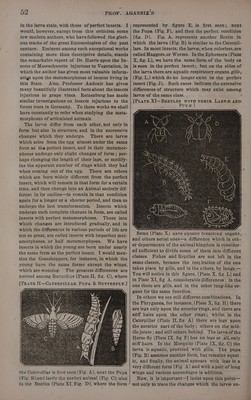
![in the larva state, with those of perfect insects. I would, however, except from this criticism some few modern authors, who have followed the glori- ous tracks of the great Entomologists of the past century. Eminent among such exceptional works containing more than descriptive details, stands the remarkable report of Dr. Harris upon the In- sects of Massachusetts injurious to Vegetation, in which the author has given most valuable inform- atign upon the metamorphoses of insects living in this State. Also, Professor Audouir has given many beautifully illustrated facts about theinsects injurious to grape vines. Ratzenburg has made similar investigations on insects injurious to the forest trees in Germany. To these works we shall have constantly to refer when studying the meta- morphoses of articulated animals. The larve differ from each other, not only in form but also in structure, and in the successive changes which they undergo. There are larve which arise from the egg -almost under the same form as the perfect insect, and in their metamor- phoses undergo only slight changes of form; per- haps changing the length of their legs, or modify- ing the apparent number of rings which they had when coming outof the egg. There are others which are born widely different from the perfect insect, which will remain in that form for a certain time, and then change into an Animal entirely dif- ferent in its outline—to remain in that condition again for a longer or a shorter period, and then to undergo the last transformation. Insects which undergo such complete changes in form, are called insects with perfect metamorphoses. Those into which changes are introduced gradually, and in which the differences in various periods of life are not so great, are called insects with imperfect met- amorphoses, or half metamorphoses. We have insects in which the young are born under nearly the same form as the perfect insect. I would men- tion the Grasshoppers, for instance, in which the young have the same forms except the wings, which are wanting. The greatest differences are noticed among Butterflies (Plate II, fig, C), where [PuaTEe [I[—CaTERPILLAR Pupa & BUTTERFLY.] the Caterpillar is first seen (Fig. A), next the Pupa (Fig. B),and lastly the perfect animal (Fig. C); also inthe Beetles (Plate XI, Fig. D), where the form represented by figure E, is first, seen; next the Pupa (Fig. F), and then the perfect condition (fig. D). Fig. A. represents another Beetle in which the larva (Fig. B) is similar to the Caterpil- lars. In most insects, the larva, when colorless, are called Maggots,or Worms. In the Ephemera (Plate X, fig. L), we have the same form of the body as is seen inthe perfect insect; but on the sides of the larva there are aquatic respiratory organs, gills, (Fig, L,) which do no longer exist in the perfect insect (Fig. J). Such cases indicate the extensive Some (Plate X) nave aquatic Dreatning organs, ~- and others aerial ones—a difference which in oth- er departments of the animal kingdom is consider- ed sufficient to divide some of them into different classes. Fishes and Reptiles are not left in the same Classes, because the restiration of the one takes place by gills, and in the others, by lungs.— You will notice in this figure, (Plate X, fig. L) and in Plate XI, fig. A, considerable differences: in the one there are gills, and in the other lung-like or- gans for the same function. In others we see still different combinations. In the Phryganea, for instance, (Plate X, fig. H) there are legs only upon the anterior rings, and there are stiff hairs upon the other rings; whilst in the Caterpillar (Plate II, fig. A) there are legs upon the anterior part of the body; others on the mid- dle joints ; and still others, behind. The larva of the Horse-fly (Plate IX. fig F) has no legs at all, only stiff hairs. In the Mosquito (Plate IX, fig. C) the larva is aquatic, provided with gilis. The pupa (Fig. B) assumes another form, but remains aquat- ic, and finally, the animal appears with legsina very different form (Fig. A) and with a pair of long wings and various appendages in addition. Now, it is important—I insist upon this point— not only to trace the changes which the larve un-](https://iiif.wellcomecollection.org/image/b33278982_0058.jp2/full/800%2C/0/default.jpg)