Twelve lectures on comparative embryology : delivered before the Lowell Institute, in Boston, December and January, 1848-9 / by Louis Agassiz ... Phonographic report, by James W. Stone ... Originally reported and published in the Boston Daily Evening Traveller.
- Louis Agassiz
- Date:
- 1849
Licence: Public Domain Mark
Credit: Twelve lectures on comparative embryology : delivered before the Lowell Institute, in Boston, December and January, 1848-9 / by Louis Agassiz ... Phonographic report, by James W. Stone ... Originally reported and published in the Boston Daily Evening Traveller. Source: Wellcome Collection.
63/116 page 57
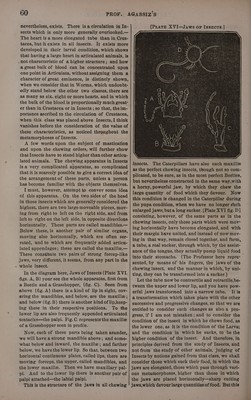
![And if we test with this first result the proposed modifications in the general classification of Ar- ticulata, we will find that on this ground Worms (Plate IV) will stand lowest, Crustacea (Plate VI) come next, and Insects highest. [See Plate VI, Lecture 6 ] Let us now examine the changes which take place in the nervous system of the Caterpillar when full grown, (the changes during the growth of the Caterpillar itself have not yet been investi- gated) till it is transformed into a perfect Butter- fly. We have at first, a nervous system, consisting of a series of equally developed and almost equally distinct swellings (Plate XII, fig. A)—in the head two large ones; next, one small ore; at about an equal distance,a second; a third, nearly equally distant: a fourth, somewhat more distant; a fifth, sixth, seventh, eighth, ninth, tenth, eleventh, al- most uniformly equally distant; and then a twelfth, ‘which is nearer the eleventh, making, with the head, thirteen. Now, precisely the same number of nervous swellings which we observe, consti- tute the number of rings existing in the Caterpil- lar. Uniformly,throughout the family of Lepidoptera, that is to say,among Butterflies and Moths, the body consists of thirteen successive rings ; and in the lowest condition of these animals—in their caterpillar state—the nervous system has as many nervous swellings,—one for each ring, almost equally distant from each other, and sending off threads to the parts around in each ring. The general structure and position of the nervous sys- tem is as follows:—The swellings are throughout united by double threads, which towards the poste- rior part of the body come so near together as to seem a continuous, thick cord ; but properly speak- ing, they consist uniformly of double threads. And in the position of these threads, there are some im- portant points. The anterior ones are above the alimentary canal; the others are below; so that the thread which unites the anterior ones with the second,constitute a sort of collar around the alimen- tary tube (Pl. XIV). But all theswellings are united by double threads, even where the threads come near together and seem to be one continuous cord. LTinsist upon this point, because it shows the uni- formity of structure of the nervous system in all articulated animals, and illustrates it, even in the structure of the nervous system which has recent- ly been discovered in {ntestinal Worms. When discovered, it was supposed that Intestinal Worms had a nervous system so different from Articulata as not to belong to that group. The nervous sys- tem in Worms forms asort of collar, with swellings around the anterior part of the alimentary canal, from which arise a double row of swellings, con- nected by simple threads, extending backwards.— This arrangement is indeed not very different from that of the higher Articulata: let only swellings, with their double threads, be disconnected, and we have the arrangement of Worms; and let the two chains of Worms be united in one, and we have the arrangement of Insects. As soon as the Caterpillar undergoes the first change towards forming the Pupa—towards be- coming immoveable, before it casts its skin for fhe last time—we see (Plate XII, fig. B) that the third and fourth swellings are brought nearer together ; and also the first and second are brought nearer together; the others remaining in the same relative position and in the same proportional distances apart. But as soon as, for the last time, the Caterpillar has lost its skin and assumed that peculiar form of Pupa in which it is motionless, then the nervous system in its longitudinal extension assumes this winding form [Plate XII, fig.C.] It brings the swellings nearer together, the first.of them being at this time entirely united with those at the head: [PLATE XTI—NeERVES OF BUTTERFLIES ] In the following stage, (Fig. D) the 2d, 3d, 4th and 5th swellings are brought nearer the head, whils the 6th, and 7th, disappear entirely during the pu- pa state, and with them disappear also the lateral threads which arose from therm in an earlier con- dition. The second, third, fourth and fifth swellings remain now for some time at the same distance, but are gradually combined in one single and more connected mass. The sixth and seventh, disap- pear. The eighth, ninth, tenth and eleventh re- main at equal distances. And if we compare this condition with the perfect insect, we can see that these few anterior swellings, though arising from five distinct ganglia, will send the nerves to the parts answering to the chest. <A region behind, with the long medial thread without lateral nerves, is the region where the separation between the chest and abdomen will take place. Before the Pupa passes into the state of the perfect insect, the approach of the swellings number two, three, four and five is still increased. So that there are now only three regions of distribution of the ner- vous centres: the head with one large mass; next, the chest with separted, though approximated](https://iiif.wellcomecollection.org/image/b33278982_0063.jp2/full/800%2C/0/default.jpg)

 No text description is available for this image
 No text description is available for this image
 No text description is available for this image