Twelve lectures on comparative embryology : delivered before the Lowell Institute, in Boston, December and January, 1848-9 / by Louis Agassiz ... Phonographic report, by James W. Stone ... Originally reported and published in the Boston Daily Evening Traveller.
- Louis Agassiz
- Date:
- 1849
Licence: Public Domain Mark
Credit: Twelve lectures on comparative embryology : delivered before the Lowell Institute, in Boston, December and January, 1848-9 / by Louis Agassiz ... Phonographic report, by James W. Stone ... Originally reported and published in the Boston Daily Evening Traveller. Source: Wellcome Collection.
79/116 (page 73)
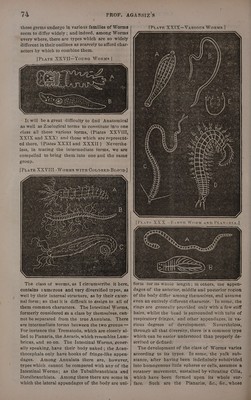
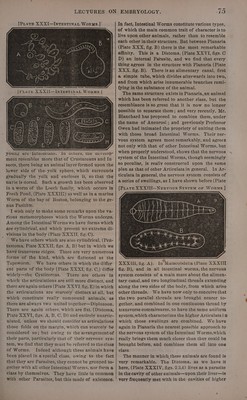
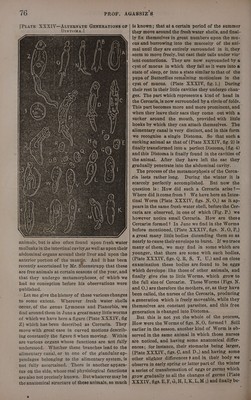
![LECTURES ON between the embryogenic phenomena, as we have just described them, and what is known of the ce- lestial bodies, in their combinations, upon an im- mense scale. First, we have primitive cells, com- bining and condensing to form the mass of the egg, likeclusters of nebular stars. After the yolk has undergone the various phases which precede the formation of the embryo or germ, this new be- ing with a spherical form, which is also the form of the primitive egg, begins to assume a rotatory movement, under the influence of life, as the ce- lestial bodies rotate under the influence of univer- sal gravitation. Atlast the progressive, onward movement is introduced, which characterizes ani- mal life properly, and is the first step in the series of progress, which, in man, ends with intellectual freedom aud moral responsibility. But this form of the division of the yolk is not the only one which is observed among animals. In Fishes, for instance, we have a division of the yolk, which differs considerably from that just de- scribed. In these there will be first a transverse depression upon the yolk, so that, seen from above, the yolk will seem divided intwo halves. And then it will be divided again at right angles, so that there will be two furrows at right angles, forming a division which remains superficial. So that in a profile view these furrows do affect the yolk but very little, and the whole mass below re- mains unaffected. But only the superficial layer undergoes this change; the lower portion and the central parts of the yolk remaining unchanged, but being gradu- ally introduced into the process—being gradually absorbed by that part of the germ which is already formed, and finally totally absorbed by the germ; or if not introduced into the substance of the germ as a part of its body, itis finally introduced as a sac from the lower part of the body into the di- gestive cavity, and is digested. So that we have all possible steps, from total division of the yolk, which is entirely changed into a germ, to a super- ficial furrowing giving rise to a germ which rests upon a modified yolk. In the first instance, by repeated subdivision, the whole substance of the yolk is prepared to become a germ; or, in the sec- ond, only a part of itis modified to forma layer upon the yolk, which grows and gradually absorbs the remainder of the yolk. In those animals in which the division of the yolk is only partial, as in fishes, the divisions finally given rise to cells. In the beginning, those divisions are only separations of the superficial mass. But those masses not being entirely sur- rounded, do not form distinct spheres or parts of _ Spheres; but at last,when they have repeatedly multiplied, then each particle is surrounded by a membrane, and thus transformed into a distinct cell. So that the germ, in whatever manner it is produced—whether by total or partial division of the yolk—is finally, when formed, constituted of EMBRYOLOGY. 73 numerous small cells. The changes which those cells undergo—the manner in which additional cells are derived from the yolk, either by division or by evolution from those already formed,—con- stitute the phases of the embryonic growth of each animal. But it is by a uniform process of division that the germ itself is first formed. The degree of maturity which the germ has reached when it is hatched, varies extraordinarily. There are ani- mals in which the germ is hatched in a degree of development which is so distant from what the animal will be finally, that it cannot be recognized, and that the type of the parent is not at all indi- structure of the germ when born. There are other animals in which, on the contrary, the germ is not hatched before it has grown within the egg to assume the external forms of the mature animal, and has even attained to a very considerable size, in many of them. It is perhaps from not having considered suffici- ently those differences that so many mistakes have been made in the study of the changes which those animals undergo. Had it been supposed that ani- mals were born in a condition in which they differ so widely from the parent, they might have been watched longer before they were described as dis- tinct animals, on the sole ground.that they were free-moving. And we should not find that animals of the same species would be described under so many different names if this had.been more gene- rally known. A great many larvez of Worms are undoubtedly simply those small animals described as Infusoriz ; and I have myself seen eggs of Planaria give rise to some of these Infusoria called Paramecium Annellides. Here, for instance, is one (Plate XX VI, figure EH), remarkable for its sucker-like discs [PLATE XXVI—Parasitic Worms.] and the Cilia by which it moves. Ihe young Planaria resembles closely this species. And it is more than probable—it is almost certain—that a great number of those so-called Infusoria, are no- thing more than the moving germs of Worms. Here is, for instance, a young Planaria, in which we have such a sucker, and in which the general form reminds us of the Infusoria very striking- ly: (Plate XXVII, fig. B). The change which](https://iiif.wellcomecollection.org/image/b33278982_0079.jp2/full/800%2C/0/default.jpg)