Twelve lectures on comparative embryology : delivered before the Lowell Institute, in Boston, December and January, 1848-9 / by Louis Agassiz ... Phonographic report, by James W. Stone ... Originally reported and published in the Boston Daily Evening Traveller.
- Louis Agassiz
- Date:
- 1849
Licence: Public Domain Mark
Credit: Twelve lectures on comparative embryology : delivered before the Lowell Institute, in Boston, December and January, 1848-9 / by Louis Agassiz ... Phonographic report, by James W. Stone ... Originally reported and published in the Boston Daily Evening Traveller. Source: Wellcome Collection.
81/116 page 75
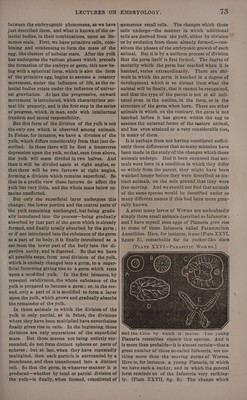
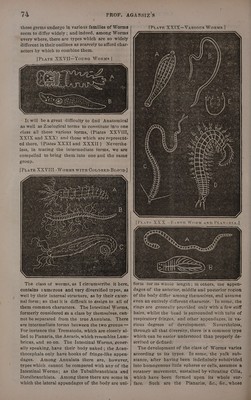
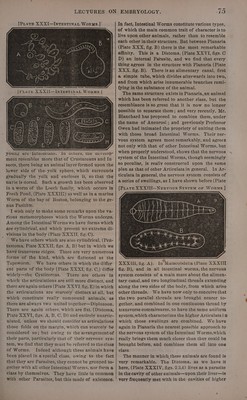
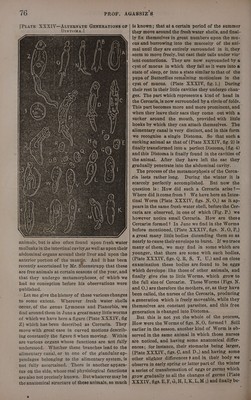
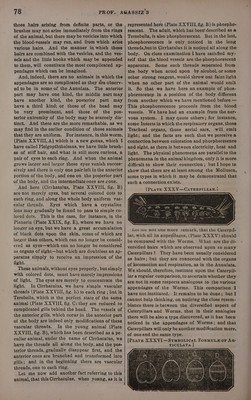
![[Prare XXXI—INTESTINAL WorMs.]’ IW young are~{otusoriaus. in others, the deveiop- ment resembles more that of Crustaceans and In- sects, there being an animal layer formed upon the luwer side of the: yolk sphere, which surrounds gradually the volk and encloses it, so that the navie is dorsal. Such a growth has been observed in a worm of the Leech family, which occurs in Fresh Pond, (Plate XX XIII) as well as in a marine Worm of the bay of Boston, belonging to the ge- nus Pasithz. I wish only to make some remarks upon the va- rious metamorphoses which the Worms undergo. Among the Intestinal Worms we have forms which are cylindrical, and which present no extreme di- visions in the body (Plate XXXII, fig. C). We have others which are also cylindrical, (Pen- tastoma, Plate XXXII, figs. A, B) but in which we have transverse ridges. There are very numerous forms of the kind, which are flattened as the Tapeworm. We have others in which the differ- ent parts of the body (Plate XXXI, fig. C,) differ widely—the Cysticercus. There are others in which the articulations are still more distinct, and there are again others (Plate XXVL, fig. E) in which the articulations are scarcely distinct at all, but which constitute really compound animals, as there are always two united together—Diplozoon. There are again others, which are flat, (Distoma, Plate XXVI, figs. A, B, C, D) and entirely unartic- ulated, unless we should consider as articulations those folds on the margin, which can scarcely be considered so; but owing to the arrangement of their parts, particularly that of their nervous sys- tem, we find that they must be referred to the class of Worms. Indeed although these animals have been placed in a special class, owing to the fact that they are Parasites, they cannot be grouped to- gether with all other Intestinal Worms, nor farm a class by themselves. They have little in common with other Parasites, but this mode of existence. 49 In fact, Intestinal Worms constitute various types, of which the main common trait of character is to live upon other animals, rather than to resemble (Plate XXX, fig. B) there is the most remarkable affinity. This is a Distoma. (Plate X XVI, figs. C D) an internal Parasite, and we find that every thing agrees in the structure with Planaria (Plate XXX, fig. B). There isan alimentary canal, first a simple tube, which divides afterwards into two, and from which arise innumerable branches rami- fying in the substance of the animal. The same structure exists in Planaria,an animal which has been referred to another class, but the resemblance is so great that it is now no longer possible to separate them; and very recently, Mr. Blanchard has proposed to combine them, under the name of Aneurosi; and previously Professor Owen had intimated the propriety of uniting them with those broad Intestinal Worms. Their ner- ‘vous system agrees most remarkably. and agrees not only with that of other Intestinal Worms, but when properly understood, shows that the nervous system of the Intestinal Worms, though seemingly so peculiar, is really constructed upon the same plan as that of other Articulatain general. In Ar- ticulata in general, the nervous system consists of a series of swellings, as I have shown before (Plate XXXII, tig. A). In°Matacobdella (Plate XX XIII fig. B), and in all intestinal worms, the nervous system consists of a main mass about the alimen- tary canal, and two longitudinal threads extending along the two sides of the body, from which arise other threads. We have now only to conceive that the two parallel threads are brought nearer to- gether, and combined in one continuous thread by transverse commissures, to have the same uniform system,which characterizes the higher Articulatain which those swellings are combined. We have again in Planaria the nearest possible approach to the nervous system of the Intestinal Worms,which really brings them much closer than they could be brought before, and combines them all into one class. The manner in which these animals are found is very remarkable. The Distoma, as we have it here, (Plate XXXIV, figs. 2.3.4) lives as a parasite in the cavity of other animals—upon their liver—is very frequently met with in the cavities of higher](https://iiif.wellcomecollection.org/image/b33278982_0081.jp2/full/800%2C/0/default.jpg)
 No text description is available for this image
 No text description is available for this image
 No text description is available for this image