Twelve lectures on comparative embryology : delivered before the Lowell Institute, in Boston, December and January, 1848-9 / by Louis Agassiz ... Phonographic report, by James W. Stone ... Originally reported and published in the Boston Daily Evening Traveller.
- Louis Agassiz
- Date:
- 1849
Licence: Public Domain Mark
Credit: Twelve lectures on comparative embryology : delivered before the Lowell Institute, in Boston, December and January, 1848-9 / by Louis Agassiz ... Phonographic report, by James W. Stone ... Originally reported and published in the Boston Daily Evening Traveller. Source: Wellcome Collection.
83/116 (page 77)
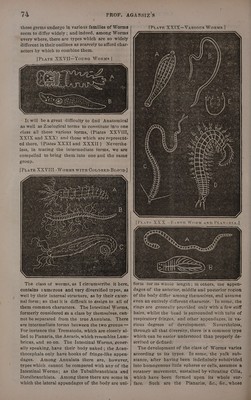
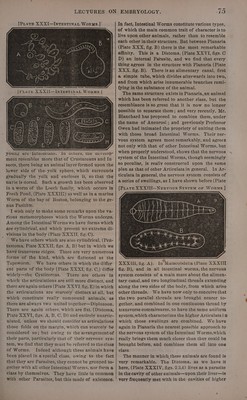
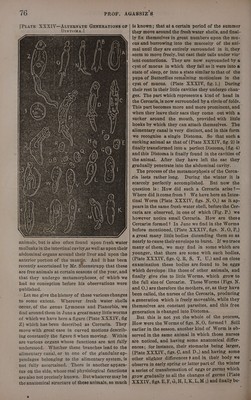
![eome theirnurses,so that the nurses are born from another kind of Worms, living equally as parasites in those shel's, and which are on that account walled grand nurses, se that we have now three generations: Grand nurses observed in the early part ef the year giving rise, by a series of devel- opment ef their eggs to so called nurses, in which there are again eggs produced which undergo all the changes of aregular developement, and are now Horn as Cercaria. And when these-Oercaria have jived as free animals for a certain time, they un dergo the changes which produce Distoma. It is a remarkable fact, that the nurses of Cer- cari bring forth a great many Cercarigs, which re- main as parasites; a great many of them being developed within the bodv of the shell fish, into a Distoma. We have, therefore, three successive generations which differ. The grand nurses give rise to a generation which resemble them in a cer- tain degree, but net in every respect. And the nurses which give rise to Cercarize ; and by meta- morphosis the Cercariss are transformed into Dis- toma. How the grand nurses are formed, has not been observed directly. But itis known from ‘other species, and it has been observed by Siebold, that the Distoma will mature eggs which will give rise to other animals similar te our grand nurses These which will either grow within the maternal Distoma body, as in this form, (P]. KXXIY, fig. B) where we have here Distoma, (Pl. XXXIV, fig. A,) and here, {Fig. B} we have its progeny. Butas this progeny is so different from the parent, there cane not be a doubt but that at a certain period the Distoma lays eggs, and that there is a certain gen- eration which resembles the first starting point of there will be always a jperiod when the animal will lay eggs. And whatever may be the number of these intervening generations, there will be al- ways a period when the animal will come back to the fundamental type of its species. In the Tape-worm, a curious observation has been made by Prof. Eschricht, who has ascertained that the head, when it is furrewed by innumerable joints, will from time to time cast these joints, and at regular periods reproduce them. The joints present a remarkable uniformity of structure, in each joint there being the various apparatus— ovaries and other organs, which are developed in these animals. So that each joint is, in certain respects, an indi- vidual by its structure, but remains united with its other joints, forming a series of articulations. In such a condition of things, we have certainly an approach toor at least some analogy with what we have observed in the Medusz, which form those piles of individuals called Strobila, which become free and give rise to as many individuals. Ea Intestinal Worms such transverse divisions take place; the animal being free and each ring be- coming as nearly as possible a peculiar individual farming a kind of compound animal, but in a dif- 10 EMBRYOLOGY. V7 ferent sense from what we have observed among Polypi, till at a certain period of the year, they cast these rings and scatter about the innumerable eggs which they preduce. The quantity of eggs which are prodeced in each of these animals, and the quantity of eggs which are produced by each individual Worm, is amazing. Prof. @wen has computed, that in-ene single full grown female Ascaris, there were sixty-four mil- lions of eggs developed. Now as it has been ascer- tained by several Entomologists, that Intes- tinal Worms and their eggs have a more persise tent life than ether animals, we should not won- der that they have a chance to re-enter the bodies of animals in which they live. It is a remarkable fact, that Intestinal Worms are found generally in particular animals, and that the same spe- cies is not developed in every kind of animal, even if they live under the same circumstances. And new the chance which these various kinds of Tape-worms have of being introduced into ani- mals of the same species as those from which they have been removed, is very great. In the Fishes, for instance, the Parasites become a part of the food of the Fishes, and in this way they are transfered into the animals in which they live. Some of these Intestinal Worms have ua- dergene the action of boiling water without being killed. Their eggs have been put under the influ- ence of strong acids witheut being destroyed. So that we should not wonder, after such experiments have been made, that these animals, having been intreduced into the alimentary canals of animals should live te grow and reproduce their species, instead of being digested. The external Worms—such as live in the water or the earth—when they are hatched, present al- ready transverse divisions. They early assume {Plate XXVIf, fig. A} the shape of common artic- ulata. Professors Milne-Edwards, Loven, and Kol- liker have traced the changes of several of those Worms. But I see that I have scarcely time to state the leading facts of their histery, and I must go on to another subject. tT shall now endeavor to show that there is a uni- formity of type among the Worms, notwithstand- ing the external differences we observe among them. In these various external Worms {Plates XXVIII and XXIX) we may notice some in which there are no external appendages at all (Plate XXIX, figs. A and B)—for instance, the Nemertes —which is very common on these shores where [ have first noticed several species. In Planaria there are also no external appendages (Plate XXX, fig. B). In the earth-worm (Plate XXX, fig. A) we hav appendages upon their rings, and although very simple, we have here the first step toward those - complicated appendages which we notice in oth- ers. The complications grow out of modifications of those appendages themselves. Instead of stiff hairs scattered about, we may have a brush of](https://iiif.wellcomecollection.org/image/b33278982_0083.jp2/full/800%2C/0/default.jpg)