Twelve lectures on comparative embryology : delivered before the Lowell Institute, in Boston, December and January, 1848-9 / by Louis Agassiz ... Phonographic report, by James W. Stone ... Originally reported and published in the Boston Daily Evening Traveller.
- Louis Agassiz
- Date:
- 1849
Licence: Public Domain Mark
Credit: Twelve lectures on comparative embryology : delivered before the Lowell Institute, in Boston, December and January, 1848-9 / by Louis Agassiz ... Phonographic report, by James W. Stone ... Originally reported and published in the Boston Daily Evening Traveller. Source: Wellcome Collection.
88/116 (page 82)
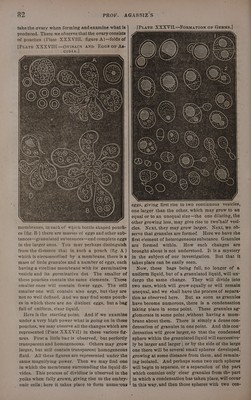
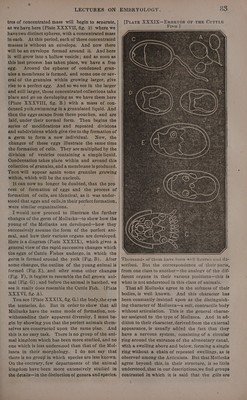
![membranes, ineach of which bottle-shaped pouch- es (fig. B ) there are masses of eggs and other sub- tances—granulated substances—and complete eggs in the larger ones. You may perhaps distinguish from the distance that in such a pouch (fig. A) which is circumscribed by a membrane, there is @ mass of little granules and a number of eggs, each having a vitelline membrane with its germinative vesicle and its germinative dot. The smaller of these pouches contain the same elements. These smaller ones will contain fewer eggs. The still smaller one will contain also eggs, but they are not so well defined. And we may find some pouch- es in which there are no distinct eggs, but a bag fall of uniform, clear liquid. Here is the starting point. Andif we examine under a very high power what is going on in these pouches, we may observe all the changes which are represented (Plate XX XVII) in these various fig- ures. First a little bag is observed, but perfectly transparentand homogeneous. Others may grow larger, but still contain transparent homogeneous fiuid. All these figures are represented under the same magnifying power. Then we may find one in which the membrane surrounding the liquid di- vides. This process of dividing is observed in the yolks when fully grown, giving rise to the embry- onie cells; here it takes place to form nume-ous [Purate XXXVII.—F¥ormaTion oF GERMS.] eggs, giving first rise to two continuous vesicles, one larger than the other, which may grow to an equal or to an unequal size—the one dilating, the other growing less, may give rise to two’half vesi- cles. Next, they may grow larger. Next, we ob- serve that granules are formed. Here we have the first element of heterogeneous substance. Granules are formed within. How such changes are brought about is not understood. It isa mystery in the subject of our investigation. But that it takes place can be easily seen. Now, these bags being full, no longer of a uniform liquid, but of a granulated liquid, will un- dergo the same change. They will divide into two sacs, which will grow equally or will remain unequal, and we shall have the process of separa- tion as observed here. But as soon as granules have become numerous, there is a condensation taking place in some point. These granules ag- glomerate in some point ,without having a mem- brane about them. There is simply a dense con- densation of granules in one point. And this con- densation will grow larger,so that the condensed sphere within the granulated liquid will successive- ly be larger and larger ; or by the side of the large one there will be several small spheres developed, growing at some distance from them, and remain- ing isolated. And perhaps some two such spheres will begin to separate, or a separation of the part which contains only clear granules from the part in which a condensation has taken place, will occur in this way, and then those spheres with two cen-](https://iiif.wellcomecollection.org/image/b33278982_0088.jp2/full/800%2C/0/default.jpg)