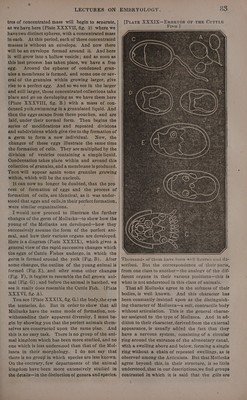
Twelve lectures on comparative embryology : delivered before the Lowell Institute, in Boston, December and January, 1848-9 / by Louis Agassiz ... Phonographic report, by James W. Stone ... Originally reported and published in the Boston Daily Evening Traveller.
- Louis Agassiz
- Date:
- 1849
Licence: Public Domain Mark
Credit: Twelve lectures on comparative embryology : delivered before the Lowell Institute, in Boston, December and January, 1848-9 / by Louis Agassiz ... Phonographic report, by James W. Stone ... Originally reported and published in the Boston Daily Evening Traveller. Source: Wellcome Collection.
90/116 (page 84)
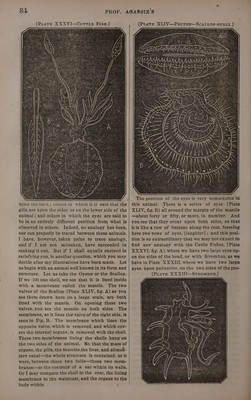
![XXXVI—CuTtLe Fisa.] 4 upou the back 3 Others In observed in others. Indeed, no analogy has been, nor can properly be traced between these animals. IT have, however, taken pains to trace analogy, and if I am-not mistaken, have succeeded in making it out. But if I shall equally succeed in satisfving you, is another question, which you may decide after my illustrations have been made. Let us begin with an animal well known in its form and structure. Let us take the Oyster or the Scallop. If we lift one shell, we see that it is lined inside with a membrane called the mantle. The two valves of the Scallop (Plate XLIV, fig. A) as you see them drawn here ona large scale, are both lined with the mantle. On opening these two valves. you see the mantle on both sides. The membrane, as it lines the valve of the right side, is seenin Fig. B. The membrane which lines the opposite valve, which is removed, and which cov- ers the interna! organs, is removed with the shell. These two membranes lining the shells hang on the two sides of the animal. So that the mass of organs, the gills, the muscles,the liver, and alimen- tary canal—the whole structure is contained, as it were, between those two folds—those two mem- branes—as the contents of a sac within its walls. Or I may compare the shell to the coat, the lining membrane to the waistcoat, and the organs to the body within. [PuatE XLIV—Pecten—ScALiLop-sHELt | 3) The position of the eyes is very remarkabie in this animal. There is a series of eyes (Plate XLIV, fig. B) all around the margin of the mantle —about forty or fifty, or more,in number. And you see that they occur upon both sides, so that itis like arow of buttons along the coat, forming here two rows of eyes, [laughter] ; and this posi- tion is so extraordinary that we may not expect to find any analogy with the Cuttle Fishes, (Plate XXXVI. fig. A), where we have two large eyes up- on the sides of the head, or with Strombus, as we have in Plate XX XIII, where we have two large eyes, upon peduncles, on the two sides of the pro- [PLATE XXXII[—Strompsvs.]](https://iiif.wellcomecollection.org/image/b33278982_0090.jp2/full/800%2C/0/default.jpg)