Twelve lectures on comparative embryology : delivered before the Lowell Institute, in Boston, December and January, 1848-9 / by Louis Agassiz ... Phonographic report, by James W. Stone ... Originally reported and published in the Boston Daily Evening Traveller.
- Louis Agassiz
- Date:
- 1849
Licence: Public Domain Mark
Credit: Twelve lectures on comparative embryology : delivered before the Lowell Institute, in Boston, December and January, 1848-9 / by Louis Agassiz ... Phonographic report, by James W. Stone ... Originally reported and published in the Boston Daily Evening Traveller. Source: Wellcome Collection.
92/116 (page 86)
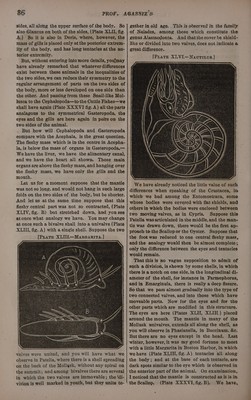
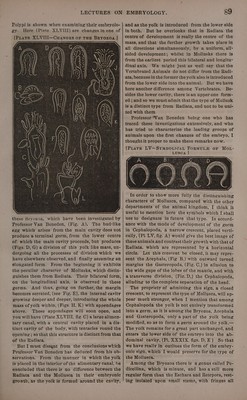
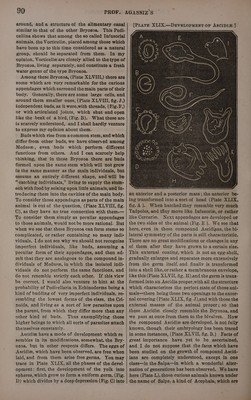
![sides, all along the upper surface of the body. So 4.) So it is also in Doris, where, however, the mass of gills is placed only at the posterior extrem- ity of the body, and has leng tentacles at the an- terior extremity. But, without entering into more Getails, you'may have already remarked that whatever differences exist between these animals in the inequalities of the two sides, we can reduce their symmetry to the regular arrangement of parts om the two sides of the body, more or less developed on one side than the other. And passing from these Snail-like Mol- Busca to the Cephalopoda—to the Cuttle Fishes—we analagous to the symmetrical Gasteropeda, the eyes and the gills are here again in pairs om the two sides of the animal. eompare with the Acephala, is the great question. The fleshy mass which is in the centre in Acepha- and we have the heart all shown. organs are above the fleshy mass, and hanging over the fleshy mass, we have only the gills and the mouth.. Let us for 2 moment suppose that the mantle was not so long. and would not hang in such large folds on the two sides of the body, but be shorter. And let us atthe same time suppose that this fleshy central part was not so eontracted, (Plate XLIV, fig. B) but stretched down, and you see at once what analogy we have. You may change at once such a bivalve shall into a univalve (Plate XLII, fig. A) with a single shell. Suppose the two [PLraTe XLII£—Marearita.] valves were united, and you will have what we observe in Patella, where there is a shell spreading on the back of the Mollysk, without any spiral on the summit; and among bivalves there are several in which the two valves are immovable; the ‘di- vision is well marked in youth, but they unite to- of Naiades, among those which constitute the genus Alasmodenta. And that the cover be shield- like or divided into two valves, does not indicate a great difference. We have already noticed the little value of such differences when speaking of the Crustacea, in two moving valves, as in Cypris. Suppose this tle was drawn down, there would be the first ap- proach to the Scallopor the Oyster. Suppose that the foot was reduced to one central fleshy mass, and the analogy would then be almost complete ; only the difference between the eyes and tentacles would remain. That this is no vague supposition to admit of such a division, is shown by some shells, in which there is a notch on one side, in the longitudinal di- ameter of the shell, for instance in Parmophorus, and in Emarginula, there is really a deep fissure. So that we pass almost gradually into the type of two connected valves, and into those which have moveable parts. Now for the eyes and for the other parts which are modified in this structure. The eyes are here (Plates XLII, XLIII,) placed around the mouth. The mantle in many of the Mollusk wnivalves, extends all along the shell, as you wil} observe in Phasianella, in Buccinum. &c. But there are no eyes except in the head. Last winter, however, it was my good fortune to meet with a little Margarita in Boston Harbor, in which we have (Plate XLIII, fig. A} tentacles all along the body; and at the base of each tentacle, are dark spots similar to the eye which is observed in the anterior part of the animal. On examination, I noticed that the mantle is constructed as it is in the Scallop. (Plate XXXVI, fiz. B). We have,](https://iiif.wellcomecollection.org/image/b33278982_0092.jp2/full/800%2C/0/default.jpg)