Twelve lectures on comparative embryology : delivered before the Lowell Institute, in Boston, December and January, 1848-9 / by Louis Agassiz ... Phonographic report, by James W. Stone ... Originally reported and published in the Boston Daily Evening Traveller.
- Louis Agassiz
- Date:
- 1849
Licence: Public Domain Mark
Credit: Twelve lectures on comparative embryology : delivered before the Lowell Institute, in Boston, December and January, 1848-9 / by Louis Agassiz ... Phonographic report, by James W. Stone ... Originally reported and published in the Boston Daily Evening Traveller. Source: Wellcome Collection.
93/116 (page 87)
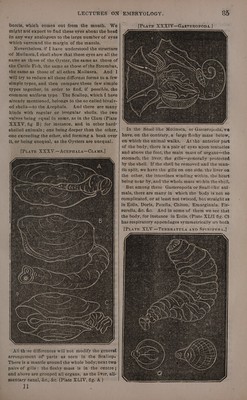
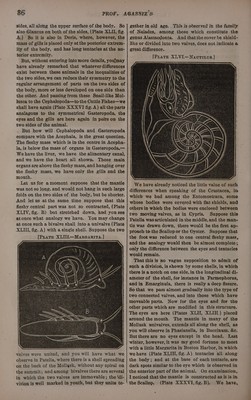
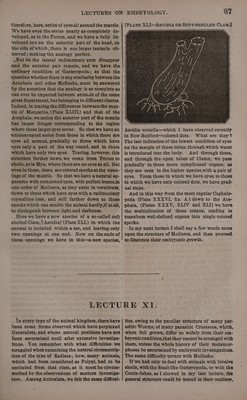
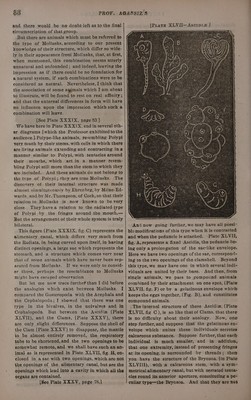
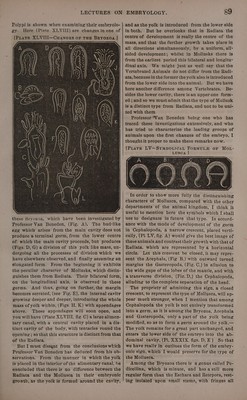
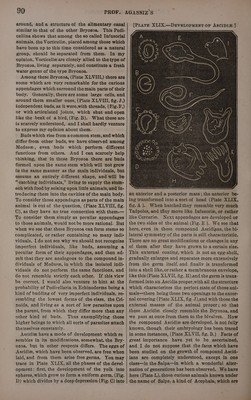
![served ; making’the analogy perfect. and the antericr pair remain, and we have the ordinary Condition of ‘Gasteropoda; so that the ‘question whether there is any similarity between the Acephala and other Molusks, must be answered * ‘oy the assertion that the analogy is as complete as can ever be expected between animals of the same great department, but belonging to different classes. Indeed, in tracing the differences between the man- tle of Margarita,{Plate XLIIT,) and that of the Acephala, we notice the anterior part of the mantle thas larger fringes ‘corresponding to the region where those larger eyes occur. So that we have an ‘uninterrupted series from those in which there are eyes all around, gradually to those which have eyes only a part of the way round, and to those which have only two eyes. Tracing, however. this structure further dewn,we come from Pecten to shells, asin Mya, where there are no eyes at all. But ‘even in these, there are‘colored specks at the open- ‘ings of the mantle. So that we have a natural ap- paratus with compoundeyes, with perfect lenses,in ‘one order ‘of Mollusca, as they exist in vertebrata, ‘down to these which have eyes with a rudimentary ‘crystalline lens, and still further down to those specks which can enable the animal hardly,if at all, to distinguish between light and darkness. Here we have anew species of a so-cailed soft shelled ‘Clam, { Ascidia) (Plate XLI,) in which the animal is included within a sac, and leaving only two openings at one end. Now on the ends of these openings we have in this—a new species, 87 [PLraTe XLI—ASCIDIA OR SOFT-SHELLED CLAM.] Ascidia scutella—which I have observed recently in New Bedfordcolored dots. What are they? The last indication of the lowest condition of eyes on the margin of these tubes, through which water is introduced into the body. And through these, and through the epen tubes of Clams, we pass gradually to those more complicated’ organs, as they are seen im the higher species,with a pair of eyes. rom those in which we have eyes, to those ia which we have only colored «ots, we have grad~ ual steps. And in this way from the most regular Cephalo- poda (Plate XXXVI, fig. A.) down to the Ace- phala, (Plates XXXV, XLIV and XLI) we have transform well-defined organs into single colored specks. In my next lecture I shali say a few words more upon the structure of Mollusca, and then proceed to illustrate their embryonic growth. een ascertained until after extensive investiga- tions. You remember with what difficulties we struggled when examining the natural circumscrip- excluded from that class, as it must be circim- scribed by the observations of modern investiga- ters. Among Articulata, we felt the same difficul- % ties, owing to the peculiar structure of many pare asitic Worms, of many parasitic Crustacea, which, when full grown, differ so widely from their em- bryonictondition,that they cannot be arranged with them, unless the whole history of their metamor+ phoses be ascertained by embryonic investigations. The same difficulty occurs with Mollusks. If we had only to deal with animals with bivalve shells, with the Snail-like Gasteropoda, or with the Cuttle-fishes, as I showed in my last lecture, the general structure could be traced in their outlines,](https://iiif.wellcomecollection.org/image/b33278982_0093.jp2/full/800%2C/0/default.jpg)