Twelve lectures on comparative embryology : delivered before the Lowell Institute, in Boston, December and January, 1848-9 / by Louis Agassiz ... Phonographic report, by James W. Stone ... Originally reported and published in the Boston Daily Evening Traveller.
- Louis Agassiz
- Date:
- 1849
Licence: Public Domain Mark
Credit: Twelve lectures on comparative embryology : delivered before the Lowell Institute, in Boston, December and January, 1848-9 / by Louis Agassiz ... Phonographic report, by James W. Stone ... Originally reported and published in the Boston Daily Evening Traveller. Source: Wellcome Collection.
97/116 (page 91)
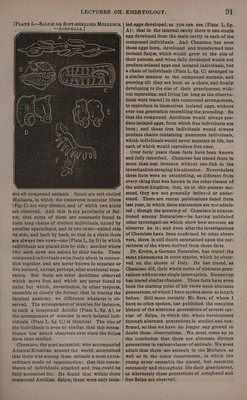
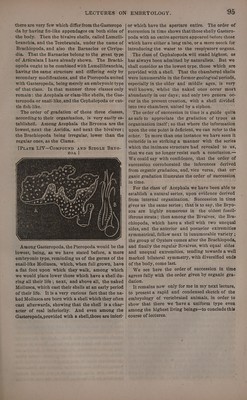
![[PLATE L—SALpP OR Sort-SHELLED MOLLUSCA —ACEPHALA.|] not all compound animals. Salps are soft shelled Mollusca, in which the transverse muscular fibres (Fig. C) are very distinct, and of which two kinds are observed. And this is-the peculiarity of Sal- px, that some of them are constantly found to form long chains of distinct individuals, united by peculiar appendages, and in two rows—united side by side, and back by back, so that in a chain there are always two rows—one (Plate L, fig D) in which individuals are placed side by side; another where two such rows are united by their backs. These compound individuals swim freely about in connec- tion together, and are never known to separate or live isolated, except, perhaps, after accidental sepa- ration. But there are other Ascidians observed which move free,and which are never found to unite, but which, nevertheless, in other respects, resemble so closely the former, that in tracing the internal anatomy, no difference whatever is ob- served. The arrangement of muscles, for instance, in such a compound Ascidia (Plate L, fig. A), or the arrangement of muscles in such isolated indi- viduals, (Plate L, fig. C,) is identical. The size of the individuals is even so similar, that this resem- blance has struck observers ever since the Salpz have been studied. . Chamisso, the poet naturalist, who accompanied Admiral Kotzebue around the world, ascertained that there was among shese animals a most extra- ordinary mode of reproduction; that this resem- blance of individuals, attached and free, could be fully accounted for. He found that within those compound Ascidian Salpe, there were only isola- ted eggs developed, as you can see, (Plate L, fig. A); that in the internal cavity there is one single egg developed from the main cavity in each of the compound individuals. And Chamisso has seen those eggs born, developed and transformed into isolated Salpz, which would grow to the size of their parents, and when fully developed would not produce isolated eggs and isolated individuals, but a chain of individuals (Plate L, fig. C) arranged in a similar manner to the compound animals, and growing till they are born as a chain, and finally developing to the size of their grandparent, with- out separating, and living (as long as the observa- tions were traced) in this compound arrangement, to reproduce in themselves isolated eggs, without ever one generation resembling the preceding. So that the compound Ascidians would always pro- duce isolated eggs, from which free individuals are born; and those free individuals would always produce chains containing numerous individuals, which individuals would never separate in life, but each of which would reproduce free ones. Over forty years these facts have been known and fully described. Chamisso has traced these in more than ene instance without one link in the investigation escaping his attention. Nevertheless these facts were so astonishing, so different from every thing that was known in the other classes of the animal kingdom, that, up to this present mo- ment, they are not generally believed or under- stood. There are recent publications dated from last year, in which these statements are not admit- ted ; though the accuracy of Chamisso is unques- tioned among Naturalists—he having published other investigations which show how accurate an observer he is; and even after the investigations of Chamisso have been confirmed by other obsere — vers, there is still doubt entertained upon the cor- rectness of the views derived from those facts. Dr. Krohn, a German Naturalist, has traced the same phenomena in some’ species, which he obser- ved on the shores of Italy. He has traced, as Chamisso did, their whole series of alternate gene- rations without one single interruption. Steenstrup has traced similarchanges. These facts have even been the starting point of his views upon alternate generations, of which [ have spoken more at length before. Still more recently Mr. Sars, of whom I have so often spoken, bas published the complete history of the alternate generations of several spe- cies of Salpa, in which the whole development through alternate generations is studied and con- firmed, so that we have no longer any ground to doubt these observations. We must come up to the conclusion that there are alternate distinct generations in various classes of animals. We must admit that there are animals in the Mollusca as well as in the other departments, in which the young never resemble the parent, but resemble constantly and throughout life their grandparent, as alternately these generations of compound and free Salpa are observed.](https://iiif.wellcomecollection.org/image/b33278982_0097.jp2/full/800%2C/0/default.jpg)