On the symptoms, causes, and treatment of puerperal insanity / by James Reid, M.D.
- Reid, James, M.D.
- Date:
- [1848]
Licence: Public Domain Mark
Credit: On the symptoms, causes, and treatment of puerperal insanity / by James Reid, M.D. Source: Wellcome Collection.
Provider: This material has been provided by The University of Glasgow Library. The original may be consulted at The University of Glasgow Library.
19/42 page 17
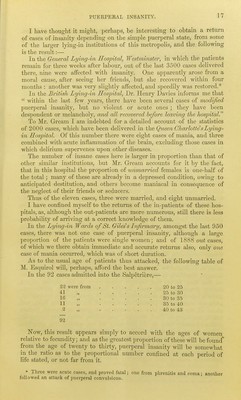
![]7 I have thought it might, perhaps, be interesting to obtain a return of cases of insanity depending on the simple puerperal state, from some of the larger lying-in institutions of this metropolis, and the following is the result:— In the Gen&ral Lying-in Hospital, Westminster, in which the patients remain for three weeks after labour, out of the last 3500 cases delivered there, nine were affected with insanity. One apparently arose from a moral cause, after seeing her friends, but she recovered within four mouths : another was very slightly affected, and speedily was restored.* In the British Lying-in Hospital, Dr. Henry Davies informs me that within the last few years, there have been several cases of modified puerperal insanity, but no violent or acute ones ; they have been despondent or melancholy, and all recovered before leaving the hospital^ To Mr. Gream I am indebted for a detailed account of the statistics of 2000 cases, which have been delivered in the Queen Charlottes Lying- in Hospital. Of this number there were eight cases of mania, and three combined with acute inflammation of the bi*aiu, excluding those cases in which delirium supervenes upon other diseases. The number of insane cases here is larger in proportion than that of other similar institutions, but Mr. Gream accounts for it by the fact, that in this hospital the proportion of unmarried females is one-half of the total; many of these are already in a depressed condition, owing to anticipated destitution, and others become maniacal in consequence of the neglect of their friends or seducers. Thus of the eleven cases, three were married, and eight unmarried. I have confined myself to the returns of the in-patients of these hos- pitals, as, although the out-patients are more numerous, still there is less probability of arriving at a correct knowledge of them. In the Lying-in Wards of St. Giles's Infi^'mary, amongst the last 950 cases, there was not one case of puerperal insanity, although a large proportion of the patients were single women; and of 1888 out cases, of which we there obtain immediate and accurate returns also, only one case of mania occurred, which was of short duration. As to the usual age of patients thus attacked, the following table of M. Esquirol will, perhaps, afford the best answer. In the 92 cases admitted into the Salpetriere,— 22 were from 20 to 25 41 „ 25 to 30 16 „ 30 to 35 11 „ 35 to 40 2 „ 40 to 43 92 Now, this result appears simply to accord with the ages of women relative to fecundity; and as the greatest proportion of these will be found from the age of twenty to thirty, puerperal insanity will be somewhat in the ratio as to the proportional number confined at each period of life stated, or not far from it. * Three were acute cases, and proved fatal; one from phrenitis and coma; another followed an attack of puei-peral convulsions.](https://iiif.wellcomecollection.org/image/b21474692_0019.jp2/full/800%2C/0/default.jpg)


 No text description is available for this image
 No text description is available for this image
 No text description is available for this image