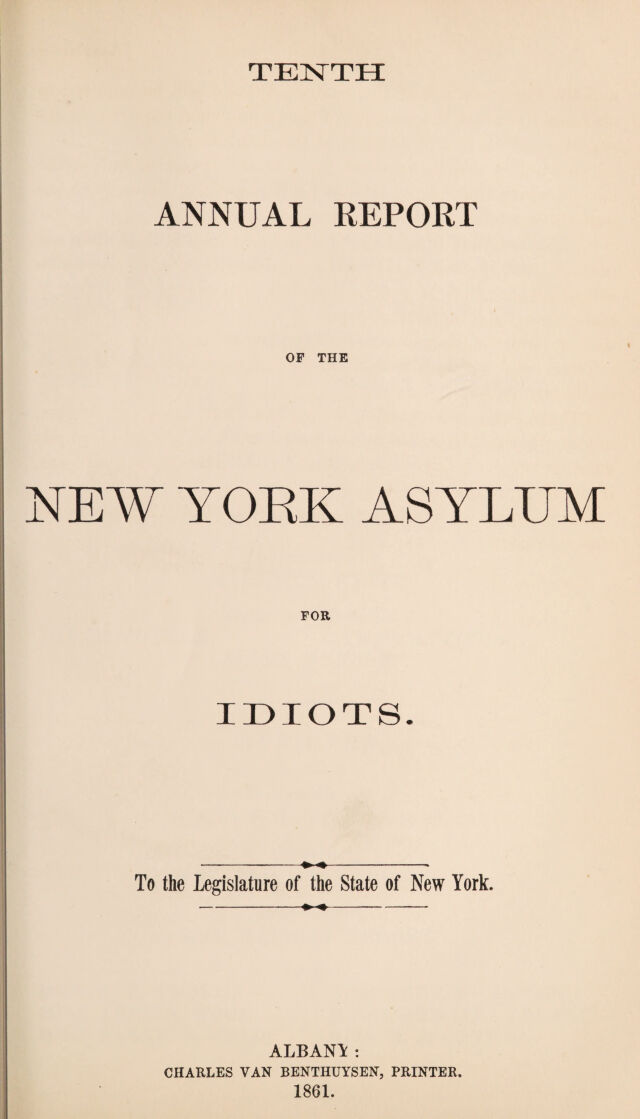
Tenth annual report of the New-York Asylum for Idiots : To the legislature of the State of New York / New York State Asylum for Idiots.
- New York State Asylum for Idiots
- Date:
- 1861
Licence: Public Domain Mark
Credit: Tenth annual report of the New-York Asylum for Idiots : To the legislature of the State of New York / New York State Asylum for Idiots. Source: Wellcome Collection.
17/28 page 17
![often very troublesome cases at home, which induces the friends to make application for their admission here. In some instances, where there has been a loss of one or both parents, they are urged upon the officers of the Asylum with great persistence, even when it is supposed that they are coming here to die. In fact, a large percentage of the deaths that have occurred in the establishment, since its foundation, have been cases that have come hither with fatal disease already at work upon them. There is another class of cases usually admitted on a proper application, but who are dismissed after a fair trial and examina¬ tion, if the result confirms the opinion of the officers as to their probable condition. I refer to cases of dementia^ in distinction from idiocy, when a gradual obliteration of the mental faculties has supervened, after an organic disease of the brain, and the disease is still active and progressive. These are dismissed as incurables. Excluding, then, all cases coming within the classes thus enu¬ merated, the institution, according to the language of our by¬ laws, affords to that portion of the youth of the State, not pro¬ vided for in any other educational establishment, and who are of a proper school-attending age, all the education practicable in each particular case. “ The education furnished by the institu¬ tion will include not only the simpler elements of instruction usually taught in common schools, where that is practicable, but will embrace a course of training in the more practical matters of every-day life ; the cultivation of habits of decency, propriety, self-management and self-reliance, and the development and in¬ crease of a capacity for useful occupations.’^ It is designed, in other words, to receive all children of a teachable age hitherto shut out from educational privileges, by reason of a defect or infirmity of their mental powers. This in¬ cludes a much wider range of natural endowment than would at first be supposed, and within this range there exists a great variety of manifestations.” The experience of this institution would not induce any radical change in the character of the aims of the institution thus defined in the by-laws. The only modification it would suggest, if any, would be the more complete subordination of all the other fea¬ tures of the system to “ the development and increase of a capa¬ city for useful occupations.” It needs no very elaborate statement of the principles and [Assembly, No. 30.] %](https://iiif.wellcomecollection.org/image/b30317915_0017.jp2/full/800%2C/0/default.jpg)


 No text description is available for this image
 No text description is available for this image
 No text description is available for this image