Licence: Public Domain Mark
Credit: A manual of veterinary physiology / by F. Smith. Source: Wellcome Collection.
Provider: This material has been provided by the Royal College of Physicians of Edinburgh. The original may be consulted at the Royal College of Physicians of Edinburgh.
26/440 page 6
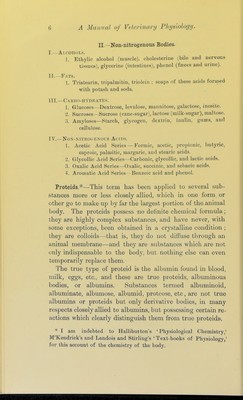
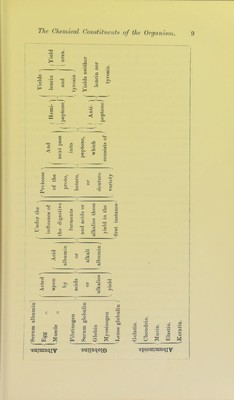
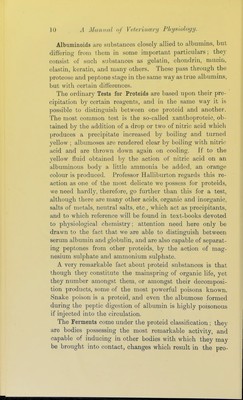
![II.—Non-nitrogenous Bodies. J.—Ai.oonoL!^. ]. Ethylic alcohol (muscle), cholesterine (bile and nervous tissues), glycerine (intestines), phenol (feces and urine). II. —Fats. 1. Tristearin, tripalmitin, triolein : soaps of these acids formed with potash and soda. III. —Carho-hydrates. 1. Glucoses—Dextrose, levulose, mannitose, galactose, inosite. 2. Sucroses—Sucrose (cane-sugar), lactose (milk-sugar), maltose. :i Amyloses—Starch, glycogen, dextrin, ioulin, gums, and cellulose. IA\—NON-MTKOi; CNOL S Aci OS. 1. Acetic Acid Series — Formic, acetic, jiropionic, butyric, caproic, palmitic, margaric, and stearic acids. 2. Glycollic Acid Series—Carbonic, glycollic, and lactic acids. 3. Oxalic Acid Series—Oxalic, succinic, and sebacic acids. 4. Aromatic Acid Series- Benzoic acid and phenol. Proteids.^—This term has been appHed to several sub- stances more or less closely allied, which in one form, or other go to make up by far the largest portion of the.animal body. The proteids possess no definite chemical formula; they are highly complex substances, and have never, with some exceptions, been obtained in a crystalline condition ; they are colloids—that is, they do not diffuse tlirough an animal membrane—and they are substances which are not only indispensable to the body, but nothing else can even temporarily replace them. The true type of proteid is the albumin found in blood, milk, eggs, etc., and these are true proteids, albuminous bodies, or albumins. Substances termed albuminoid, albuminate, albumose, albumid, proteose, etc, are not true albumins or proteids but only derivative bodies, in many respects closely allied to albumins, but possessing certain re- actions which clearly distinguish them from true proteids-. * I am indebted to Halliburton's 'Physiological Chemistry,' M'Kendrick's and Landois and Stirling's ' Text-books of Physiology,' for this account of the chemistry of the body.](https://iiif.wellcomecollection.org/image/b21933480_0026.jp2/full/800%2C/0/default.jpg)