Licence: Public Domain Mark
Credit: A manual of veterinary physiology / by F. Smith. Source: Wellcome Collection.
Provider: This material has been provided by the Royal College of Physicians of Edinburgh. The original may be consulted at the Royal College of Physicians of Edinburgh.
28/440 page 8
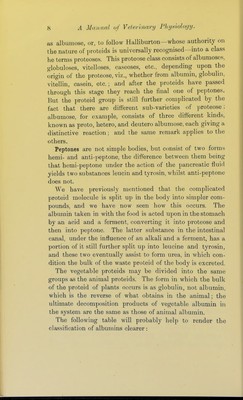
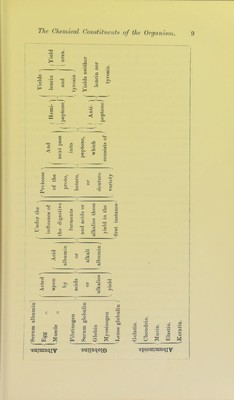
![as albiimose, or, to follow Halliburton—whose authority on the nature of proteids is universally recognised—into a class he terms proteoses. This proteose class consists of albumoses, globuloses, vitelloses, caseoses, etc., depending upon the origin of the proteose, viz., whether from albumin, globuhn, vitellin, casein, etc.; and after the proteids have passed through this stage they reach the final one of peptones. But the proteid group is still further complicated by the fact that there are different sub-varieties of proteose; albumose, for example, consists of three different kinds, known as proto, hetero, and deutero albumose, each giving a distinctive reaction; and the same remark applies to the others. Peptones are not simple bodies, but consist of two forms hemi- and anti-]ieptone, the difference between them being that hemi-peptone under the action of the pancreatic fluid yields two substances leucin and tyrosin, whilst anti-peptone does not. We have previously mentioned that the complicated proteid molecule is split up in the body into simpler com- pounds, and we have now seen how this occurs. The albumin taken in with the food is acted upon in the stomach by an acid and a ferment, converting it into proteose and then into peptone. The latter substance in the intestinal canal, under the influence of an alkali and a ferment, has a portion of it still further split up into leucine and ty rosin, and these two eventually assist to form urea, in which con- dition the bulk of the waste proteid of the body is excreted. The vegetable proteids may be divided into the same groups as the animal proteids. The form in which the bulk of the proteid of plants occurs is as globulin, not albumin, which is the reverse of what obtains in the animal; the ultimate decomposition products of vegetable albumin in the system are the same as those of animal albumin. The following table will probably help to render the classification of albumins clearer :](https://iiif.wellcomecollection.org/image/b21933480_0028.jp2/full/800%2C/0/default.jpg)