Volume 1
The New Sydenham Society's lexicon of medicine and the allied sciences : (based on Mayne's Lexicon) / by Henry Power and Leonard W. Sedgwick.
- Henry Power
- Date:
- MDCCCLXXXI [1881]-MDCCCXCIX [1899]
Licence: Public Domain Mark
Credit: The New Sydenham Society's lexicon of medicine and the allied sciences : (based on Mayne's Lexicon) / by Henry Power and Leonard W. Sedgwick. Source: Wellcome Collection.
Provider: This material has been provided by King’s College London. The original may be consulted at King’s College London.
178/812
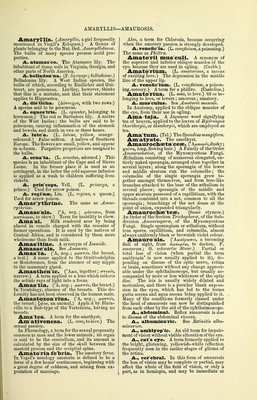
![AMARANTINE—AMARYLLIDIFORM^. melanclioly.) A native of Brazil, where it is called Garuru vermelho, and is employed in making emollient poultices. £L, obtusifo'lius. (L. obtusus, blunt; folium, a leaf.) This plant is said to be a diuretic. £Lm olera'ceus. (L. oleraceus, herb-like. Hind. Mursa; Beng. Sada-nuti; Tel. Tola- Kura ; Burm. Hen-kanway.) A native of India and Burmah. Demulcent. In the Taleef Shereef it is said to prove aperient when boiled with salt and butter. The variety Giganteus has a thick succulent stem, which is eaten as a substitute for asparagus. A.m polygr'amas. (TIoA-ys, many; yafxiw, to take to wife. Hind. Chumli-Sag, Chowlai; Beng. Champa-nuti.) An Indian species, found also in the Moluccas and Cochin China. It pos- sesses demulcent properties, and is said in the Taleef Shereef to prove useful in bilious dis- orders and to be aperient and diuretic. .^.polyg-onoi'des. {U.oXvyovotL^i's', from TToXvyovov, the plant polygonum; el^os, likeness.) Goosefoot, sowbane. A native of Barbadoes and Jamaica, where it is alleged to have the property of making a sow cast her young. It is a strong rank weed, supposed by some to be poisonous. Barham states that, when made up_ with lard, it makes a good cataplasm for local inflammations and swellings. It has also been recommended internally for strangury, especially for that arising from the use of cantharides. In India it is con- sidered very wholesome. (Waring.) A., prostra'tus. (L. prostratus, low- lying.) A species used for food. H.. spino'sus. (L. spinosus, spiny. Hind. Kanti-nuti; Duk, Xante mat; Tam. Mulluk- Kirai; Tel. Mundlatota-Kura; Mai. Mullan- chira ; Beng. Kanta mari.) A common weed in many parts of India, Ceylon, and Burmah. Erect, glabrous; leaves with two spines in the axils; panicles sparingly branched; utricles 2—3, cleft at top ; bracts unequal, bearded; seeds black. The leaves of this plant are bruised and made into emolKent poultices; and in the Mauritius a decoction of the leaves and root is administered internally as a diuretic. .A., sylves'tris. (L. sylvestris, belonging to a wood.) A species used for food. iSL. tenuifo'lius. (L. tenuis, t\i\n', folium, a leaf. Sindee, mulleero.) A plant used in Sindh as fodder for camels. A.m vir'idis. (L. viridis, green.) A native of Jamaica and Brazil domesticated in Europe. It is used in the form of enema in the dry belly- ache of Jamaica as the best and most common emolKent herb that the island affords. Amaran'tine. (Same etymon.) Ever- lasting, unwithering, undecaying. iVmarail'tOllSa {'A/jidpavTo^, unfading; from a, neg.; and fxapaivw, to quench, to decay. F. amarante.) Undecaying; unfading. Amaran'tUS. kfxapavTo^, unfading.) Amaranthus. A plant in use amongst the ancients as an emmenagogue and resolvent. It is supposed to be the Celosia cristata, or cock's comb. Ama'rarit. A plant of Southern Abys- sinia possessing emetic properties. Ama're. (Lat.) Bitter. Amarel'la. (L. bitter.) A name of the Gentian, Gentiana lutea. Also, the Foly- gala vulgaris^ because of its bitterness. Amarellus. (Lat.) Bitterish. Amaril'la del Xtey. A name of a bark furnished by the Cinchona Bonplandiana. It is of the size of a goose-quill, with a tawny-grey epidermis, a fracture clean on the outer part, fibrous within, a slightly aromatic odour, and a bittei', asti'ingent taste. It contains 8 per cent, of alkaloids, of which seven is quinine. Ama'rin. Cgi-HigNa (L. amarus, bitter.) An organic base obtained by boiling hydrobenza- mide with alkaline solutions. It is insoluble in water, melting at 100° C. (212° F.), and it is poisonous. Also, an alkaloid (C]2H48'N'2) resulting from the action of ammonia on essence of bitter al- monds. Also, a name formerly given to the supposed bitter principle of vegetables. Amarini'te. A name proposed by Desvaux to be applied to the several bitter vegetable prin- ciples. Amar'itas. (G. Bitterkeit.) Bitterness. Amarit'ies. (Lat.) Bitterness. AmaritU'dO. (Lat.) Bitterness. Amaron'cium. A typical Group of the Subfamily Polyclinina, Family Botryllida, Order Ascidia, Class Tmicata. (Schmarda.) Ama'ror. (Lat.) Bitterness. Amarthri'tiS. ('A^a, together; apQpi- T-is, gout.) Gout of the whole body, or affecting many joints at the same time. AmarucacllU. The Folianthes tube- rosa. Ama'rum. (Lat.) Magnesium sulphate, or Epsom salt. (Crabb.) jSL.sim'plex. (L. amarus; simplex, simple.) An old term for the compound infusion of gen- tian. Ama'rus. (Lat.) Bitter. Applied to cer- tain substances termed bitters, as distinctive of their medicinal properties. A. dul'cis orieuta'lis. (L, dulcis, sweet; orientalis, eastern.) A name of the Costus. A., sal. (L. sal, salt.) An old name for magnesium sulphate, Amary'g'SBa A/napvyri, from afiapvaoru), to shine.) A term understood by some to mean the eyes, by others, the eyebrows. (Gorraeus.) Amaryl'leae. A tribe of bulbous plants, belonging to the Nat. Ord. Amaryilidacem, chai'acterised by the absence of a coronet in the flower. Amaryllida'ceae. (G. amaryllis- gewdchse.) AmarylUds. A Nat. Order of the Section JEpigynm, Subclass Fetaloidea, Class Monocotyledones; or, according to some, a Family of the Order Eusatce. Chiefly bulbous and scape- bearing herbs, not scurfy or woolly, with linear flat root-leaves, and perfect regular (or nearly so) flowers, 6-androus; perianth petaloid, 6-partite, superior, with or without a corona; stamens 6, inserted on the segments of the perianth ; anthers introrse; ovary inferior, 3-celled ; fruit capsular, 3-celled, 3-valved, with loculicidal dehiscence and numerous seeds, or a berry with 1—3 seeds; seeds with fleshy or horny albumen ; embryo with the radicle next the hilum. Natives of many parts of the world, but most abundant at the Cape of Good Hope. Amaryllid'eaB. A synonym of Amaryl- lidacece. Amaryllid'eous. (G. amarylVmilm- lich.) Kesembliug, or related to, the Amaryllis. Amaryllidifor'mae. Applied by G. Herbert to a section of the Amaryllidece, which are more allied to the Amaryllis.](https://iiif.wellcomecollection.org/image/b21292917_0001_0178.jp2/full/800%2C/0/default.jpg)
 No text description is available for this image
 No text description is available for this image
 No text description is available for this image