Volume 1
The New Sydenham Society's lexicon of medicine and the allied sciences : (based on Mayne's Lexicon) / by Henry Power and Leonard W. Sedgwick.
- Henry Power
- Date:
- MDCCCLXXXI [1881]-MDCCCXCIX [1899]
Licence: Public Domain Mark
Credit: The New Sydenham Society's lexicon of medicine and the allied sciences : (based on Mayne's Lexicon) / by Henry Power and Leonard W. Sedgwick. Source: Wellcome Collection.
Provider: This material has been provided by King’s College London. The original may be consulted at King’s College London.
30/812
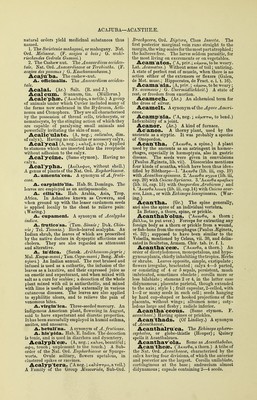
![ACAJUBA—ACANTHE^. natural orders yield medicinal substances thus named. 1. The Swietenia mahogoni, or mahogany. Nat. Ord. MeliacecB. (F. acajou d bois; G. wohl- riechendes Cedrela Gummi.) 2. The Cashew nut. The Anacardmm occiden- tale. Nat. Ord. Anacardiacece or Terebinths. (F. acajou des pommts ; G. Kaschunussbaum.) Acaju'ba. The cashew-nut. £k.m officinalis. The Anacardium occiden- tale. Acalai. (Ar.) Salt. (E. and J.) Acalcunii St annum, tin. (Miillerus.) Acale'plise. ('AKaX?j0t], a nettle.) A group of animals under which Cuvier included many of the forms now embraced in the Hydrozoa, Acti- nozoa and Ctenophora. They are all character] sed by the possession of thread cells, trichocysts, or nematocysts, by the stinging action of which they are capable of paralysing small animals and powerfully irritating the skin of man. Acalic'ulate. (A, neg.; caliculus, dim. of calyx). Having no caliculus or accessory calyx. Acal'ycal (A, neg.; /.aXv^, a cup.) Applied to stamens which are inserted into the receptacle without adhesion to the calyx. Acal'ycine. (Same etymon). Having no calyx. Acal'yplia. {kKi\v<po<s, without shell.) A genus of plants of the Nat. Ord. EuphorbiaceiB. amenta'cea. A synonym of A.fruti- cosa. A. carpinifo'lia. Hab. St. Domingo. The leaves are employed as an antispasmodic. A. cilia'ta. Hab. Arabia, Asia, Trop. Africa. In Ashantee known as Crowera, and when ground up with the lesser cardamom seeds is applied locally to the chest to relieve pain: (^Waring.) ja.. cupameni. A synonym of Acalypha indica. A. frutico'sa. {Tam. Sinnie; Duk. Chin- nie; Tel. Tsinnie.) Birch-leaved acalypha. An Indian shrub, the leaves of which are prescribed by the native doctors in dyspeptic affections and cholera. They are also regarded as attenuant and alterative. £l. in'dica. (Sansk. Arithamum-jayrie ; Mai. Koopa-mani; Tam. Cupa-mani ; Beng. Muk- tojuri.) An Indian annual. The root bruised and infused is used as a cathartic, the infusion of the leaves as a laxative, and their expressed juice as an emetic and expectorant, and when mixed with salt as a cure for scabies ; a decoction of the whole plant mixed with oil is antiarthritic, and mixed with lime is useful applied externally in various cutaneous diseases. The leaves are also applied to syphilitic ulcers, and to relieve the pain of venomous bites. A. vir^ln'ica. Three-seeded mercury. An indigenous American plant, flowering in August, said to have expectorant and diuretic properties. It has been sucessfully employed in humid asthma, ascites, and anasarca. .A., betuli'na. A synonym of A.fruticosa. A., bis'pida. Hab. E. Indies. The decoction is tonic, and is used in diarrhoea and dysentery. Acalyph'eaB. (A, neg.; /caXos, beautiful; acpn, touch; unpleasant to the touch.) A Sub- order of the Nat. Ord. Euphorbiacece or Spurge- worts. Ovule solitary, flowers apetalous, in clustered spikes or racemes. Acalyp'tera. ('A neg.; /ca>.il7rTyoa,a veil.) A Family of the Group Muscarida, Sub-Ord. £rachi/cera, Ord. Diptcra, Class Insecta. The first posterior marginal vein runs straight to the margin, the wing-scales for the most part atrophied; the halteres free. The larvae seldom parasitic, for the most living on excrements or on vegetables. Acam'atOS. ('A, priv.; KUjuivu}, to be weary. Lat, Acamatus.) Without sense of toil; untiring. A state of perfect rest of muscle, when there is no action either of the extensors or flexors (Galen, de Mot. muse; Hippocrates, de Fract. c. i, t. 16). Acama'sia. (A, priv.; KdfivM, to be weary; Fr. acamasie; G. TJnermudlichkeit.) A state of rest, or freedom from exertion. Acamecll. (Ar.) An alchemical term for the dross of silver. Acamelt. K&jViOUYm.(ii\h.e Agave Ameri- cana. Acamp'sia. ('A, neg.; KafnTTw, to bend.) Inflexibility of a joint. Acanor. (Ar.) A kind of furnace. Ac'anoSa A thorny plant, used by the ancients as a styptic. It was probably a species of Onopordon. Acan'tha. CAKavda, a spine.) A plant used by the ancients as an astringent in haemor- rhages, especially in haemoptysis, also in gastric disease. The seeds were given in convulsions (Paulus iEgineta, lib. vii). Dioscorides mentions four kinds of acantha, which have been thus iden- tified by Sibthorpe—1. AKavda (lib. iii, cap. 19) yfith Acanthus spinosus. 2. AKavda aypia (lib. iii, cap. 20) with Cnicus Syriacus. 3. AKavQa apafSiKij (lib. iii, cap. 15) with Onopordon Arabicum ; and 4. AKavQaXzvKt] (lib. iii. cap.14) with Cnicus acar- nus, Linn., or with Echinops lanuginosus. (War- ing-) Acan'tha. (Gr.) The spine generally, and also the spine of an individual vertebra. In Botany, a thorn, spine, or prickle. Acanthab'olus. (A/cai/ea, a thorn ; (3d\X(o, to put over.) Forceps for extracting any foreign body as a thorn or prickle from a wound, or fish-bone from the oesophagus (Paulus ^gineta, vi. 32); supposed to have b'^en similar to the Volsella, mentioned by Celsus, vii. 30, and delin- eated in Scultetus, Armam. Chir. tab. iv. f. 1. Acantba'cese. ('AKavda, a thorn.) An order of dicotyledonous, monopetalous, and hypo- gynousplants, chiefly inhabiting thetropics. Herbs or shrubs. Leaves opposite, simple, exstipulate ; flowers irregular, bracteated ; calyx 4—5 parted, or consisting of 4 or 5 sepals, persistent, much imbricated, sometimes obsolete; corolla more or less bilabiate ; stamens 2 or 4, in the latter case didynamous; placentae parietal, though extended to the axis; style 1; fruit capsular, 2-celled, with 1—2 or many seeds in each cell; seeds hanging by hard cup-shaped or hooked projections of the placenta, without wings; albumen none; coty- ledons large and fleshy ; radicle inferior. Acantha'ceous. (Same etymon. F. acanthace.) Having spines or prickles. Acan'tliads. (Of LLndley.) A synonym of AcanthacecB. Acantlialru'ca. The Echimps sphcero' cephalus, or globe-thistle (Hooper); Quincy spells it Acanthalzuca. Acantliav'ola. Same as Acanthabolm. Acan'tbeae. ('A/cai-ea, athorn.) A tribe of the Nat. Ord. Acanthacece, characterised by the calyx having four divisions, of which the anterior and posterior are the largest. Corolla unilabiate, cartilaginous at the base; androecium almost didynamous; capsule containing 2—4 seeds.](https://iiif.wellcomecollection.org/image/b21292917_0001_0030.jp2/full/800%2C/0/default.jpg)
 No text description is available for this image
 No text description is available for this image
 No text description is available for this image